
Most founders we meet have tried something already. A new website. A few months of posting. An agency that sent ranking reports while the phone stayed quiet. Each of those can help, but on their own they rarely bring in clients, because getting found and getting chosen depend on several things working together, in the right order.
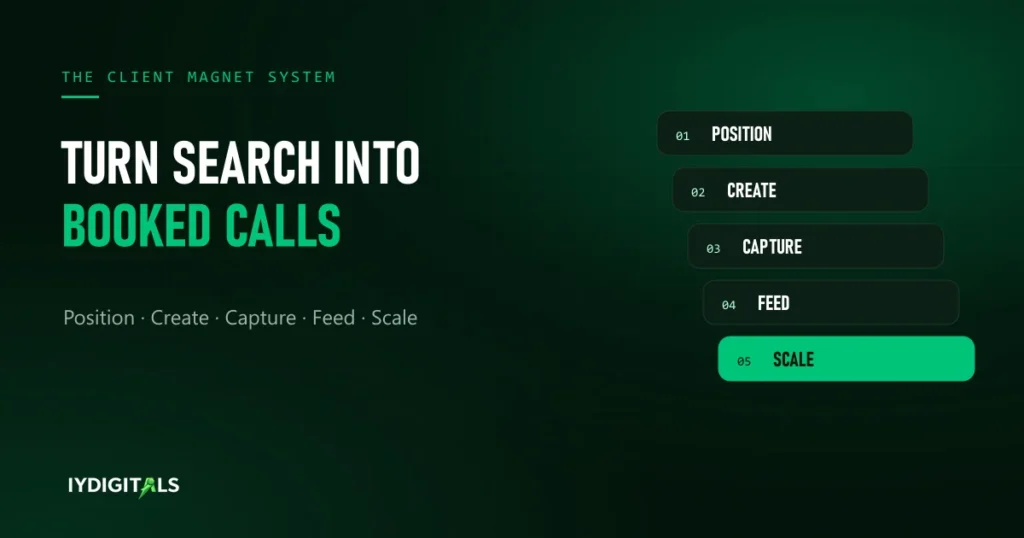
The Client Magnet System is how we put those things together. It has five stages: Position, Create, Capture, Feed and Scale. We do them in order, because each one depends on the one before it.
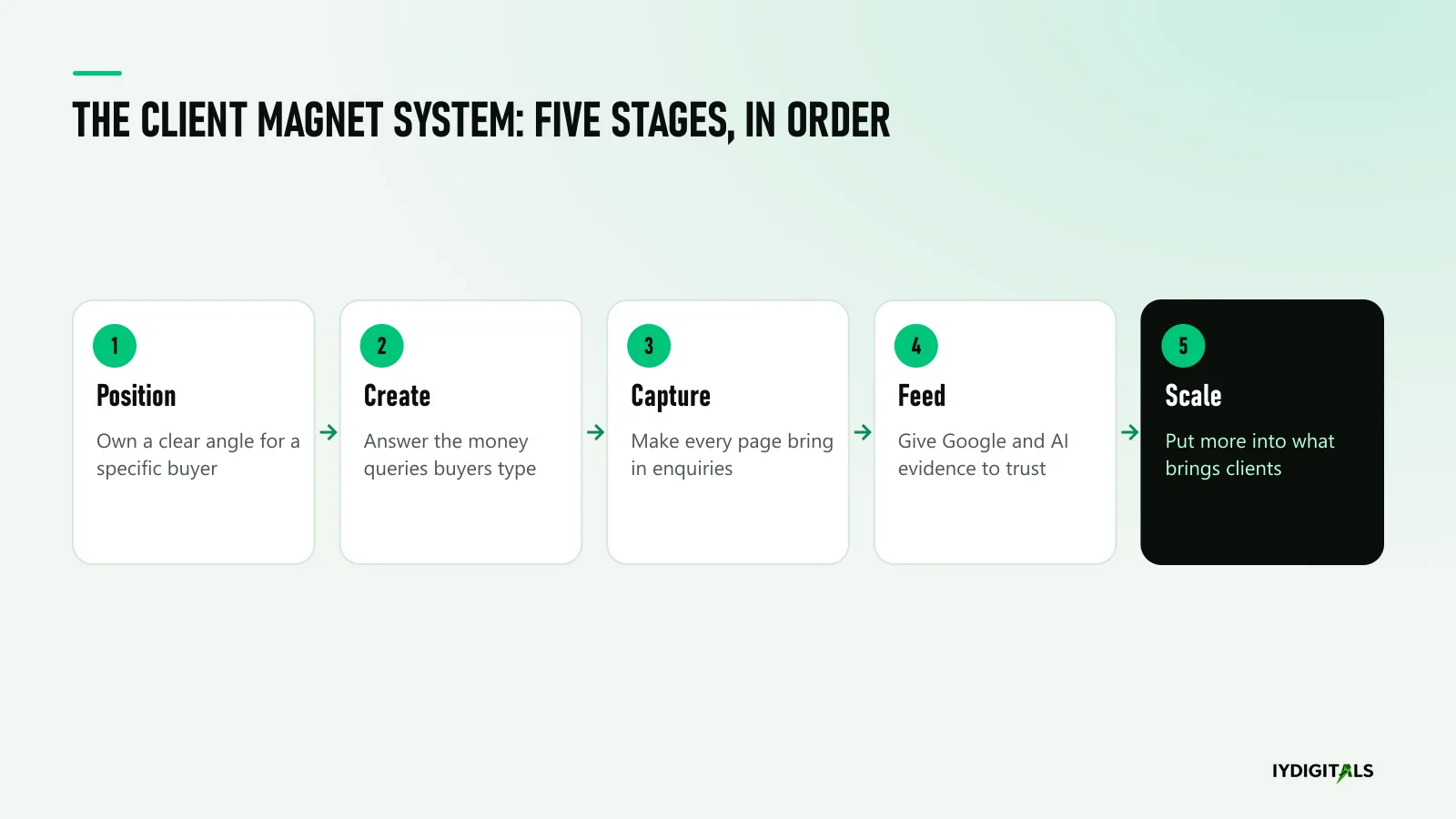
1. Position: own an angle buyers recognise
A buyer who asks ChatGPT for “a digital agency in Nigeria” gets a long, vague list. A buyer who asks for “the best land surveyor in Ikeja” gets three names. The narrower and clearer your position, the easier it is for Google and AI assistants to know exactly when to recommend you.
Positioning means deciding who you serve, where, and what you want to be known for, then saying it the same way everywhere: on your website, your Google Business Profile, your social profiles and every directory listing. Kings Geo Consult does more than land surveying, but it made sure the web knew it as a registered land surveyor in Lagos with drone mapping expertise. Google now names it for both.
Questions we answer in this stage:
- Which buyer is worth the most to you, and which do you serve best?
- Which places do you genuinely serve, and which do you want to grow into?
- What proof do you already have that you are good at it?
- What do competitors claim, and where is there room to be clearly different?
2. Create: answer the searches that have money behind them
Your buyers are already searching. Some searches are casual. Others, such as “how much does a land survey cost in Lagos” or “trusted property developer in Lekki”, come from people close to paying. We call those money queries.
In this stage we find your money queries from real search data and real AI prompts, never from guesswork. Then we build content that answers them properly: service pages, location pages, guides, comparisons and FAQs on your own website, supported by posts, carousels and videos on social media. Every piece links to the others, so a reader who arrives on one page finds the next answer without leaving your site.
Your website comes first. A social platform can change its rules or close your account overnight. Content on your own site keeps working for years and is what AI assistants quote.
3. Capture: make every page bring in clients
Traffic that doesn’t turn into enquiries is a cost. We build every page so a visitor, especially one on a phone, always knows the next step and can take it in one tap: booking a call, sending a WhatsApp message, joining a training or downloading a guide.
That is why we build on our own content structure rather than a generic theme. Each page carries the offer that fits its topic. Proof sits next to the claim it supports. A button stays within reach as you scroll on a phone, without filling the page with repeated buttons. And when the offer changes, say from a call to a webinar, it changes in one place across the whole site.
4. Feed: give Google and AI the evidence they trust
AI assistants recommend businesses they can verify. In this stage we make sure that evidence exists and agrees with itself wherever it appears:
- Your pages are indexed on Google and on Bing. Bing matters more than most people realise, because ChatGPT and Copilot draw on it.
- Your Google Business Profile is complete, accurate and collecting genuine reviews.
- Your business name, address and phone number match across directories and listings.
- Structured data tells search engines your business type, location, services and profiles.
- Other websites mention you: industry directories, lists of top providers, partners and the press.
- FAQ, About and proof pages answer the questions buyers and AI assistants ask before they trust a business.
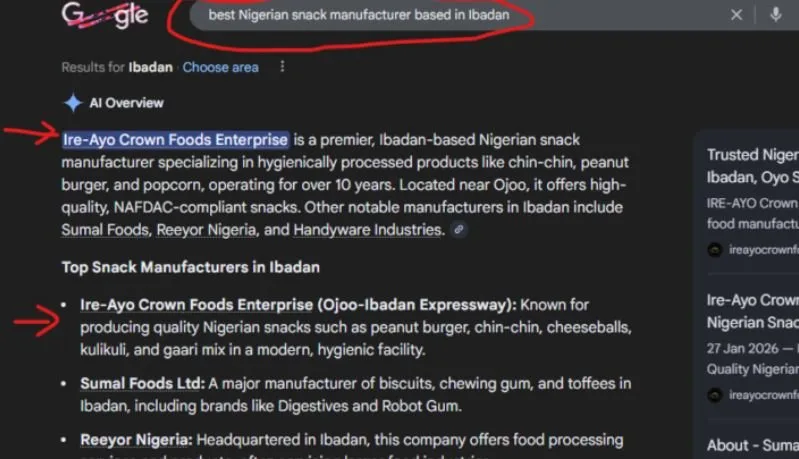
This is the stage that took Gallant Naija Laundry to the top of Google for “premium laundry service Ikeja” in six days, and led Google’s AI Overview to name Ire-Ayo Crown Foods first among snack manufacturers in Ibadan.
5. Scale: put more into what works
Once the first four stages are in place, data starts to flow: which searches bring visitors, which pages produce enquiries, which AI assistants mention you and for what. We read that data every month and put more effort into whatever is bringing in clients, whether that is a new city, a new service page or a stronger answer to a question buyers keep asking. See what to expect in your first 90 days.
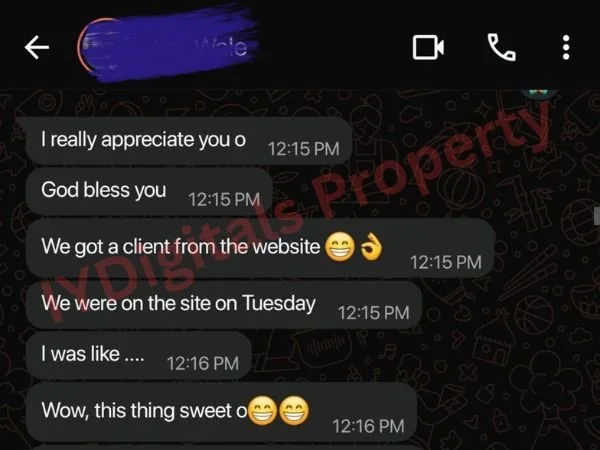
Big Knuckles’ Kitchen saw enquiries and sales rise by 40% in nine weeks. Blink & Smile Homes went from chasing referrals to receiving premium bookings every week. In the words of its director, Shola Roebuck: “Before this, I was chasing every referral I could get. Now I don’t chase anything.”
How this differs from a typical agency
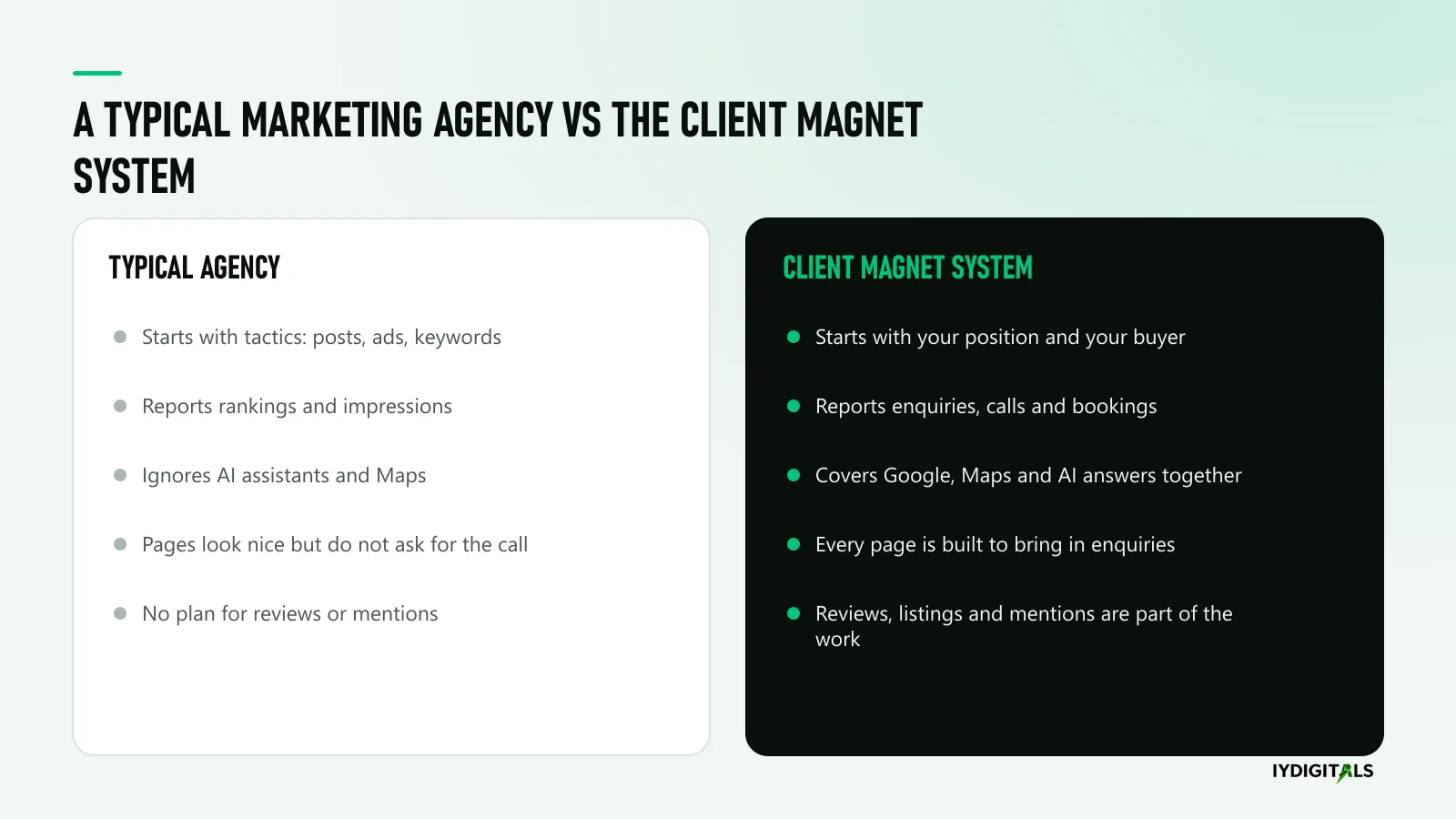
A typical agency starts with tactics: posts, ads, keywords. The Client Magnet System starts with your position and your buyer, and every later stage is judged by one thing: whether it brings in enquiries from the people you want to serve.
Who built it

The Client Magnet System was built by Iyanu Taiwo, founder of IYDigitals, from more than ten years of marketing work for founders across Africa, the UK and the US. More than 50 founders and experts have been trained in it. It is the same method we apply to every client project, and the one we are applying to IYDigitals itself.
If you want more buyers, sales and clients coming to you, the next step is a free 30-minute strategy call with the IYDigitals team. Tell us the growth you are aiming for, and we will map out how the system gets you there, then do the work for you.