How Google AI Overviews choose which businesses to show
Want more buyers and sales from AI search, without doing the work? Let the IYDigitals team handle it. Talk to an expert now →
On this page
- What an AI Overview actually is
- How Google picks the businesses it names
- The signals that get a business named
- AI Overviews, AI Mode and the map: three different places
- The questions worth targeting, by type of business
- Should you ever opt out?
- What doesn’t work
- A real example from Ibadan
- How to check where you stand
Search “best land surveyor in Ikeja” or “who makes the best snacks in Ibadan” on Google today and, more often than not, the first thing you see isn’t a list of links.
It is a short written answer at the top of the page, naming a handful of businesses and explaining why.
That answer is an AI Overview, and for many buyers it is now the first and sometimes only thing they read.
If your business is named there, you are on the shortlist before the buyer has scrolled. If it isn’t, you are competing for whatever attention is left.
This guide explains, in plain terms, how AI Overviews pick the businesses they name, and what you can do to become one of them.
What an AI Overview actually is
An AI Overview is a summary Google writes for some searches, using its Gemini models. It doesn’t come from a separate database of approved businesses.
It is built from the same search index Google uses for normal results.
Google reads pages it has already crawled and indexed, pulls out what is relevant, writes an answer and links to the sources it relied on.
Two consequences follow. First, if Google hasn’t indexed your pages, or you have blocked them from showing snippets, you can’t be quoted.
Second, there is no form to fill in and no fee to pay. Being named is the result of what Google can find and trust about you.
How Google picks the businesses it names
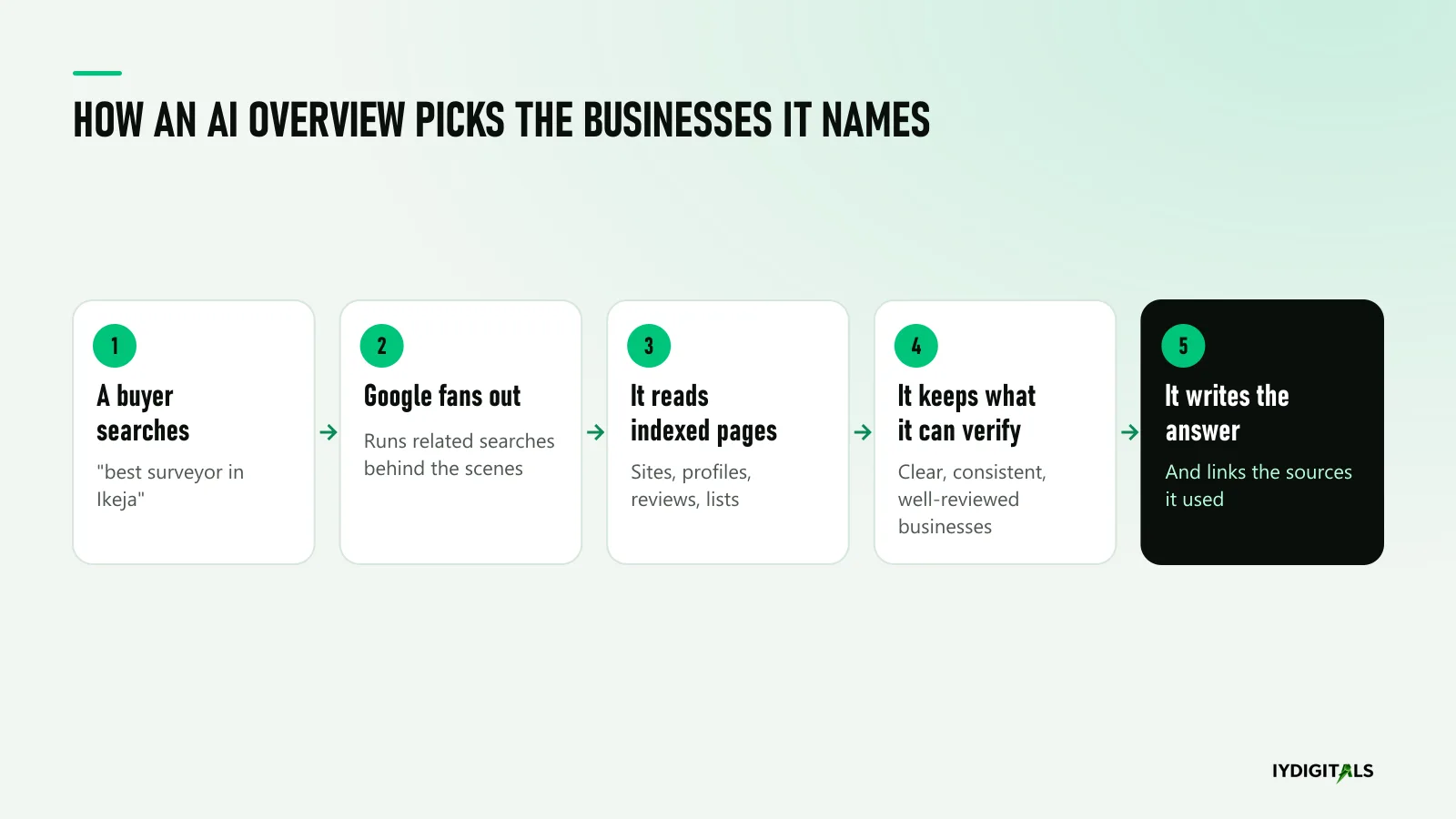
When someone searches “best property lawyer in Lekki”, Google doesn’t just run that one search.
It runs several related searches behind the scenes, a process Google calls query fan-out: perhaps “property lawyers Lekki reviews”, “land dispute lawyer Lagos”, “conveyancing lawyer Lekki Phase 1”.
It reads the pages, profiles and lists those searches return, then writes an answer that names the businesses it can describe with the most confidence.
“Confidence” is the key word. Google has no way of knowing which lawyer is genuinely best.
It knows which businesses are clearly described, consistently listed, well reviewed and mentioned by others. Those are the ones it names.
Independent studies have also found that a large share of the pages cited in AI Overviews already rank on the first page of normal results for the same search, so strong ordinary SEO remains the foundation.
The signals that get a business named
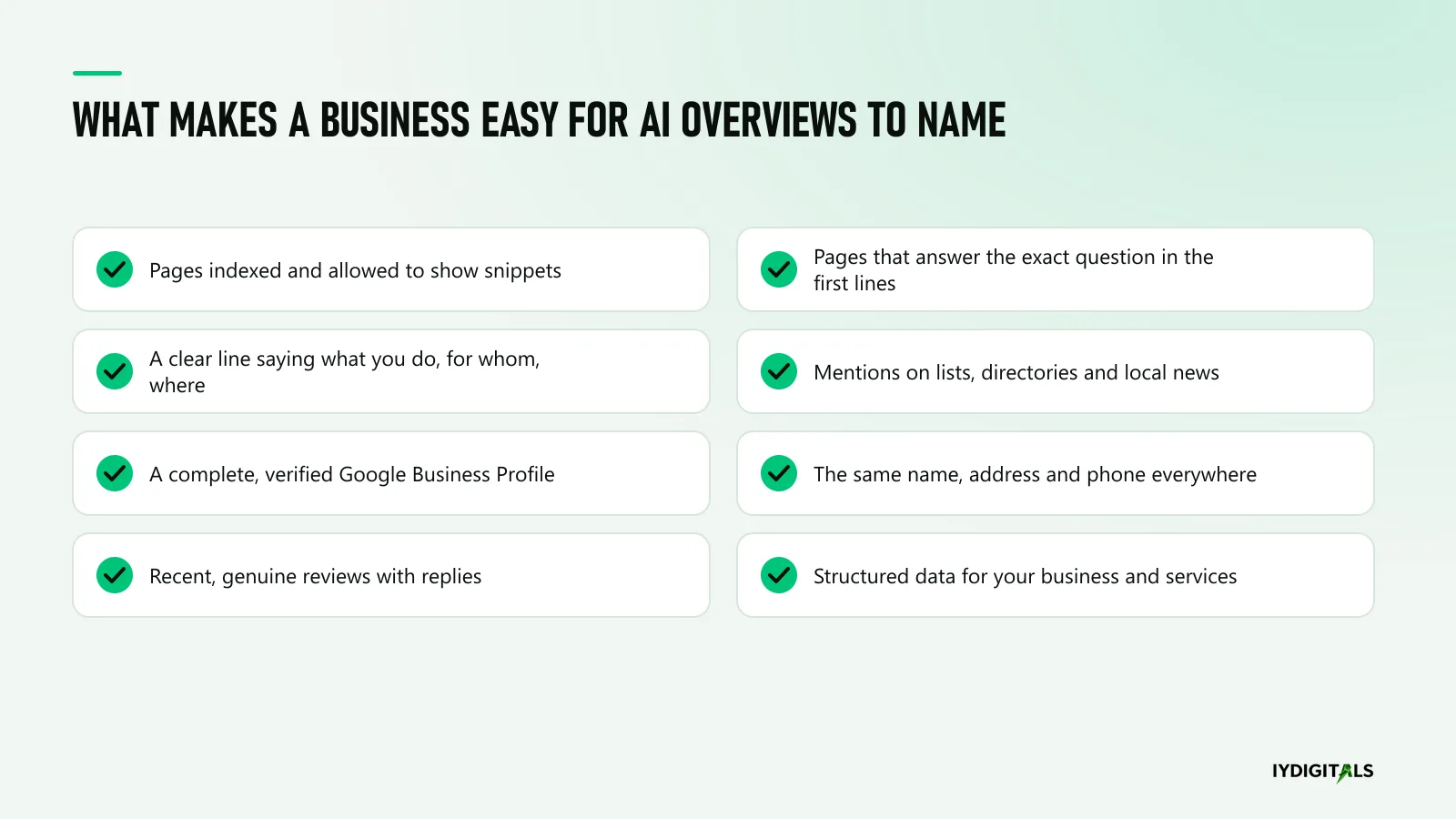
1. Pages that are indexed and allowed to show snippets
The minimum requirement. Check in Google Search Console that your important pages are indexed, and make sure no one has added a nosnippet tag that hides them from AI features.
2. A clear statement of what you do, for whom and where
A homepage that says “registered land surveyors in Ikeja, Lagos, serving developers and buyers across the state” gives Google a sentence it can repeat.
A homepage that says “excellence in every project” gives it nothing.
3. A complete, verified Google Business Profile
For local questions, your Business Profile is one of the main sources Google reads: categories, services, hours, photos and reviews.
Industry studies of local AI Overviews consistently point to profile completeness as a major factor. Our guide to turning Google Maps views into calls walks through the fixes.
4. Recent, genuine reviews, with replies
Reviews tell Google, in customers’ own words, what you are good at.
When an AI Overview says a business is “known for punctual delivery” or “praised for clear communication”, that phrasing often comes from reviews.
A steady flow of recent reviews matters more than a large number of old ones.
5. Pages that answer the exact question in the first lines
If a buyer asks “how much does a land survey take in Lagos?” and your page answers it in the first paragraph, Google can quote you. Long introductions that bury the answer are less likely to be used.
6. Mentions on other trusted sites
Google gives weight to what others say about you: “best of” lists, directories, local news, associations and partners.
A business mentioned on several independent sites is easier to recommend than one that only describes itself.
7. The same details everywhere
Your business name, address and phone number should match across your website, your profile and every listing. Inconsistent details make it harder for Google to be sure it is looking at one business.
8. Structured data
Business schema on your website states your business type, location, services and contact details in a format machines read easily. It doesn’t guarantee inclusion, but it removes guesswork.
AI Overviews, AI Mode and the map: three different places
Google now shows businesses in three AI-shaped places, and it helps to know which one your buyers are seeing.
- AI Overviews appear at the top of ordinary results for some searches. They lean heavily on pages that already rank well for that search, and they usually link a handful of sources.
- AI Mode is a separate, conversational search, opened from a tab or button. It runs more related searches and draws from a wider pool of pages, so it sometimes names businesses that don’t rank on page one. Research by SEO tool companies has found that AI Mode and AI Overviews often reach similar conclusions but cite different pages, so a business can appear in one and not the other.
- The map pack, the three businesses under a map, still appears for many local searches, often directly below or beside the AI Overview. It is driven mostly by your Business Profile, reviews and distance from the searcher.
For a local service business, all three matter.
The map pack wins the “near me” search, the AI Overview wins the “best … in [area]” question, and AI Mode wins the longer, more considered research a buyer does before a big decision.
The questions worth targeting, by type of business
AI Overviews don’t appear for every search, and you don’t need to win every one. Focus on the questions that come right before a buyer contacts someone.
- Property developers and agents: “best estate in Lekki for families”, “is [estate name] genuine”, “how to buy land in Abuja from abroad”, “estate agents in Gwarinpa”.
- Professional firms: “property lawyer in Lekki”, “accounting firm for start-ups in Lagos”, “how to register a company in Nigeria”.
- Clinics and local services: “paediatric clinic in Wuse”, “best laundry in Ikeja”, “dentist open on Sunday in Lagos”.
- SaaS and B2B companies: “best payroll software for Nigerian SMEs”, “[your product] alternatives”, “how to automate invoices in Nigeria”.
For each question, ask what a genuinely helpful answer would include, and make sure your website contains that answer in plain words. If the question is local, make sure your Business Profile supports it too.
Should you ever opt out?
Google Search Console now includes a setting that lets site owners exclude their site from generative AI features such as AI Overviews and AI Mode, and the nosnippet tag does the same at page level.
For almost every business that wants customers, opting out is a mistake: it removes you from the place buyers increasingly look first, while competitors stay in.
The only common exception is content you sell, such as paid research or courses, where you may not want it summarised for free.
What doesn’t work
- Stuffing keywords into your business name. It breaks Google’s Business Profile guidelines and risks suspension.
- Fake or paid reviews. Google removes them and can restrict profiles. They also tend to read as fake to the buyers who see them.
- Mass-produced pages. Hundreds of near-identical pages with only the town name changed are treated as spam, not evidence.
- Waiting for a special AI setting. There is no switch that puts you in AI Overviews. The work is the same work that makes a business credible online.
A real example from Ibadan
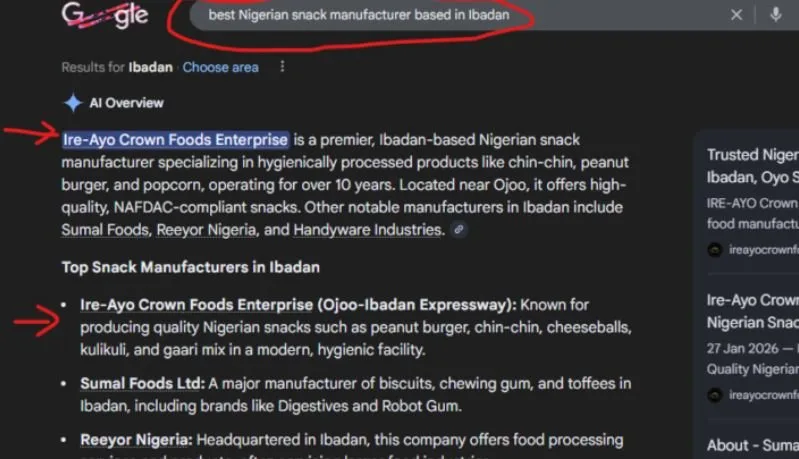
Ire-Ayo Crown Foods is a snack manufacturer in Ibadan. Its website, profile and listings were set up to say clearly what it makes, where and for whom, with consistent details everywhere.
Today, when someone asks Google for a snack manufacturer in Ibadan, the AI Overview opens with Ire-Ayo’s name, and the business now sells into Lagos and Port Harcourt as well as Ibadan.
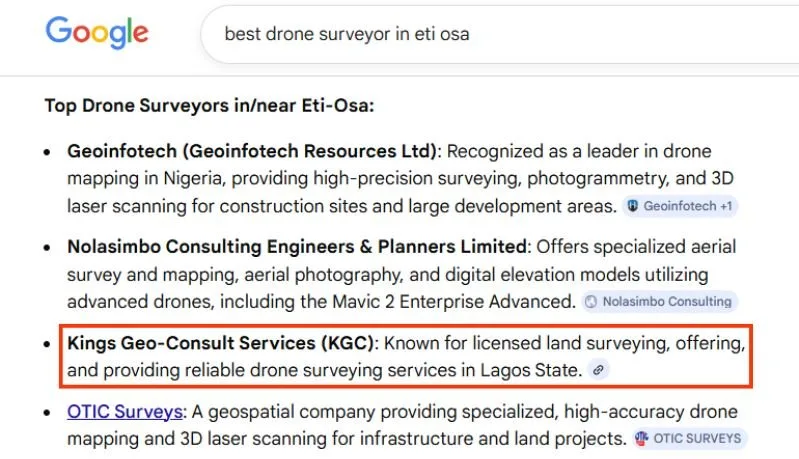
Kings Geo-Consult, a land surveying firm, appears in Google’s AI answers for drone surveyors in Eti-Osa, Lagos, as well as ranking first for “best land surveyor in Ikeja”.
How to check where you stand
- Write down five questions your buyers search, with your city or area.
- Search each one on Google on your phone and note whether an AI Overview appears, which businesses it names and which sources it links.
- Compare those businesses with yours on the eight signals above.
- Repeat the same searches every month. Answers change, and the trend tells you more than any single search.
Google’s AI Overviews are only one of the places buyers now ask.
ChatGPT, Copilot and Perplexity work differently, and our guides on why Bing matters for ChatGPT and Copilot and how to check whether ChatGPT mentions your business cover them.
If you would rather have someone do this for you, that is what we do at IYDigitals. See how AI search brings in buyers, look at our client results, or book a free strategy call.
Common questions
Can I pay to appear in Google's AI Overviews?
No. Organic AI Overviews are built from Google's search index, not from payment. Ads can appear near them, but they are labelled as sponsored and are a separate system.
Do I need a special file or setting to be included?
No special file. Your pages need to be indexed, crawlable by Googlebot and eligible to show a snippet. If you block snippets with nosnippet, you also remove those pages from AI features.
Why does the AI Overview name different businesses each time?
The answer is regenerated, and small changes in wording, location or the pages Google reads can change the names it picks. That is why it is better to track a set of questions over several weeks than to judge one search.
Is AI Mode the same as AI Overviews?
They are related but behave differently. AI Overviews appear at the top of normal results; AI Mode is a separate conversational search that often draws on a wider pool of pages. A business can appear in one and not the other, so check both.

Visibility & Conversion Strategist