How African SaaS companies get into “best tools” answers
Want more buyers and sales from AI search, without doing the work? Let the IYDigitals team handle it. Talk to an expert now →
On this page
Ask ChatGPT for “the best HR software” and you will mostly get global names.
Ask for “the best HR software for companies in Nigeria” or “in Kenya” and the answer often changes, but not always in favour of the African products built for exactly that buyer.
Many excellent African SaaS companies are simply missing from the answers, while tools with a fraction of their local fit are named again and again.
The reason is rarely the product. It is the evidence.
AI assistants build “best tools” answers from what they can find written about each product across the web, and global tools have years of reviews, comparison articles and lists behind them.
This guide explains where those answers come from and how African SaaS companies can earn their place in them.
Where best-tools answers come from
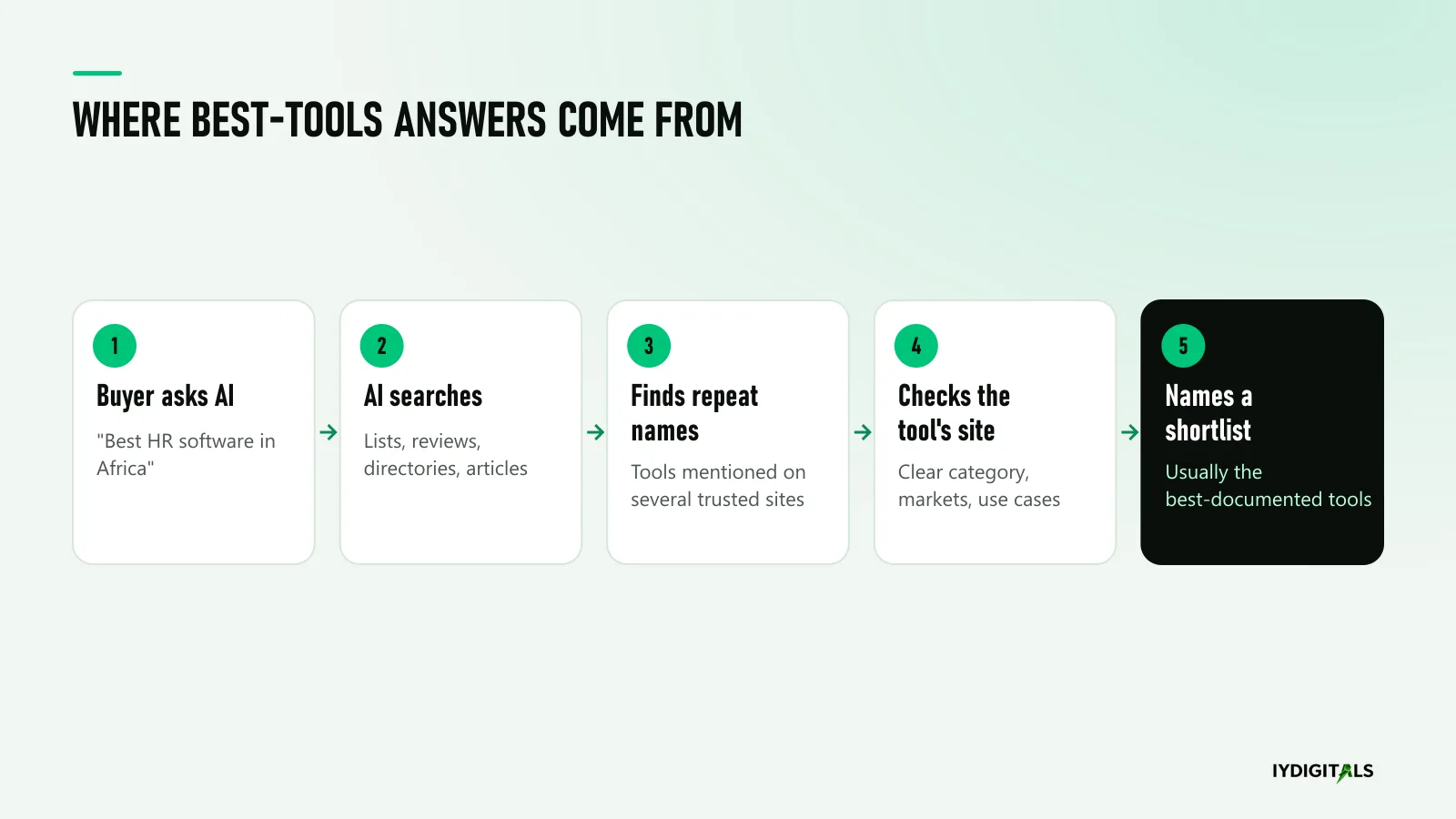
When a buyer asks for the best tools in a category, the assistant searches for pages that already answer that question: “best X software” articles, review platform category pages, directories, comparison pages and community discussions.
Products that appear on several of those trusted sources, described consistently, are the ones it feels confident naming.
A product that appears on one page, or only on its own website, rarely makes the cut.
That gives African SaaS founders a clear job: be present, accurately described, on the sources assistants read for your category, and make your own website the clearest source of truth about what you do and for whom.
Start with your own website
Before chasing lists, make sure that anyone who looks you up, human or machine, understands you in seconds.
- Name your category in plain words. “Inventory management software for retailers and distributors in Nigeria and Ghana”, not “the operating system for commerce”.
- State your markets. Which countries you serve, which currencies and payment methods you support and where your support team is.
- Show the local fit. Integrations with regional payment providers, compliance with local tax or payroll rules, offline or low-bandwidth features, local-language support. These are the details that let an assistant recommend you for “in Nigeria” questions.
- Publish use-case and comparison pages. Pages for each buyer type and honest comparisons with the global tools buyers consider. See our guide on comparison pages AI assistants quote.
- Get indexed everywhere. Google and Bing, since ChatGPT and Copilot rely heavily on Bing. Read why Bing matters for ChatGPT and Copilot.
The sources to win
Software review platforms
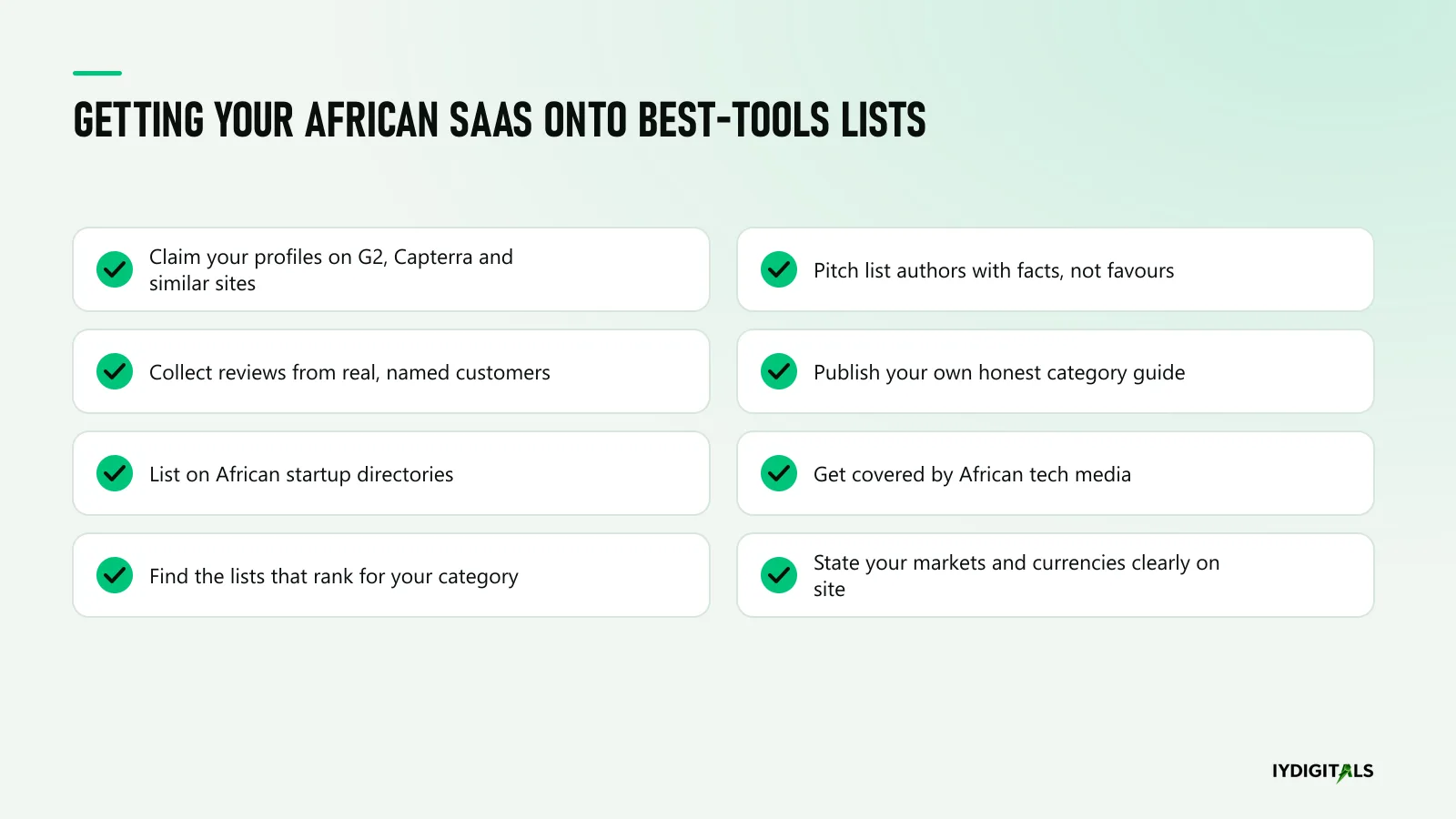
Claim your profiles on the major software review platforms, such as G2 and Capterra, complete them fully and ask real customers to review you.
Category pages on these platforms are among the sources assistants cite most for software questions.
A steady trickle of genuine reviews from named companies is worth far more than a burst of reviews from friends.
African startup and software directories
Databases and directories that track African startups and software, such as Seedtable and StartupList Africa, publish ranked and filtered lists, and some of those lists rank in search.
Make sure your profile exists and is accurate on the ones relevant to your category and country.
The articles that rank for your category
Search your category in your markets, “best payroll software in Nigeria”, “best school management software in Kenya”, and note the articles on page one.
Then ask ChatGPT and Perplexity the same questions and note which pages they cite. The overlap is your target list.
Reach out to the authors with a short, factual pitch: what you do, who uses you, what is different and a way to try the product. Editorial inclusion takes patience, but it lasts.
African tech media
Coverage in African tech publications gives assistants independent evidence that you exist and matter: funding announcements, product launches, customer milestones, data from your platform.
Data is especially useful; journalists cover new numbers about how businesses in a market behave.
Communities
Founder and professional communities, forums and Q&A threads are increasingly quoted.
Participate genuinely, answer questions in your area of expertise and let customers mention you naturally. Promotional posts tend to backfire.
Your own honest category guide
Publish the guide you wish existed: “How to choose HR software for a Nigerian company”, with real criteria and fair notes on the main options, including global ones.
When it is genuinely useful, it gets read, linked and cited, and it frames the category on your terms.
How to pitch a list author
Most “best tools” articles are written by people who are busy, and who receive many low-effort requests. A good pitch is short, factual and makes their job easier.
- Read the article first. Know which tools are listed, what criteria the author uses and what seems missing, such as a tool built for the local market.
- Lead with fit, not flattery. “Your list covers payroll tools for Nigerian SMEs; none of the listed tools handles NHF remittances, which ours does” is more useful than “we love your blog”.
- Give facts they can verify. What the product does, who uses it (with named customers if they agree), markets served, how pricing works and a link to documentation.
- Offer access. A free account or a short walkthrough, so they can test it themselves.
- Make it easy to update. Include a ready-written two-sentence description they can adapt.
- Follow up once, politely. Then move on. Lists are updated over time; a good relationship can pay off at the next refresh.
Never offer payment for an editorial placement or ask for a link in exchange for something. If a site asks for payment, treat it as advertising, judge it as advertising and expect any link to be marked as sponsored.
A 90-day plan for a small team
- Weeks 1 and 2: rewrite your homepage and product pages for clarity; verify Bing; list the 20 category questions you want to win; record who AI names today and which sources it cites.
- Weeks 3 to 6: claim and complete review platform profiles; ask 10 to 20 customers for reviews; list on the African directories relevant to your category; publish one honest comparison page.
- Weeks 7 to 10: pitch the authors of the five articles that rank and get cited for your category; publish your own category guide; share a small data insight with two tech journalists.
- Weeks 11 to 13: re-run your 20 questions; note any new mentions and sources; double down on whatever moved.
What not to do
- Don’t buy unlabelled list placements. Some sites sell “best tools” slots. Paid inclusion presented as editorial can mislead buyers and breaks search engine guidelines. If you pay for visibility, treat it as advertising.
- Don’t fake reviews. Review platforms verify and remove them, and getting caught damages trust far more than having few reviews.
- Don’t describe yourself differently everywhere. If one directory calls you a CRM, another an ERP and your site “a growth platform”, assistants can’t tell what you are.
- Don’t chase every list. Focus on the sources that actually rank and get cited for your category and markets.
Reviews: how to get them without breaking rules
Reviews on software review platforms often decide whether a tool appears on a category page at all, and those category pages are frequently cited.
A steady review programme is one of the highest-return things an African SaaS team can do.
- Ask at the right moment. After a customer hits a success milestone, such as their first payroll run or first 100 invoices, not at signup.
- Ask personally. A short message from the founder or account manager gets far more responses than an automated email.
- Make it easy. A direct link to your profile and a note on how long it takes.
- Ask everyone, not only fans. Selective asking can break platform rules, and a few honest four-star reviews look more credible than a wall of perfect scores.
- Follow each platform’s incentive rules. Some allow small thank-you gestures with disclosure; many don’t. Check before offering anything.
- Reply to reviews. Thank people, answer criticism calmly and show what you changed.
Win the specific questions first
You probably won’t be named for “the best CRM in the world” this year.
You can be named for “the best CRM for real estate companies in Lagos” or “CRM that integrates with WhatsApp and Paystack”.
Buyers increasingly ask with that kind of context, and those are the answers where a focused African product has the advantage. Win them one at a time, then work outwards to broader questions.
Measure progress monthly
Keep a list of 20 to 30 category questions, from broad to specific, and run them monthly in ChatGPT, Perplexity, Gemini and Google. Record who is named and which sources are cited.
As your reviews, listings and mentions grow, you should see your name appear first in the specific answers, then in broader ones. Our guide on checking whether AI mentions your business shows how.
This work sits within our wider approach to winning more demos from AI search. If you would like help, see how we work with SaaS companies, look at our client results, or book a free strategy call.
Common questions
Why do AI assistants always recommend global tools?
Because global tools have far more reviews, articles and comparisons written about them. Assistants name what they can verify. An African product with little written about it is easy to overlook, even if it fits the buyer better.
Should we pay to be included in best-tools articles?
Be careful. Some sites sell placements, and paid inclusion without clear labelling can mislead buyers and break search engine guidelines.
Prioritise editorial lists, review platforms and genuine coverage, and treat any paid placement as advertising.
Which directories matter for African SaaS?
Global software review platforms such as G2 and Capterra, African startup databases and directories, and the specific lists that rank in search for your category and country.
Check which sources AI assistants cite for your category questions and start there.
How can a small SaaS compete with a global brand in AI answers?
Win the specific questions first: your country, your industry, your integrations and your local requirements.
Buyers increasingly ask with that context, and that is where a focused regional product can be named ahead of a global one.

Visibility & Conversion Strategist