GEO vs SEO: what changes when buyers ask AI
Want more buyers and sales from AI search, without doing the work? Let the IYDigitals team handle it. Talk to an expert now →
On this page
For twenty years, the question was simple: “Where do we rank on Google?” Today a growing number of buyers skip the list of links entirely.
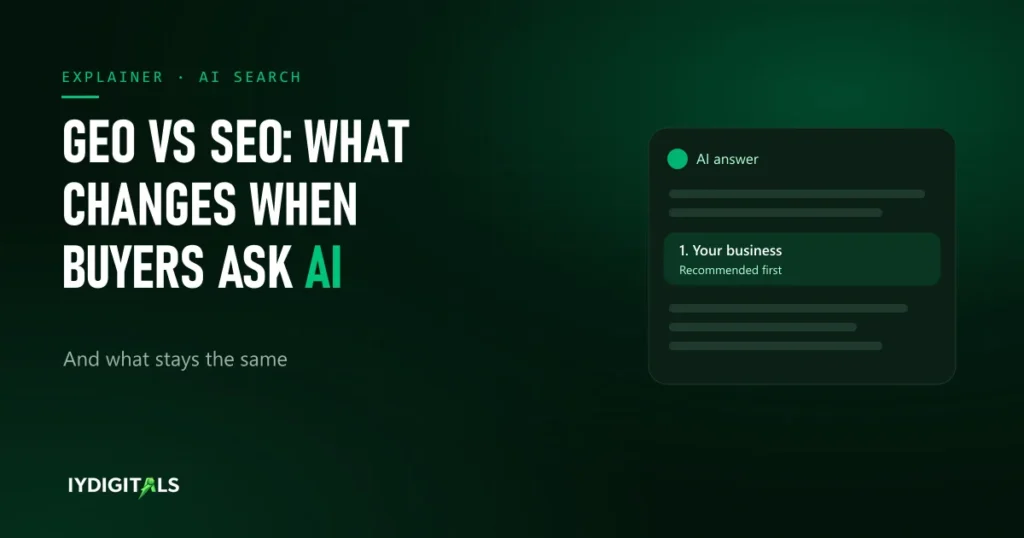
They ask ChatGPT, Gemini or Google’s AI Mode a direct question, such as “Which property lawyers in Lekki are reliable?”, and get back a short answer with three or four names.
If your business isn’t one of them, the ranking you worked for may never be seen.
That shift has produced a new term, GEO, and a lot of confusion. Is SEO dead? Do you need a new agency? Is this just a rebrand?
This guide explains, in plain English, what SEO and GEO each do, where they overlap, what is genuinely new, and what a founder in Nigeria should do about it.
The short version
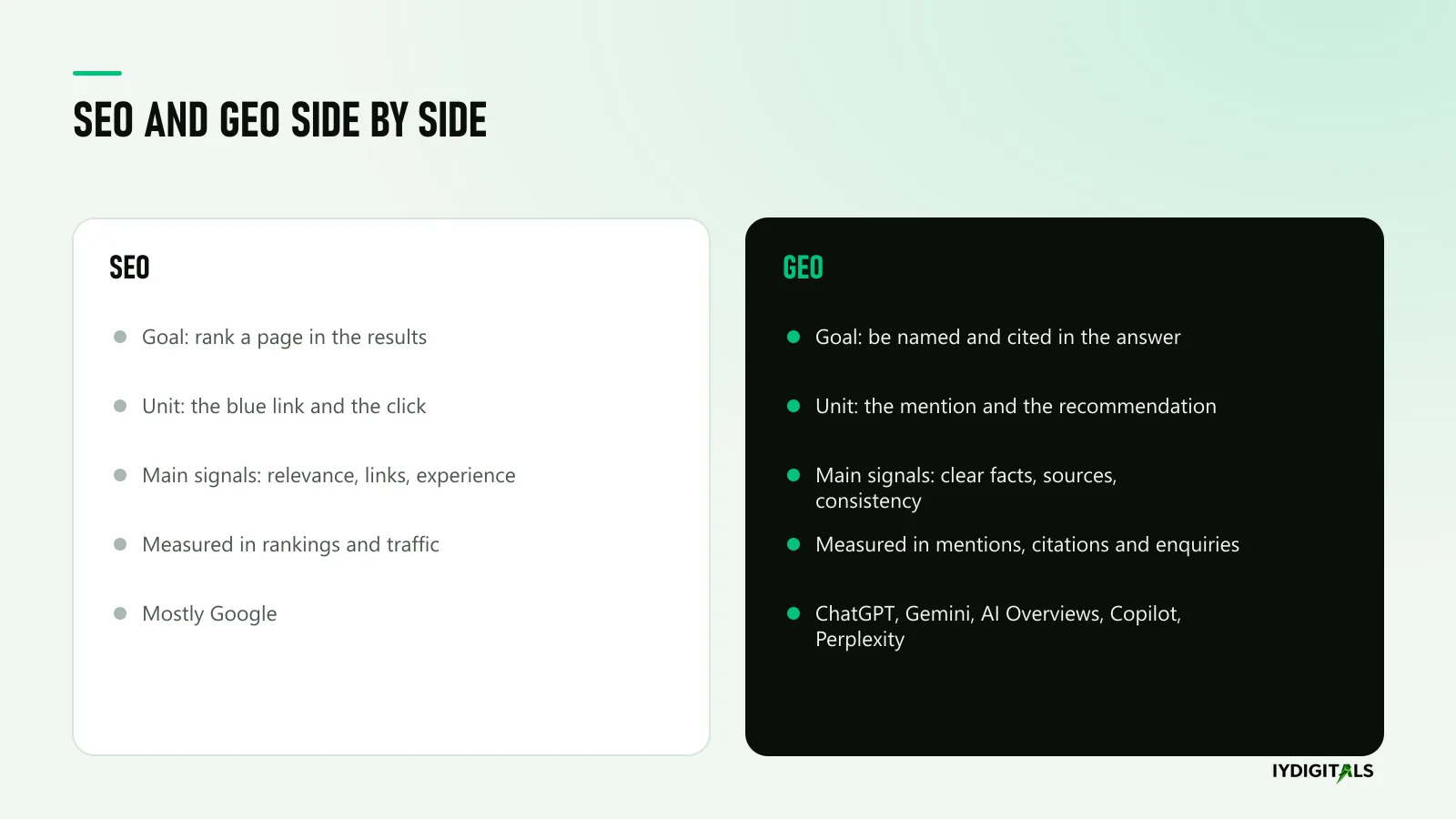
SEO, search engine optimisation, is the work of getting your pages to rank in search results so people click through to your website.
GEO, generative engine optimisation, is the work of getting your business named, described accurately and cited inside the answers generated by AI assistants.
The term was popularised by a 2023 academic paper from researchers at Princeton and other institutions, and it is now used across the industry.
You will also see AEO (answer engine optimisation) and “AI SEO”. They describe largely the same goal.
What stays the same
The most important point is that GEO builds on SEO rather than replacing it. AI assistants don’t invent their knowledge of local businesses.
When they answer a question about the best surveyor in Ikeja, they search an index, usually Google’s or Bing’s, read the pages and profiles they find and summarise them. So the fundamentals still matter:
- Your site must be crawlable, fast and indexed.
- Your pages must clearly answer the questions buyers ask.
- Your business must be trusted, with genuine reviews and mentions elsewhere.
- Your Google Business Profile must be complete and accurate.
A business that has neglected SEO will struggle with GEO. A business with good SEO has a head start.
What changes
The goal moves from the click to the mention
In classic SEO, success is a high position and a click. In AI answers, the buyer may never click anything. They read three names and phone one. Success is being one of those names, described accurately, ideally first.
The buyer’s question gets longer and more specific
People type “estate agent Lekki” into Google.
They ask an assistant “Which estate agents in Lekki are good for shortlet investments and can handle buyers abroad?” Pages that answer specific, real questions in plain words are the ones assistants quote.
Your whole footprint counts, not just your site
AI assistants cross-check. They compare what your website says with your Google profile, directories, social pages, reviews and articles that mention you.
If your details differ or nobody else mentions you, the assistant is less confident naming you. GEO puts much more weight on consistency and on independent mentions than traditional SEO did.
Bing matters again
ChatGPT and Microsoft Copilot lean heavily on Bing’s index.
Many Nigerian businesses have never verified their site with Bing, which means they are partly invisible to those assistants.
Our guide on why Bing matters for ChatGPT and Copilot explains how to fix it in an afternoon.
Measurement changes
Rankings are easy to track. Mentions in AI answers vary by question, by assistant and by day.
The practical answer is to track a fixed set of buyer prompts every month and record whether you are named, in what position and which sources the assistant cites, then connect that to enquiries.
We cover the method in how to see whether AI assistants mention your business.
Where AI assistants get their information
It helps to know what the assistants are reading.
When they answer a question about a business or a category, they typically draw on a mix of: the business’s own website; search indexes such as Google’s and Bing’s; Google Business Profiles and map data; review platforms; directories and “best of” lists; news and industry publications; and community discussions.
Each assistant weights these differently, and the sources cited for the same question can change from week to week.
That is why GEO focuses on being present, accurate and consistent across many of these sources, rather than perfecting a single page.
What GEO adds on top of good SEO
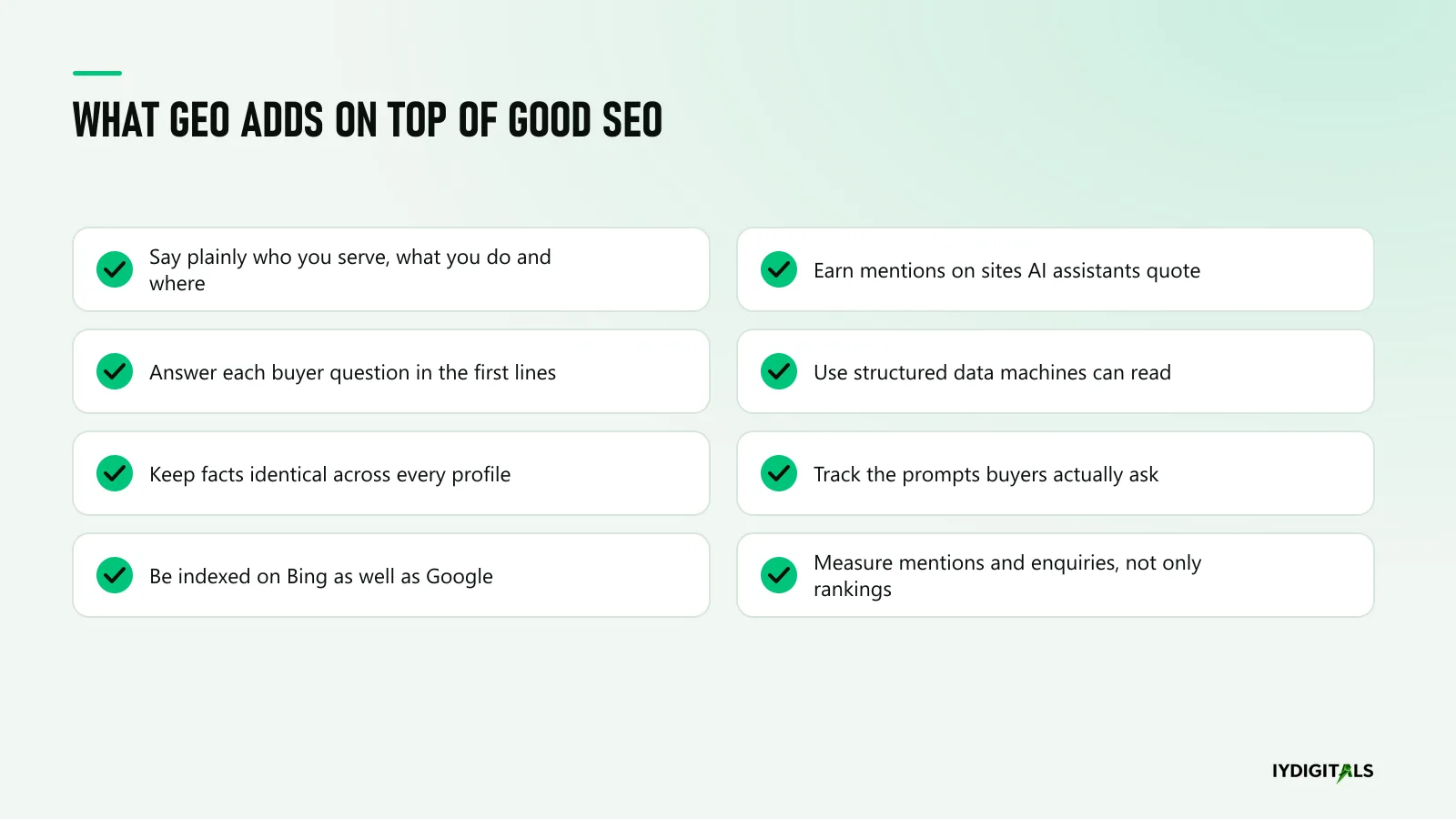
- Say plainly who you serve, what you do and where. In the first lines of your homepage and every service page. Assistants recommend specialists.
- Put the answer first. Each page should answer its main question in the opening paragraph, then explain.
- Keep facts identical everywhere. Name, address, phone, services and description across your website, Google, Bing, social profiles and directories.
- Be indexed on Bing as well as Google. Verify the site, submit the sitemap and turn on IndexNow.
- Earn mentions on sites AI assistants quote. Industry directories, “best of” lists, associations, local news and partner sites.
- Use structured data. Business details, services and FAQs in a format machines read reliably.
- Track the prompts buyers actually ask. Not just keywords.
- Measure mentions and enquiries, not only rankings.
Four myths about GEO
“SEO is dead”
It isn’t. AI assistants still need to find, read and trust web pages, and those pages are found through search indexes. What has changed is that ranking alone is no longer the finish line.
“You can pay ChatGPT to recommend you”
Organic recommendations aren’t for sale. Some assistants now show advertising in some markets, but ads are labelled as sponsored. The names in the answer itself come from the evidence the assistant finds about each business.
“It’s all about special AI files and tricks”
Technical details help: allowing AI crawlers, structured data, fast pages. But no file or tag will make an assistant recommend a business it can’t verify. Clarity, consistency, reviews and mentions do the heavy lifting.
“It only matters for big brands”
The opposite is often true.
For local and specialist questions, such as “drone surveyor in Eti-Osa” or “fertility clinic in Maitama”, assistants have very few strong sources to choose from.
A small business with clear, consistent evidence can become the answer faster than in classic search, where big sites dominate.
A 30-day starting plan
If you want to start on both SEO and GEO without hiring anyone yet, this order gets the most done in a month.
- Week 1: find your baseline. Write down ten questions your buyers ask. Search them on Google and Maps, and ask them in ChatGPT, Gemini and Copilot. Note who is named and which websites are cited.
- Week 1: fix the basics. Make sure your site is indexed on Google and Bing, and that your Google Business Profile is complete and accurate.
- Week 2: rewrite your key pages. Homepage and main service pages: who you serve, what you do and where, in the first lines. Answer one buyer question per page, clearly.
- Week 3: make your details identical everywhere. Website, Google, Bing Places, Facebook, Instagram, LinkedIn and the directories that list your category in your city.
- Week 4: start earning evidence. Ask recent clients for reviews, get listed on two or three relevant directories and approach one partner or association for a mention.
- Day 30: check again. Run the same ten questions. Note what changed. Repeat monthly.
Our AI search checklist for Nigerian founders breaks this down further.
What it looks like when it works
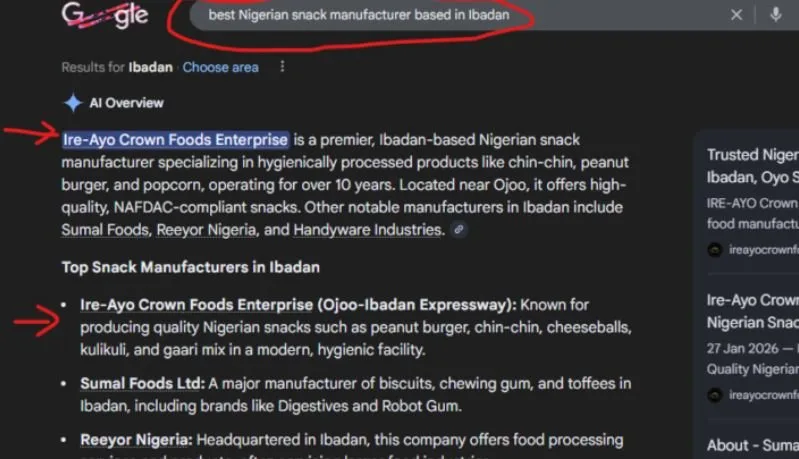
Ire-Ayo Crown Foods, a snack manufacturer in Ibadan and one of our clients, shows what the result can look like.
Today, when someone asks Google for the best Nigerian snack manufacturer in Ibadan, its AI Overview opens with Ire-Ayo’s name.
Why this is an opportunity for Nigerian founders
In many Nigerian categories, AI answers are thin.
Ask an assistant for “the best property surveyor in Abuja” or “a reliable shortlet operator in Ikoyi” and you will often get vague, outdated or international results.
That means the businesses that do the work now can become the default answer before their competitors notice the question is being asked.
Read how to get your business recommended by ChatGPT in Nigeria for a step-by-step version, and how Google AI Overviews choose businesses for Google specifically.
So, which do you need?
Both, as one piece of work. A useful way to think about it:
- If your site isn’t indexed, is slow or has thin pages, start with SEO fundamentals.
- If you rank reasonably but AI assistants don’t name you, focus on clarity, consistency, Bing and mentions.
- Either way, measure what matters: whether buyers find you, trust you and get in touch.
That combined approach is what we call AI search visibility. If you are weighing up who should do it, our guide on how to choose an AI SEO agency in Nigeria lists the questions to ask. You can also see our client results or book a free strategy call.
Common questions
Is GEO replacing SEO?
No. AI assistants still rely on search indexes and well-ranked pages to find information, so solid SEO remains the foundation. GEO adds the work needed to be named and quoted in the answer, not just listed in the results.
What is the difference between GEO, AEO and AI SEO?
They describe largely the same goal.
AEO (answer engine optimisation) focuses on being the direct answer to a question, GEO on being cited by generative AI, and "AI SEO" is the everyday name for both. What matters is the outcome: buyers hearing your name when they ask.
Can I measure GEO?
Yes, though differently from rankings.
Track a fixed set of buyer prompts each month and record whether you are named, in what position and which sources are cited, then connect that to enquiries. Some analytics tools also show visits from AI assistants.
Should a small Nigerian business care about GEO yet?
Yes, especially for high-value services.
Buyers deciding on property, legal, medical or professional services increasingly ask AI for a shortlist, and local categories are often uncontested today, which makes early work cheaper and faster to pay off.

Visibility & Conversion Strategist