Follow-up automation for service businesses: stop losing leads after the first message
Want more buyers and sales from AI search, without doing the work? Let the IYDigitals team handle it. Talk to an expert now →
On this page
Most service businesses think their problem is not enough leads. Often, the bigger problem is what happens to the leads they already get. A prospect fills in a form on Friday evening.
Someone replies on Monday. The prospect says “let me think about it” and nobody asks again. Three weeks later they sign with a competitor who simply kept in touch.
Every one of those lost leads cost money to attract, through your website, your Google profile, your ads or a referral that took years to earn.
Follow-up automation makes sure that once someone raises their hand, they get a fast, useful answer and a clear next step, and that nobody is forgotten just because they went quiet.
This guide explains where leads leak, what a good follow-up system looks like and how to keep it personal.
Where service businesses lose leads
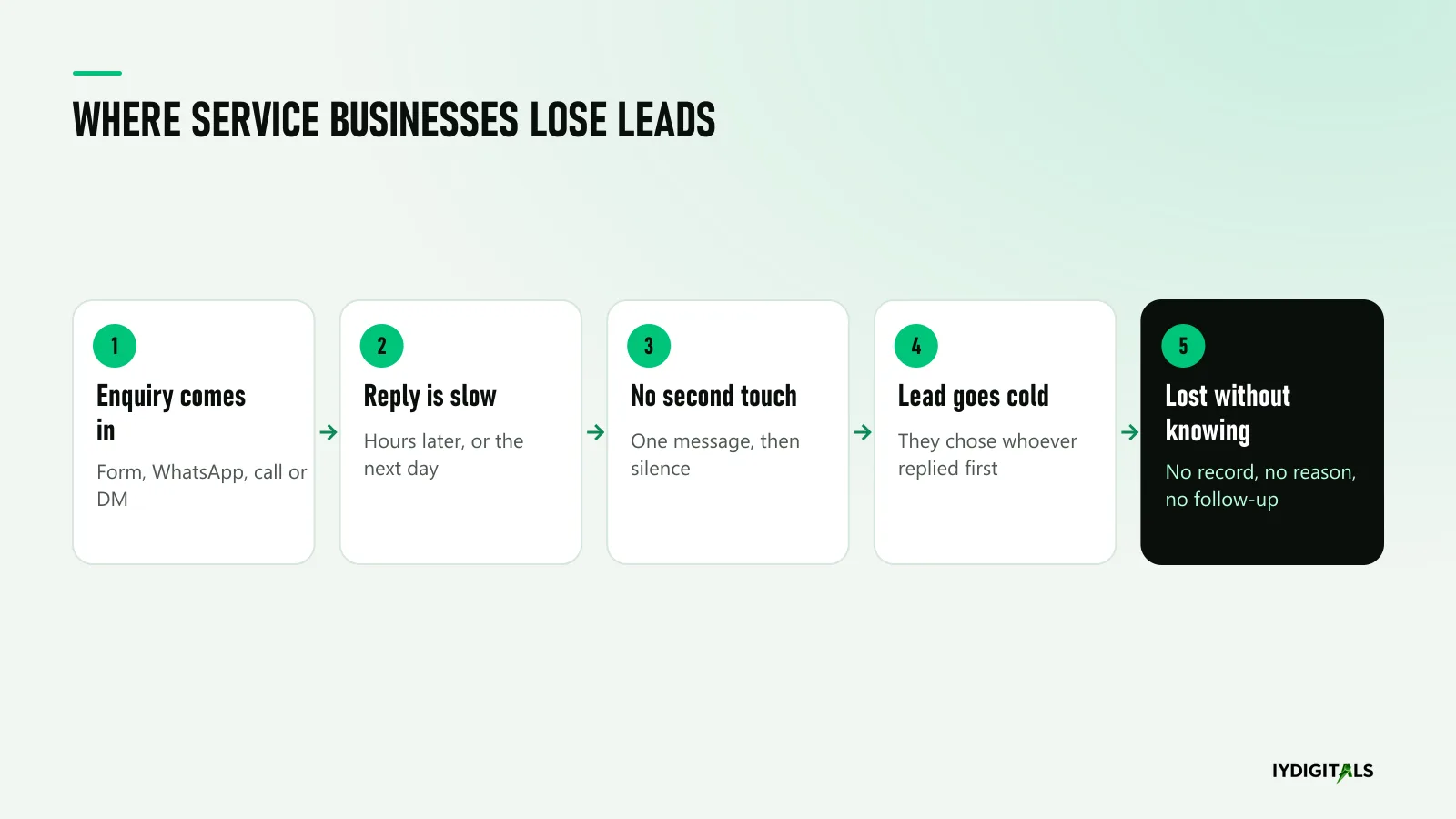
The first reply is too slow
People who enquire about a service usually contact more than one business.
A consultancy, a law firm, a travel agent or a clinic that replies within minutes has a real advantage over one that replies the next day.
The prospect is still thinking about the problem, and the first useful reply often sets the shortlist.
There is no second touch
Many prospects reply “thanks, I’ll get back to you” and then don’t. They are busy, not uninterested. Without a gentle follow-up, they drift away.
A large share of deals that eventually close need more than one conversation.
Nobody knows what happened
Leads arrive by WhatsApp, phone, email, website forms, Instagram DMs and referrals. They sit in different phones and inboxes.
When a salesperson leaves or a busy week arrives, leads simply vanish, and nobody can say how many were lost or why.
What good follow-up looks like
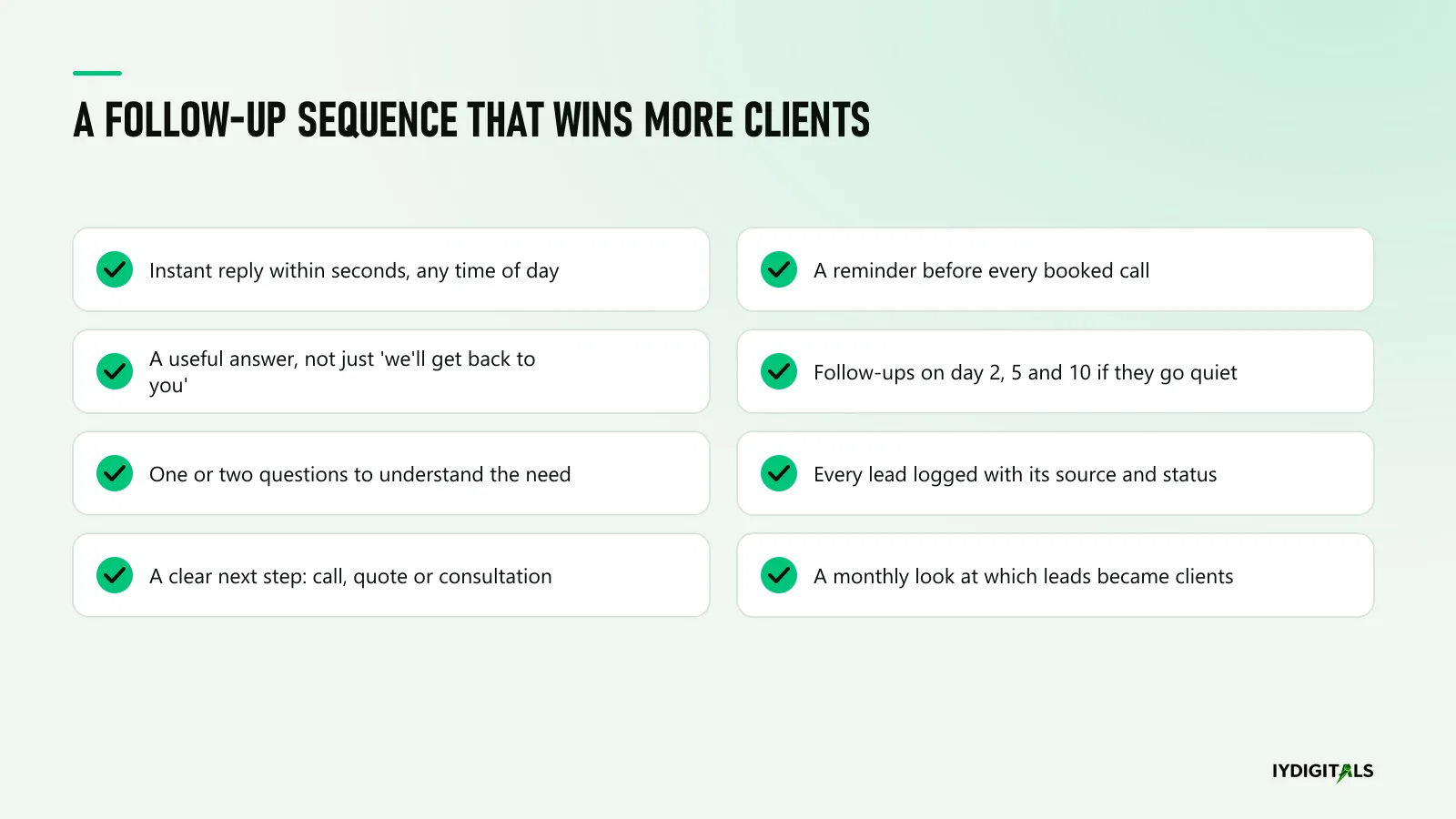
1. An instant reply that actually helps
Within seconds, day or night, the prospect gets a reply in your business’s name.
Not just “we’ll get back to you”, but something useful: an answer to the common question, what happens next and when a person will be in touch.
For example, a travel and visa consultancy can reply with the documents usually needed for the visa the person asked about, and a link to book a call.
2. One or two questions to understand the need
“Is this for you or your company?” “When do you need it done?” Short questions help you prioritise, and they show the prospect you are paying attention.
3. A clear next step
Every reply should end with one next step: book a consultation, send documents for a quote, choose a time for a call. Prospects who are told exactly what to do next are far more likely to do it.
4. Reminders before every booked call
A reminder the day before and an hour before reduces missed appointments. Include the time, how you will call or meet, and anything they should prepare.
5. Follow-ups when people go quiet
If a prospect stops replying, follow up on about day two, day five and day ten. Each message should add something: an answer to a common concern, a relevant example, a short guide. After the third, stop, and leave the door open.
6. A record of every lead
Name, contact, source, what they asked for, stage and next step. Whether it lives in a CRM or a shared spreadsheet, it means no lead depends on one person’s memory.
7. A monthly look at the numbers
How many enquiries came in, from where, how many became calls and how many became clients. That tells you which channels deserve more effort and where your process is leaking.
Example sequences by type of business
A consultancy or professional firm
Instant reply: “Thank you for contacting us about [service]. A member of our team will reply personally within two working hours.
In the meantime, here’s a short guide to how our engagements usually work: [link]. Is this for your own business or on behalf of an organisation?”
Day two, if quiet: “Hi [name], following up on your enquiry about [service]. If it helps, we can do a 20-minute call to understand what you need. Here are a few times this week: [link].”
Day five: a short, relevant example of similar work, or the answer to a question prospects often ask.
Day ten: “I’ll stop following up for now so I don’t crowd your inbox. If the timing changes, just reply here.”
A travel, visa or education consultancy
The first reply can share the checklist of documents usually needed for the route the person asked about, explain what the consultancy handles and invite them to book an assessment.
Follow-ups can address the concerns people commonly have, such as timelines and how refusals are handled, rather than repeating the offer.
A clinic or wellness practice
The first reply confirms the request, lists available appointment times or a booking link and states whether the patient’s HMO is accepted.
Reminders the day before and an hour before reduce missed appointments. Never discuss symptoms or medical details by automated message.
A home or business services company
For cleaning, laundry, facility management, installations and similar services, the first reply can ask for the location, the size of the job and photos where relevant, then confirm when a quote will be ready.
A follow-up after the quote (“Any questions about the quote?”) wins jobs that would otherwise go quiet.
Keep it personal
The fear with automation is that it makes a business feel robotic. It doesn’t have to. A few rules keep it human:
- Write like a person. Short sentences, the prospect’s name, your name.
- Hand over fast. Automation handles the first minute; a named person handles the conversation.
- Never automate judgement. Quotes, advice on their specific situation, complaints and negotiations belong to a person.
- Stop when asked. If someone says no, thank them and stop. Don’t add enquirers to marketing lists without their consent, and handle their details in line with Nigeria’s Data Protection Act.
How to know it’s working
Follow-up is easy to set up and easy to forget. Four numbers, checked monthly, tell you whether it is paying off:
- Time to first reply. How long, on average, between an enquiry and a useful reply. Aim for minutes, not hours.
- Enquiry to conversation. The share of enquiries that turn into a real call, meeting or quote request.
- Conversation to client. The share of those conversations that become paying clients.
- Revived leads. Clients who signed after going quiet and being followed up. This is the number that shows what follow-up is worth, because without it those clients would have been lost.
Write the numbers down before you start, then compare after three months. Most businesses find the biggest improvement comes from the first two: replying faster, and making the next step obvious.
Tools: start simple
You don’t need expensive software to start. Many small firms begin with the WhatsApp Business app (greetings, quick replies and labels), email templates and a shared spreadsheet.
As volume grows, a CRM connected to WhatsApp, website forms and email can send replies and follow-ups automatically and show every lead in one place. The tool matters less than the habit.
For property businesses, our guide to WhatsApp lead automation shows a property-specific setup.
What it looks like when the system works
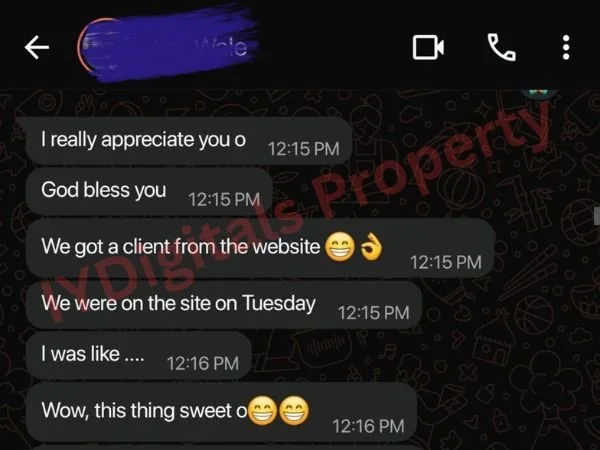
When visibility and follow-up work together, the results show up in messages like this one from a client, telling us a new client had come in through the website.
Where to start this week
- Send an enquiry to your own business from another phone or email. Time the reply and read it as a prospect would.
- Count last month’s enquiries and how many became clients. Note how many simply went quiet.
- Write a helpful first reply and three short follow-ups for your most common enquiry.
- Put every new lead in one place, starting today.
Follow-up is the step that turns visibility into revenue. It sits alongside being found on Google, Maps and AI search in our Client Magnet System.
If you also want more enquiries coming in, read how professional firms get clients without relying on referrals. See our automation service, our client results, or book a free strategy call.
Travel firms: see how Lagos travel and visa consultants get more clients.
Common questions
Won't automated follow-ups annoy people?
Not if they are useful, few and personal. A helpful message with an answer, a short guide or a time to talk feels like good service. Three follow-ups over ten days, then stop, is a sensible limit.
What tools do I need?
Many small businesses start with the WhatsApp Business app, email templates and a shared spreadsheet.
Larger teams use a CRM connected to WhatsApp, their website forms and email, so every lead is recorded and followed up automatically.
Is it legal to keep messaging people who enquired?
Following up on an enquiry someone made is normal, but respect their choice. Stop when they say no, don't add them to marketing lists without consent, and handle their data in line with Nigeria's Data Protection Act.
Which leads should a person handle, not automation?
High-value leads, anyone who is upset or confused, anyone ready to buy and anything needing judgement, such as a quote or advice on their specific situation. Automation should get them to a person faster.

Visibility & Conversion Strategist