How consultants and professional firms get clients without relying on referrals
Want more buyers and sales from AI search, without doing the work? Let the IYDigitals team handle it. Talk to an expert now →
On this page
Most good consultants and professional firms in Nigeria were built on referrals. A satisfied client tells a friend, the friend calls, and the business grows.
It works, and the clients who come by referral are often the best.
But anyone who has run a firm for a few years knows the other side: the months when nobody refers anyone, the slow quarters that have nothing to do with the quality of the work, and the feeling that growth depends on luck and on who you happen to know.
The firms that grow steadily add a second source of clients: people who have never heard of them, have exactly the problem they solve, and find them through Google, Maps, LinkedIn or an AI assistant.
This guide explains how to build that second source without giving up the first.
Why referrals alone hold firms back
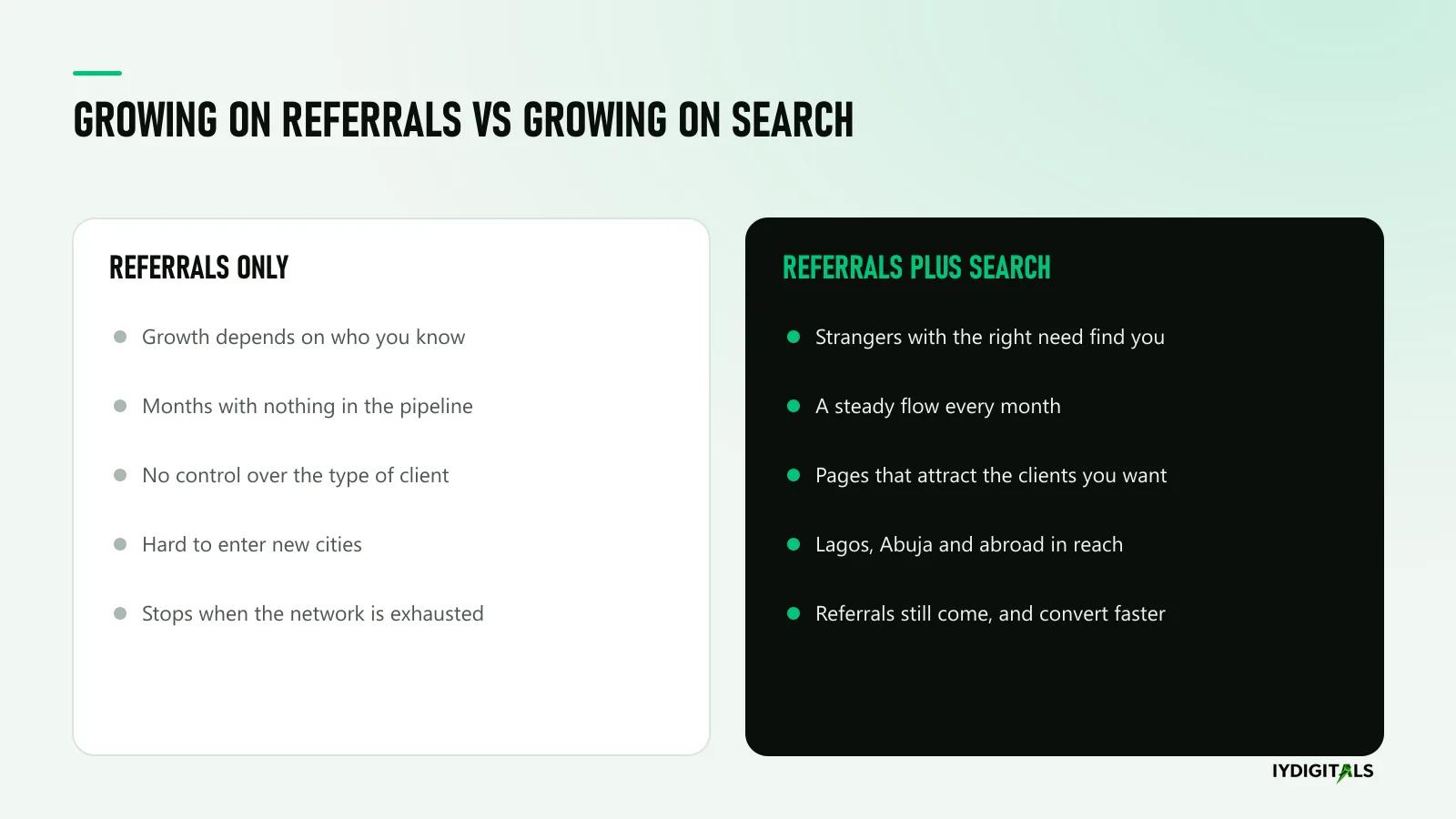
- They are unpredictable. You can’t decide when a referral will come, so planning hires and cash flow is hard.
- They are limited to your network. If your clients are mostly in Ibadan, it is hard to win clients in Lagos or Abuja by referral alone.
- You don’t choose the work. Referrals bring whatever your network needs, not necessarily the work you most want to do.
- They hide you from everyone else. The many buyers who search instead of asking a friend never discover you.
Meanwhile, buyers have changed how they look for help.
A finance director in Victoria Island who needs a tax adviser, or a founder in Abuja who needs an HR consultant, increasingly searches Google, checks LinkedIn or asks ChatGPT before asking anyone.
Even people who were referred to you now check you online before they call. If they find little, the referral weakens.
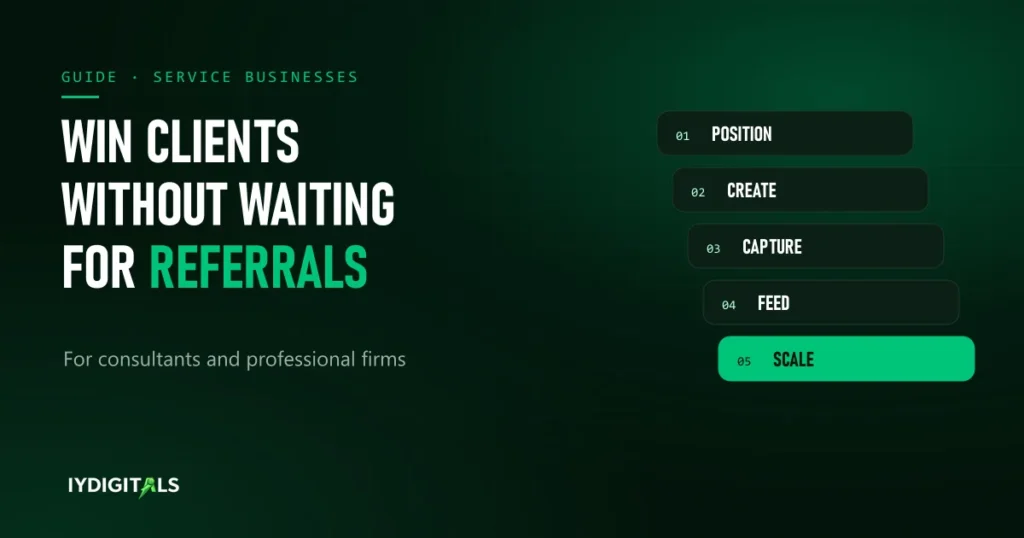
The five steps from referral-dependent to findable
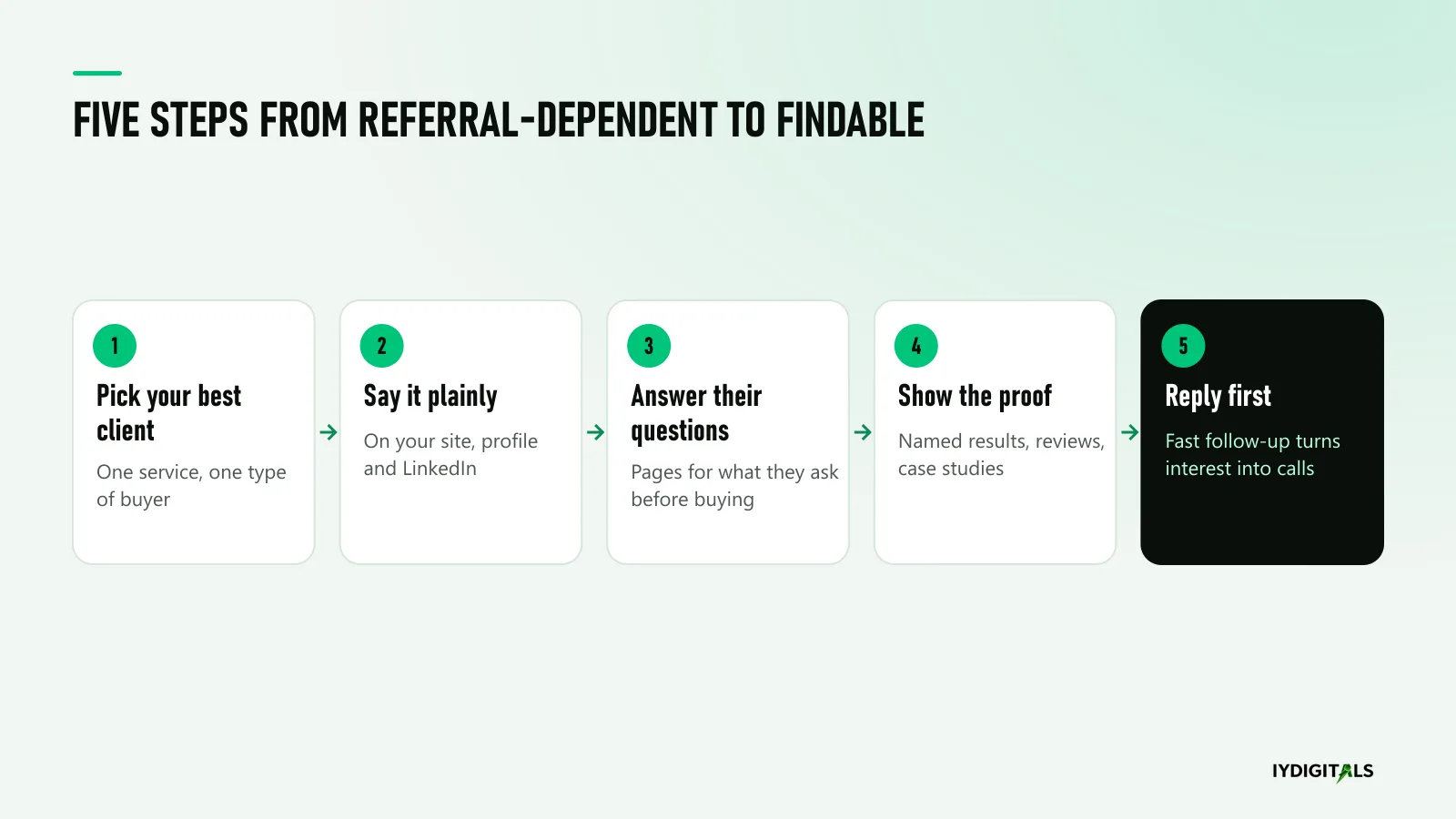
1. Pick the client you most want more of
Firms that try to be found for everything are found for nothing.
Start with one service and one type of buyer: “HR policy and compliance for growing companies in Lagos”, “audit and tax for property developers in Abuja”, “procurement advisory for organisations working with government”.
You can add more later. Specific firms get named; general ones get skipped.
2. Say it plainly, everywhere
Put that positioning in the first lines of your homepage, your Google Business Profile description, your LinkedIn company page and your founders’ LinkedIn headlines.
Buyers, Google and AI assistants all need to see the same clear statement of what you do, for whom and where.
If your homepage says “innovative solutions for your business needs”, rewrite it today.
3. Publish answers to the questions buyers ask before they hire
Think of the questions you hear in every first meeting. “Do we need an audit this year?” “What does it take to register with this regulator?” “How long does a restructuring take?” “What should a consultancy contract include?” Each one deserves a clear, factual page on your website.
These pages bring in buyers at the moment they are researching, show your expertise before the first call and give AI assistants something specific to quote.
A dedicated page for each main service, explaining who it is for, what the process looks like and how to start, matters more than a blog full of general news. Quality beats volume.
Five excellent pages that answer real buyer questions will do more than fifty thin posts.
4. Show proof a stranger can verify
A referral comes with built-in trust. A stranger needs evidence.
Publish named case studies where clients agree, testimonials with real names and roles, the credentials and experience of your people, and reviews on Google and on platforms your buyers recognise.
Proof that lives only in your sales deck can’t help someone who hasn’t met you yet.
5. Reply first
Buyers who find you through search are usually talking to two or three firms at once. The firm that replies quickly and clearly, with a sensible next step, gets the meeting.
A fast reply on WhatsApp or email, and a polite follow-up when someone goes quiet, wins more clients than most marketing. We explain how in follow-up automation for service businesses.
Where buyers will find you
Google and your website
Service and question pages, written in plain language, are the foundation. They rank for the searches buyers make and they feed everything else.
Google Maps
Even business buyers search Maps for firms near them. A complete, verified Google Business Profile, with the right category and real reviews, makes you look established. See our guide to why your Google profile isn’t bringing calls.
For business-to-business services, LinkedIn is where buyers check who you are. A clear company page and founder profiles that match your website positioning help both buyers and AI assistants connect the dots.
AI assistants
When a buyer asks ChatGPT, Copilot or Google’s AI for a recommendation, the answer is built from what those tools can find about firms like yours: websites, profiles, reviews, directories and mentions on other sites.
Firms that are specific, consistent and mentioned elsewhere get named. Read why AI recommends your competitor and not you and GEO vs SEO for the full picture.
Keep referrals flowing, and make them convert better
Building search visibility doesn’t mean giving up on referrals. Done well, each makes the other stronger.
- Make referrals easy to pass on. Give happy clients a simple way to describe you, such as a one-line summary and a link to the page for the service they used. A referral that says “they sorted our HR compliance in six weeks, here’s their page” is far more powerful than “call this guy”.
- Make sure the referral checks out. Almost every referred buyer searches your name before calling. A clear website, named people, case studies and recent reviews turn a lukewarm referral into a booked meeting.
- Turn clients into public proof. With permission, every successful engagement can become a case study, a review or a testimonial that helps strangers trust you as much as the referrer does.
- Stay visible to past clients. Useful articles, shared on LinkedIn and by email, keep you in mind when a past client’s colleague mentions a problem you solve.
What to measure
Firms that move away from referral dependence need to know whether it is working. Track a few simple things every month:
- Where each new enquiry came from. Referral, Google search, Google Maps, LinkedIn, AI assistant or social media. Ask every new enquiry “how did you find us?” and write it down.
- Enquiries from strangers. The number of enquiries from people with no prior connection to the firm is the clearest sign that search is working.
- Which pages bring enquiries. Your website analytics show which service and question pages people read before they get in touch. Write more like those.
- What AI assistants say. Once a month, ask ChatGPT and Google’s AI the questions your buyers ask, and note whether your firm is named.
- Time to reply. How long new enquiries wait for an answer. It is often the cheapest number to improve.
Within a few months, most firms can see the share of clients from search rising, and the months without referrals stop being months without work.
What changes when it works
The first sign is usually enquiries from people you don’t know, asking about exactly the service you described.
Then referrals start converting faster, because when the referred buyer checks you online, they find a firm that looks as good as its reputation.
Big Knuckles’ Kitchen, a food brand, saw this kind of change. Its founder believed the location was holding the business back.
The real problem was that people searching for what it sells couldn’t find it. Once that was fixed, enquiries and sales grew by 40% in nine weeks from the same location.
In the founder’s words: “It was never my location. It was just visibility.”
The same principle applies to consultants and professional firms: the clients are already searching. The question is whether they find you.
A note on patience
Search visibility is not an advert you switch on.
The first enquiries from strangers often arrive within weeks of fixing your website and Google profile, but the steady flow that replaces the feast-and-famine of referrals usually builds over several months of consistent work: one strong page at a time, one review at a time, one case study at a time.
The good news is that, unlike adverts, the work compounds.
A page that answers a buyer’s question well keeps bringing enquiries long after it is published, and every new piece of proof makes the next client easier to win.
A one-hour start
- Write one sentence: the service you want more of, the buyer it is for and the city or region you serve.
- Read your homepage’s first lines. Do they say that sentence? If not, rewrite them.
- List the five questions you hear in every first meeting. Those are your first five pages.
- Search your main service with your city on Google and in ChatGPT. Note who appears. That is your real competition.
IYDigitals helps consultants and professional firms across Lagos, Abuja and beyond become the name buyers find first.
See how we work with service businesses, look at our client results, or book a free strategy call.
If you also serve clients abroad, read how Nigerian businesses win UK clients through search.
Common questions
Are referrals bad for a consulting business?
No. Referrals are usually the best clients a firm gets. The problem is depending on them, because they are unpredictable and limited to your network. Search and AI visibility add a second, steadier source of clients.
How long does it take to get clients from search?
For a specific service in a specific city, many firms see enquiries within weeks of fixing their website and Google profile. Broader, competitive services take months of consistent content and proof.
Do I need to post on social media every day?
No. Social media helps, but buyers searching for a consultant usually go to Google, Maps, LinkedIn and increasingly ChatGPT. Pages that answer their questions keep working long after a post has disappeared.
What if my clients are businesses, not individuals?
The same principles apply, with more emphasis on credentials, named people, sector experience and case studies, because business buyers often have to justify their choice to others.

Visibility & Conversion Strategist