How Nigerian businesses win clients in the UK through search
Want more buyers and sales from AI search, without doing the work? Let the IYDigitals team handle it. Talk to an expert now →
On this page
A UK start-up needs a development team. A London accountancy practice wants bookkeeping support. A Nigerian nurse in Leeds wants to buy land back home and needs a firm she can trust.
A charity in Manchester needs research in West Africa. Each of them could hire a business in Nigeria, and many of them would like to. What stops them is rarely price or skill.
It is uncertainty: they can’t easily tell which Nigerian firms are reliable.
The Nigerian businesses that win UK clients consistently are the ones that remove that uncertainty before the first conversation.
They are easy to find when a UK buyer searches, and what the buyer finds answers their doubts. This guide explains how to become that business.
Two UK markets, not one
Nigerian businesses usually serve two quite different groups of UK buyers.
- UK businesses and organisations buying services that can be delivered remotely: software, web and app development, design, digital marketing, data and research, accounting support, customer support and specialist consulting.
- The Nigerian diaspora in the UK buying services connected to Nigeria: property, land surveying, legal help, travel, family support, education and investments. These buyers already know Nigeria, but they still need to trust the specific firm, often more than a local buyer would, because they can’t visit.
Both groups search, and both check carefully. But they search for different things, and they need different proof. If you serve both, give each its own page.
How a UK buyer finds and hires a Nigerian firm
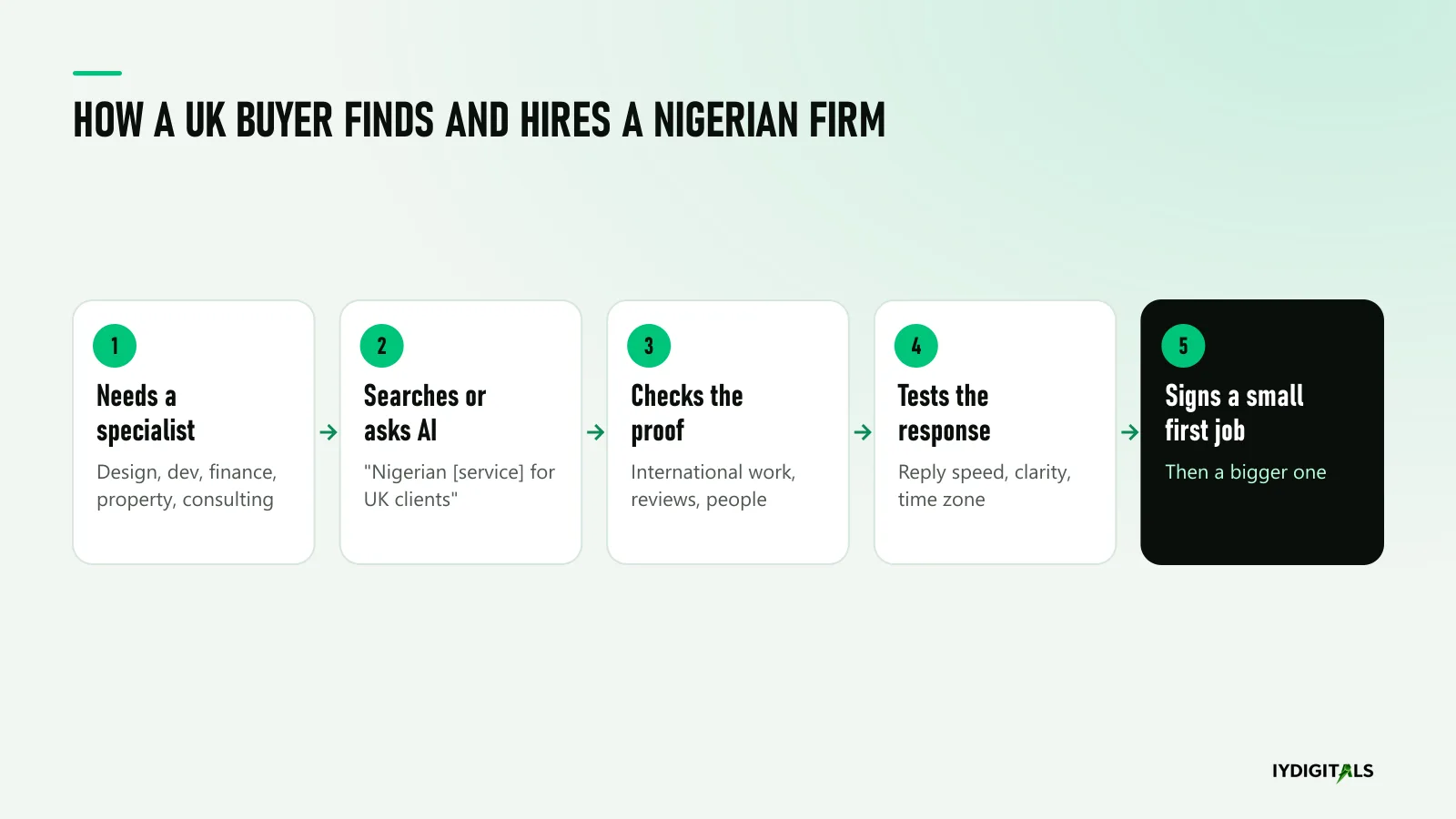
UK business buyers search for a specific service, often with words that signal they are open to working remotely: “offshore development team Africa”, “Nigerian web developers for UK businesses”, “outsourced bookkeeping for UK accountants”.
Diaspora buyers search for the service in Nigeria: “land surveyor in Lagos for diaspora”, “property lawyer in Abuja for UK residents”.
And both increasingly ask ChatGPT or Google’s AI directly for recommendations.
Then they check. Who is behind the firm? Have they worked with UK clients before? Do the reviews look genuine? Will they reply during UK hours?
Usually the first engagement is small, a trial project or a single transaction. The firm that handles it well wins the next, larger one.
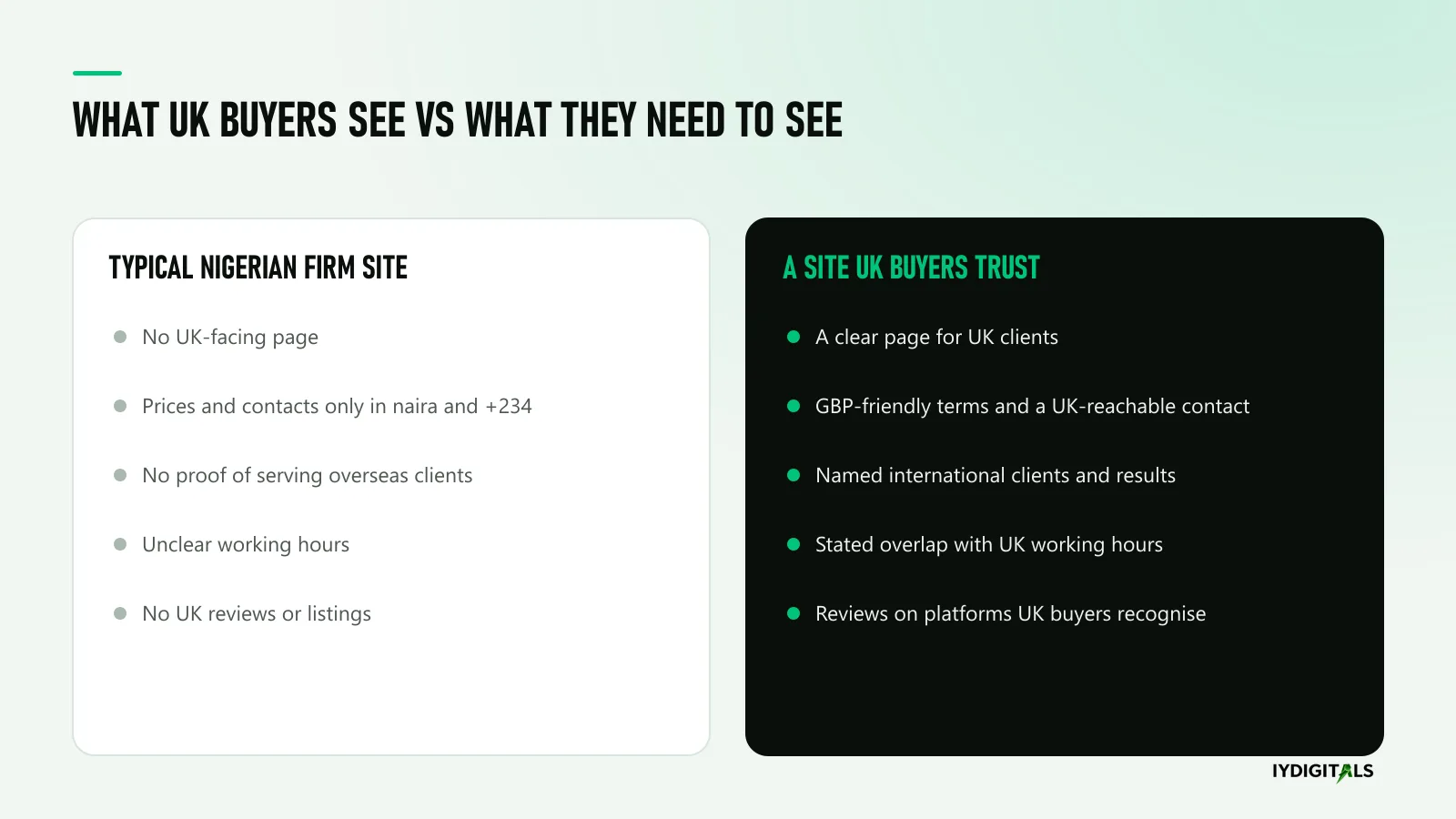
What UK buyers see, and what they need to see
A page written for UK buyers
Most Nigerian business websites are written for Nigerian customers, which is right.
But a UK buyer landing on a page about naira payments and Lagos traffic will assume the firm isn’t for them.
A dedicated page for UK clients, explaining what you do for them, how engagements work, how contracts and payments are handled and how communication works, tells them immediately that they are in the right place.
Named international proof
UK buyers want evidence that you have done this before for people like them.
Named clients (with permission), case studies with specific results, testimonials with real names and roles, and the people who will do the work. Anonymous logos and generic claims are much weaker.
Reviews on platforms they recognise
UK consumers know Trustpilot and Google reviews. UK businesses often check Clutch and LinkedIn.
Reviews on a platform the buyer already trusts are worth far more than testimonials on your own site. Ask your existing international clients to leave them.
Working hours in UK time
Nigeria is one hour ahead of the UK in winter and on the same time in summer. That is a genuine advantage over many offshore options, and many UK buyers don’t know it. Say it plainly: “We work UK office hours.”
Easy contact and payment
Make it easy to contact you from the UK: email, a booking link for video calls, WhatsApp and, if you have one, a UK-reachable number.
Explain how invoices and payments work in pounds or dollars. Uncertainty about paying is one of the quickest ways to lose an international client.
What to put on your UK clients page
A good UK clients page answers, in order, the questions a cautious UK buyer has before they get in touch:
- Who you help in the UK. The type of client and the specific services, in their words. “We build and maintain web applications for UK start-ups” or “We help Nigerians in the UK buy land in Lagos safely.”
- Proof you have done it before. Named clients, short case studies with specific results and a few testimonials with real names, roles and locations.
- Who they will work with. The founder and the team, with photos, roles and LinkedIn profiles.
- How an engagement works. The first call, the proposal, the first small project, how progress is reported and how long typical projects take.
- Hours and communication. “We work UK office hours” and how quickly you reply, with the channels you use: email, video calls, WhatsApp or Slack.
- Contracts and payment. How agreements are signed, which currencies you invoice in and how clients can pay safely.
- A low-risk first step. A short call, a paid audit or a small pilot project, with a clear way to book it.
For diaspora services, add the trust questions buyers abroad ask: how they can verify your company, how they will see progress without visiting and how their money is protected.
Keep every claim specific and checkable. UK buyers are used to checking companies, and specific facts reassure them more than any adjective.
Be findable where UK buyers look
Google, with the right pages
UK buyers search for specific services. A page for each main service, written with UK buyers in mind, has a far better chance of ranking than a general homepage.
For diaspora services, pages that answer the questions buyers abroad ask before they pay are especially powerful.
Our guides on how diaspora buyers check a Lagos developer and selling off-plan property to Nigerians in the UK show what that looks like for property.
For business services, LinkedIn is where UK buyers check people. A complete company page and founder profiles that match your website, with posts that show your work and your thinking, make a firm feel real and reachable.
Directories and review platforms
International directories such as Clutch, and review platforms such as Trustpilot, rank in UK searches and are read by AI assistants. A complete, accurate profile with genuine reviews often brings enquiries on its own.
AI assistants
When a UK buyer asks ChatGPT for “reliable development agencies in Nigeria” or “trusted land surveyors in Lagos for diaspora buyers”, the answer is built from websites, directories, reviews and mentions.
Firms that are specific, consistent and mentioned on trusted sites get named. Read why AI recommends your competitor and not you.
Handle the first project brilliantly
Search brings the first enquiry. The first project decides everything after it.
UK clients who have a good first experience with a Nigerian firm tend to stay, give larger projects and recommend the firm to others.
Agree the scope in writing, confirm timelines you can actually meet, report progress before the client has to ask and deliver exactly what was promised.
Then ask for a review on a platform UK buyers recognise and, with permission, turn the project into a short case study.
Each well-handled first project becomes proof for the next UK buyer who searches.
Win at home first
The firms that win abroad are usually already strong at home, and their strength at home is part of the proof.
A UK buyer who searches your name and finds a strong Google profile, real reviews from Nigerian clients, press mentions and a clear website is far more likely to take the next step.
Ire-Ayo Crown Foods, one of our clients, became the business Google’s AI Overview names first for snack manufacturers in Ibadan, and now sells into Lagos and Port Harcourt as well.
Visibility built in one market creates the evidence that opens the next.
Mistakes that lose UK clients
- Fake UK addresses. Buyers check, and a fake address destroys trust instantly. Use your real location and be proud of it.
- Vague claims. “World-class solutions for global clients” says nothing. Specific results with real names say everything.
- Slow replies. If a UK buyer waits a day for an answer, they assume the project will be just as slow.
- No small first step. A clear, low-risk way to start, such as a paid audit or a small first project, makes the decision much easier.
Where to start
- Decide which UK buyer you most want: UK businesses, the diaspora or both.
- Search your main service the way they would, on Google and in ChatGPT. Note who appears.
- Write a UK clients page that answers their doubts: proof, process, hours, contracts, payments.
- Ask three existing international clients for a review on a platform UK buyers recognise.
IYDigitals helps Nigerian founders become visible to buyers at home and abroad. See how we work with service businesses and property businesses, look at our client results, or book a free strategy call.
Common questions
Do UK clients hire service firms based in Nigeria?
Yes, especially for services that can be delivered remotely, such as software and web development, design, marketing, accounting support, research, customer support and consulting.
The Nigerian diaspora in the UK is also a large market for property, travel, legal and financial services back home.
Is the time difference a problem?
Rarely. Nigeria is one hour ahead of the UK in winter and on the same time in summer, so working hours overlap almost completely. Say this clearly on your website, because many UK buyers don't know it.
Do we need a UK company or address?
Not necessarily. Many firms win UK clients with a Nigerian company and clear international proof. Some later register a UK entity for contracting or payments.
Take proper legal and tax advice before you do, and never use a UK address you don't actually operate from.
Which review platforms matter to UK buyers?
For consumers, Trustpilot and Google reviews are widely recognised. For business services, Clutch and similar platforms, along with LinkedIn recommendations, carry weight.

Visibility & Conversion Strategist