Why AI recommends your competitor and not you
Want more buyers and sales from AI search, without doing the work? Let the IYDigitals team handle it. Talk to an expert now →
On this page
You ask ChatGPT for the best business in your category in your city, and it names your competitor. You ask again with different words, and it names them again.
Maybe it names two or three others too. It doesn’t name you, even though you have been in business longer, serve more clients or do better work.
It feels unfair, but it is rarely random. AI assistants recommend the businesses they can verify most easily, and your competitor has simply left more evidence lying around.
The good news is that evidence can be built. This guide explains the seven most common reasons an AI assistant picks a competitor, and what to fix first.
How AI assistants choose
When someone asks ChatGPT, Gemini, Copilot or Google’s AI for a recommendation, the assistant searches the web, reads what it finds about the businesses in that category and names the ones it is most confident about.
It doesn’t know which business is best. It knows which businesses are best documented.
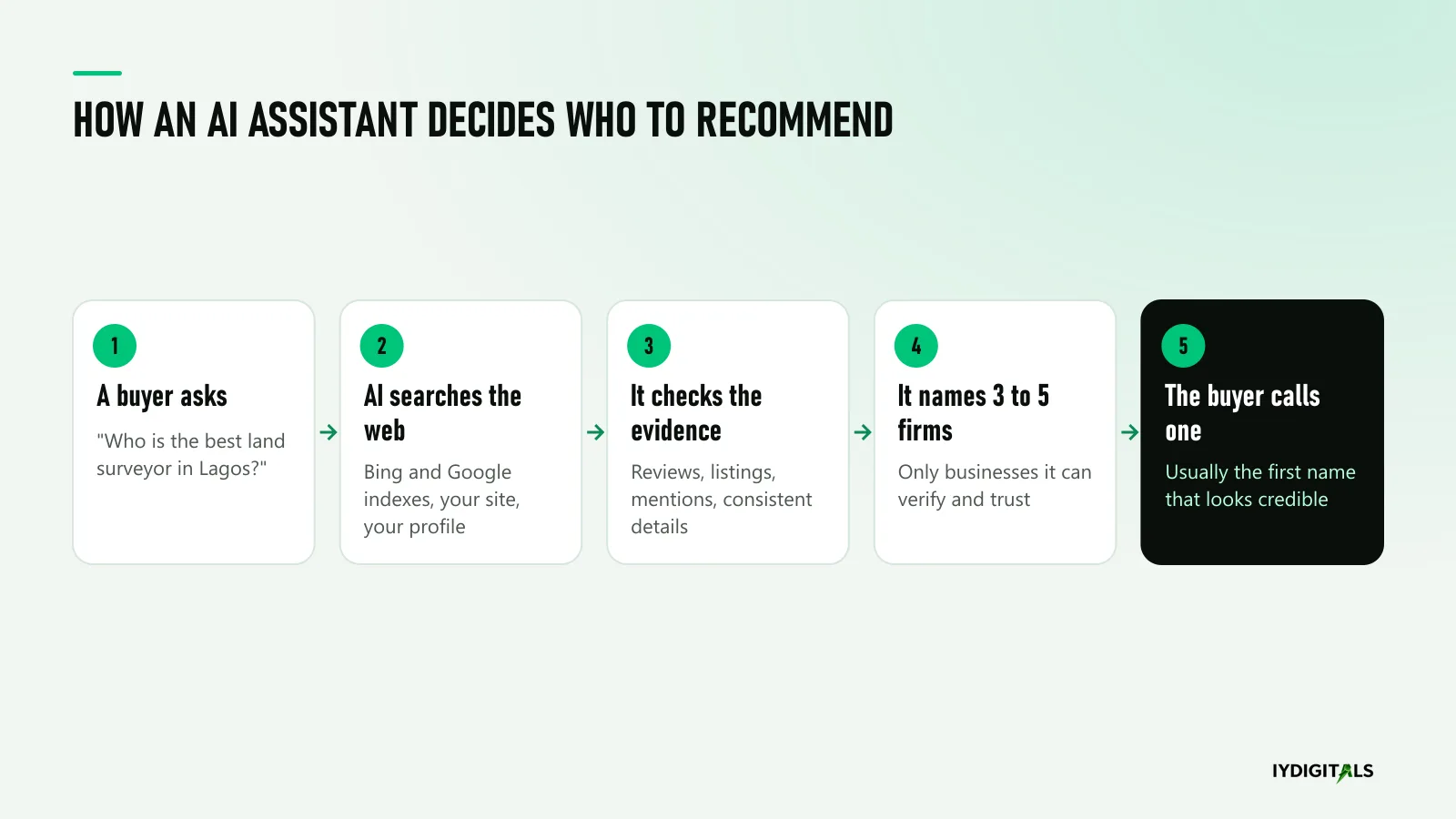
So the question to ask isn’t “why does AI like them more?” It is “what does the web say about them that it doesn’t say about us?”
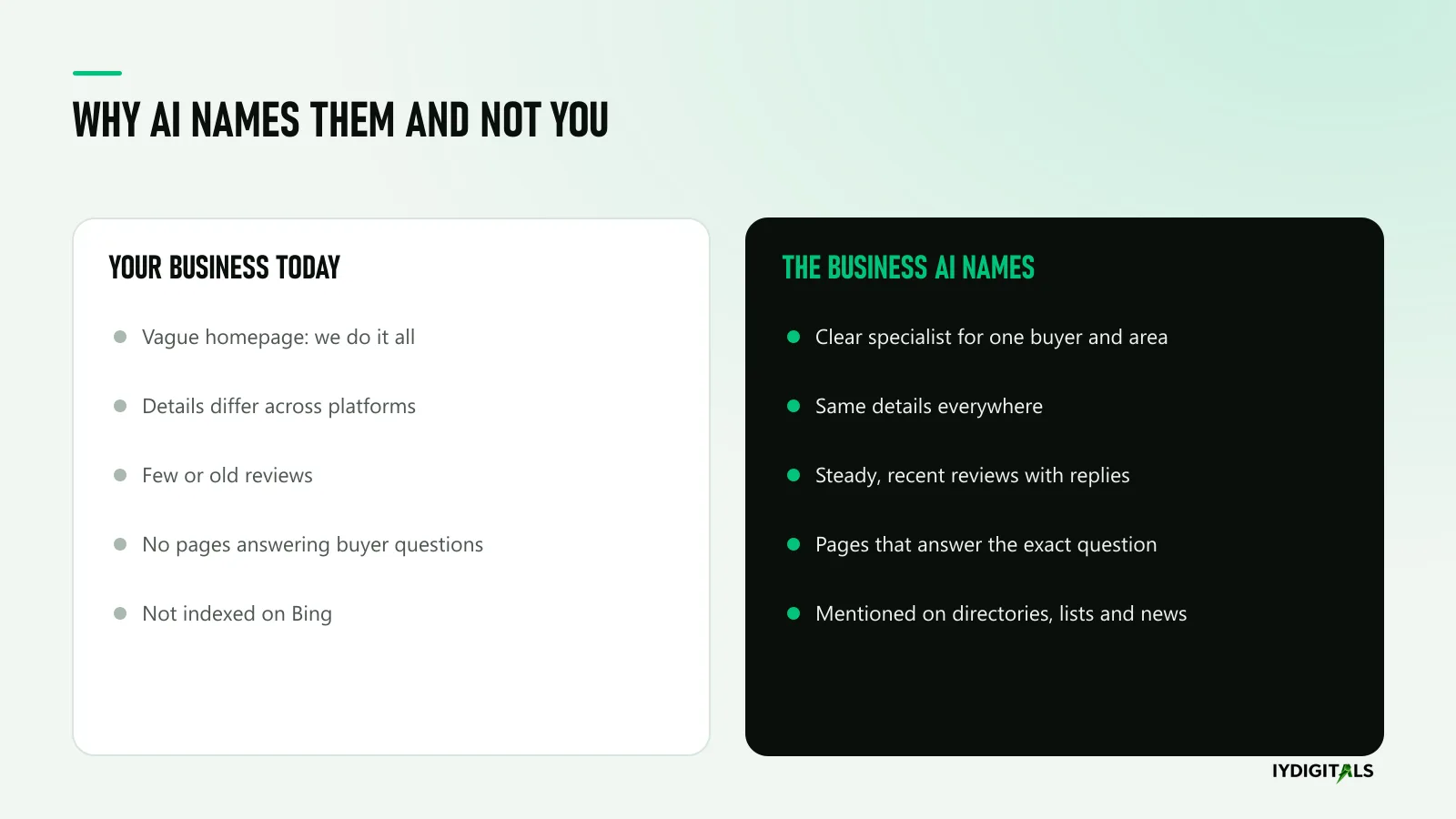
The seven reasons
1. They are clearer about what they do, for whom and where
If your homepage says “we provide innovative solutions for all your needs” and your competitor’s says “registered land surveyors in Ikeja, Lagos, with drone mapping”, the assistant knows exactly when to recommend them and has no idea when to recommend you. Specialists get named. Generalists get skipped.
Fix: say plainly, in the first lines of your homepage and each service page, what you do, who it is for and which areas you serve.
2. Their details are consistent everywhere
An assistant pulling information from your website, Google Business Profile, Facebook page and three directories wants them all to agree.
If your address, phone number or even your business name differ between them, the assistant can’t be sure it is looking at one business.
Fix: make your name, address, phone number and description identical everywhere they appear, and update or remove old listings.
3. They have more, and more recent, reviews
For local and service businesses, reviews are one of the strongest trust signals. A competitor with steady, recent reviews and replies looks active and trusted.
A business with a handful of reviews from three years ago looks uncertain.
Fix: ask every satisfied client for a review, make it easy with a direct link, and reply to every review. Never buy reviews or offer rewards for them.
Our guide to getting calls from Google Maps covers reviews and the rest of your profile.
4. They have pages that answer the exact question
When a buyer asks “how much does a land survey cost in Lagos?” or “which estate agents in Lekki handle shortlets?”, assistants look for pages that answer that question directly.
If your competitor has a page that does and you don’t, they get quoted.
Fix: publish pages and guides built around the questions your buyers actually ask, with the answer in the first paragraph.
5. They are indexed on Bing, not just Google
ChatGPT and Microsoft Copilot rely heavily on Bing’s index. A business that has only ever thought about Google may be partly invisible to them.
Fix: verify your site in Bing Webmaster Tools, submit your sitemap, switch on IndexNow and claim your business on Bing Places.
6. Other websites talk about them
Assistants trust what others say about a business more than what the business says about itself.
If your competitor appears on industry directories, “best of” lists, partner sites or in the news, and you don’t, the assistant has more independent evidence for them.
Fix: get listed accurately on the directories and platforms that rank for your category in your city, and earn genuine mentions through partners, associations and media.
7. Their website is easy for machines to read
Some websites hide their content behind slow scripts, images of text or pages that barely load on mobile data.
Others include structured data that states the business type, address, services and opening hours in a format machines understand.
Fix: make sure your key information is written as text on fast-loading pages, and add business structured data to your site.
An example: two interior design studios in Lekki
To see how this plays out, imagine two interior design studios in Lekki of similar size and quality. A homeowner asks ChatGPT, “Who are the best interior designers in Lekki for a new apartment?”
The first studio has a beautiful Instagram page and a website whose homepage says “Creative spaces for modern living”.
There is no mention of Lekki, no list of services and no project pages.
Its Google profile has six reviews, the newest from two years ago, and the phone number on the profile differs from the one on Instagram.
The second studio’s homepage says “Interior design for new homes and apartments in Lekki, Ikoyi and Victoria Island”.
It has a page for each service (full apartment design, kitchen and wardrobe design, staging for shortlets), a project page for each completed home with photos and the area, a Google profile with a steady stream of recent reviews, and a mention in a local “best interior designers in Lagos” article.
The assistant names the second studio, not because its work is better, but because every piece of evidence it finds points the same way: who they serve, where, what they do and that real clients are happy.
The first studio isn’t being judged and rejected; it is simply not being found.
What to publish this month
If your business is the one being overlooked, these four pages and updates usually close the biggest gaps fastest:
- A rewritten homepage opening. One sentence saying what you do, for whom and where, followed by your strongest proof.
- A page for your main service in your main area. Built around the exact question buyers ask, with the answer in the first paragraph.
- A results or projects page. Real work, with the client type, the area and what changed, using only facts you can stand behind.
- An updated Google Business Profile. Correct category, every service, new photos and a review request sent to your last ten happy clients.
Then check back after a few weeks. Our guide to checking whether AI assistants mention your business shows how to track the change, and GEO vs SEO explains how this work fits with ordinary search.
What to fix first
You don’t need to fix everything at once. In our experience, the fastest wins usually come in this order:
- Clarity and consistency. A clear description of what you do and identical details everywhere. This alone can change how assistants describe you.
- Google Business Profile optimisation and reviews. Especially for local searches, where the map often decides who gets the call.
- Bing indexing. Quick to fix and often overlooked.
- Pages for the questions buyers ask. Start with the two or three questions that come up on every sales call.
- Mentions on other websites. The slowest to build, and the hardest for competitors to copy once you have them.
A 30-minute competitor audit
You can find most of the reasons your competitor is winning in half an hour, with nothing more than a phone and a notebook.
- Ask the questions your buyers ask (5 minutes). Run three or four buyer prompts in ChatGPT, Perplexity and Google, such as “best [service] in [area]” and “who should I use for [problem] in [city]”. Note who is named and in what order.
- Collect the sources (5 minutes). Perplexity and Google’s AI Overviews show the websites they quoted. ChatGPT often does too when it searches. List every source that mentions your competitor.
- Compare the homepages (5 minutes). Read the first lines of your homepage and theirs. Which one says more clearly what the business does, for whom and where?
- Compare the map listings (5 minutes). Look at both Google Business Profiles: categories, number and age of reviews, photos, recent posts and whether the details match each website.
- Compare the answers (5 minutes). For two questions your buyers ask often, check whether each business has a page that answers them directly.
- Check Bing (5 minutes). Search both business names on Bing. If your competitor appears and you don’t, that alone can explain a lot of ChatGPT and Copilot answers.
By the end, you will usually have three to five specific gaps. Those are your to-do list, in the order they are likely to matter.
Ire-Ayo Crown Foods, a snack manufacturer in Ibadan, closed those gaps. Today, when someone asks Google for the best Nigerian snack manufacturer in Ibadan, its AI Overview opens with Ire-Ayo’s name.
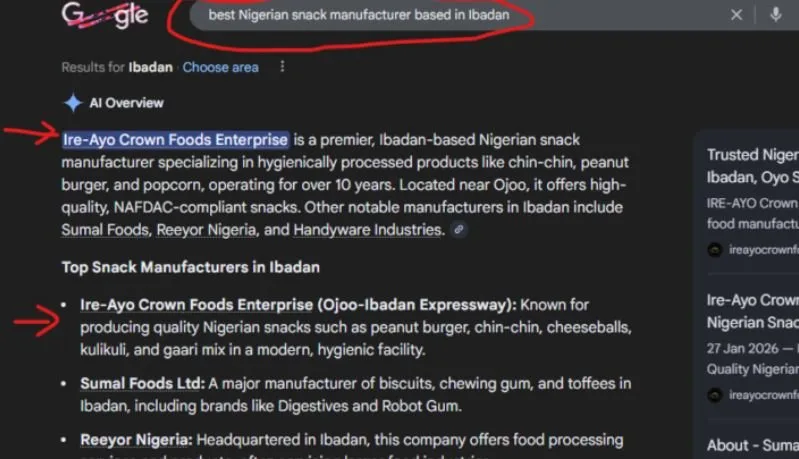
If you would rather have someone find and close the gaps for you, that is what we do at IYDigitals.
Read how to get your business recommended by ChatGPT in Nigeria, see how AI search brings in buyers, or look at results for founders like you.
Common questions
Is my competitor paying to be recommended by ChatGPT?
Usually not. ChatGPT now offers ads in some markets, including Nigeria, but these are labelled as sponsored. Organic recommendations come from the evidence assistants find about a business on the web, not from payment.
Can I find out why AI chose my competitor?
Partly. Ask the same question in ChatGPT, Perplexity or Google and look at the sources quoted in the answer. Those are the websites the assistant relied on. Compare what they say about your competitor with what exists about you.
My business is better than my competitor's. Why doesn't AI know that?
AI assistants can only judge what is written about you online. If your competitor's strengths are clearly documented and yours aren't, the assistant will favour them.
Better service needs to be visible as evidence: reviews, results, detailed pages and mentions.
How long does it take to overtake a competitor in AI answers?
For a specific service in a specific area, often weeks once the main gaps are fixed. For broad, competitive categories, months. Track the same prompts monthly to see when the answer changes.

Visibility & Conversion Strategist