How to get more genuine Google reviews in Nigeria (without breaking the rules)
Want more buyers and sales from AI search, without doing the work? Let the IYDigitals team handle it. Talk to an expert now →

On this page
Ask most Nigerian business owners why they don’t have more Google reviews and you will hear the same answer: “Our customers are happy, they just don’t leave reviews.” It’s true.
Most satisfied customers never think to write one. They tell a friend, they come back, they pay their invoice on time. But online, where new customers decide, that goodwill is invisible.
Reviews are now one of the first things people check before they call a business, and one of the strongest signals Google and AI assistants use to decide which businesses to show and recommend.
The good news is that a steady flow of genuine reviews doesn’t need tricks. It needs a simple routine that you actually follow.
This guide shows you the routine, the rules you must not break and how to reply in a way that wins the next customer.
Why reviews matter more than ever
- They decide the comparison. On Google Maps, people see three businesses side by side. Recent reviews are usually what tips the decision.
- They affect where you appear. Google says prominence, including reviews, is part of how it ranks local results.
- They feed AI answers. When someone asks Google’s AI Mode or ChatGPT for “a reliable laundry in Ikeja”, assistants look at what customers say. Read why AI recommends your competitor and not you.
- Recency matters. Twenty reviews from three years ago look less convincing than ten from the last three months. A steady flow beats a one-off push.
The rules you must not break
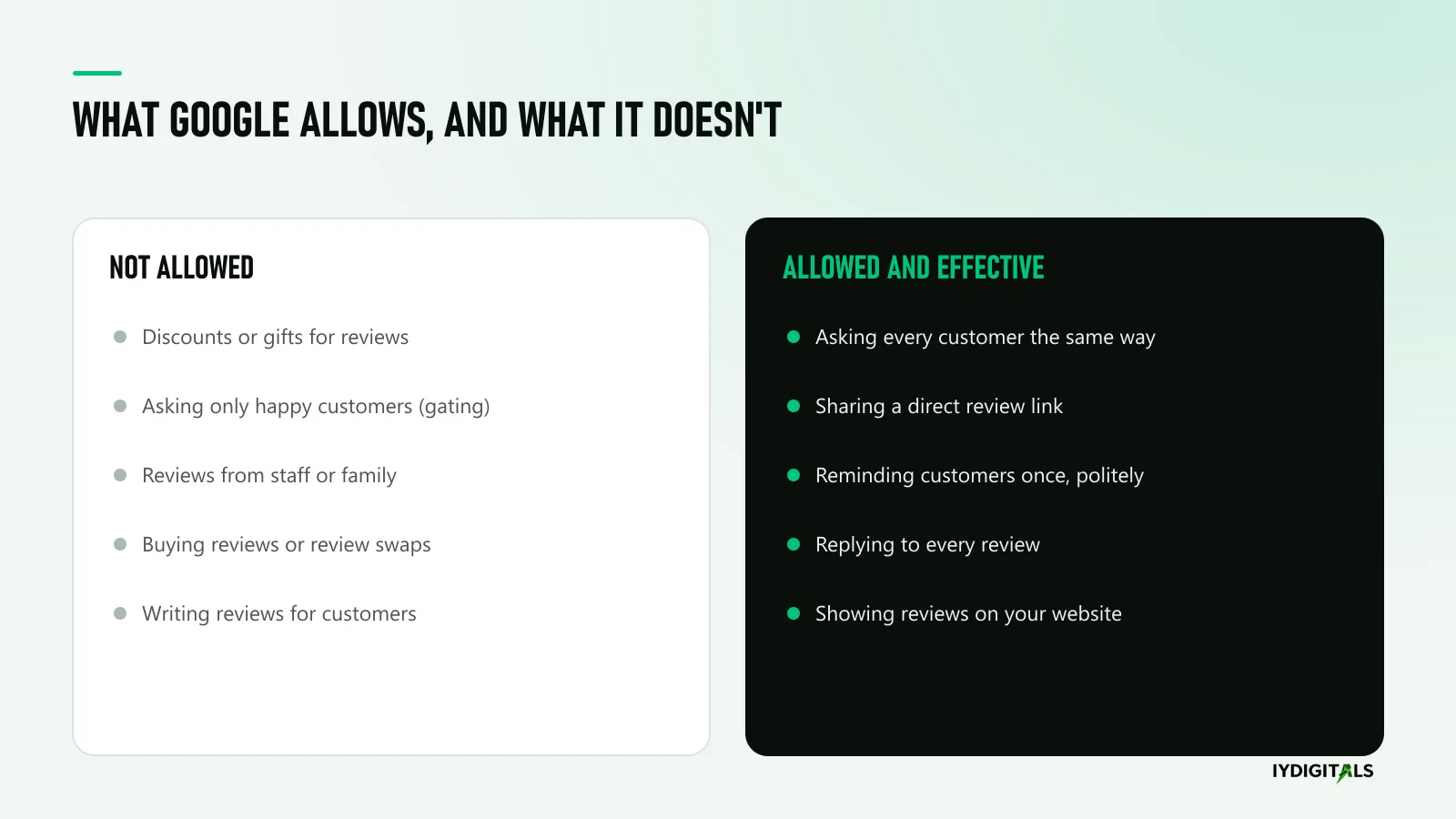
Google’s policies on reviews are strict, and enforcement has increased. Breaking them can lead to reviews being removed, new reviews being blocked for a period, or warnings shown on your profile. Never:
- Offer anything in exchange for a review. No discounts, airtime, gifts, free services or entry into a draw, whether you ask for a positive review or “any review”.
- Ask only happy customers. Picking out the customers you expect to be positive, sometimes called review gating, isn’t allowed. Ask everyone the same way.
- Use staff, family or friends. Reviews from people with a conflict of interest are against the rules, including reviews from employees on your own business.
- Buy reviews, or swap them. Paid review services and “I’ll review you if you review me” groups are easy for Google to detect.
- Write reviews for customers. Even if the customer agrees, a review must be their own words from their own account.
These rules protect you as well. A profile full of suspicious five-star reviews makes careful buyers more nervous, not less.
A routine that keeps working
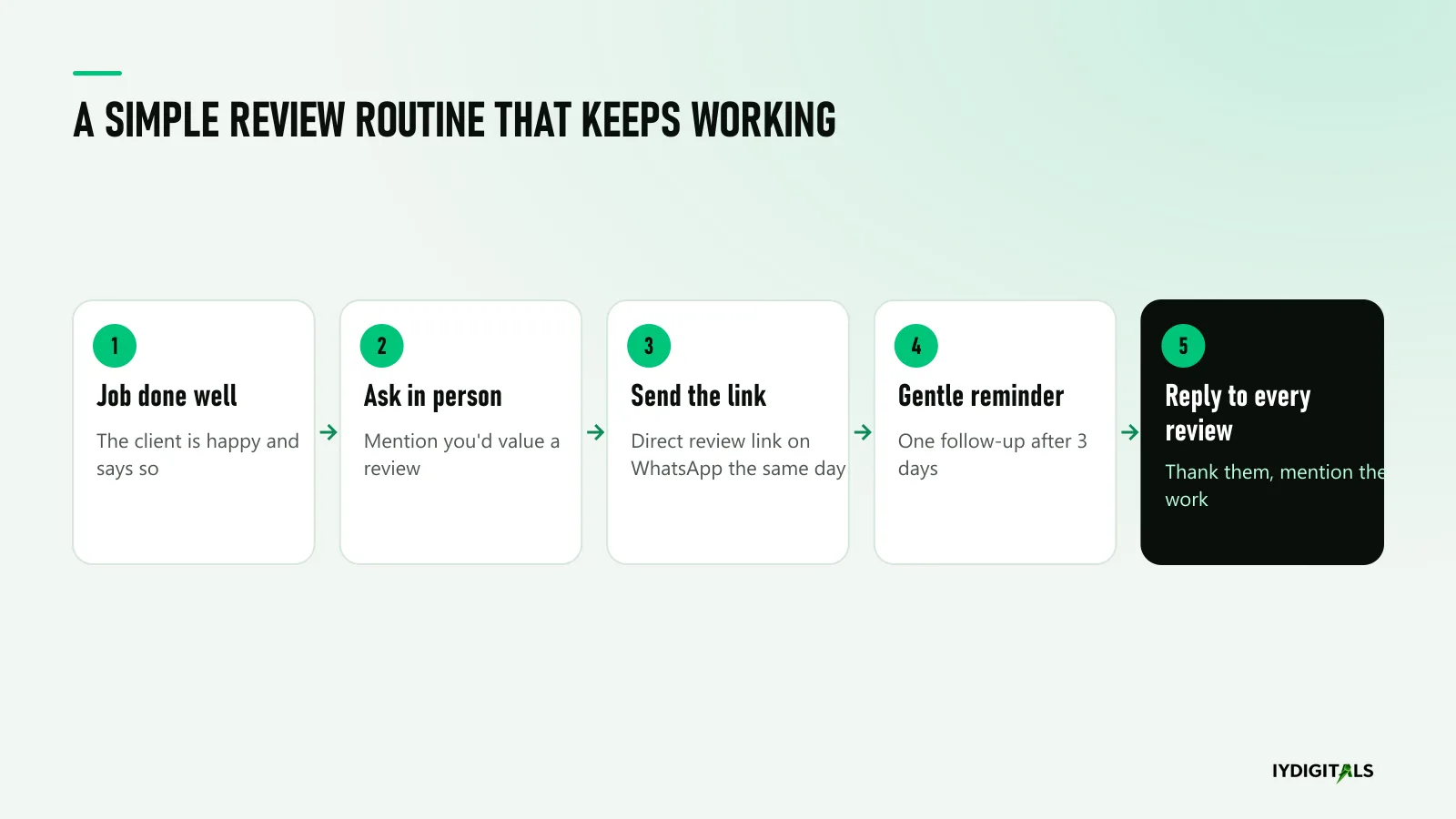
1. Get your direct review link
In your Google Business Profile, find the option to ask for reviews. Google gives you a short link that opens the review box directly, and a QR code. Save both.
Every extra tap between your customer and the review box loses people.
2. Ask in person, at the right moment
The best time to ask is the moment a customer is happiest: when the survey report is delivered, the apartment is handed over, the case is resolved, the order arrives perfect or the patient thanks the doctor.
A simple, honest line works: “We’re a growing business and reviews really help new customers find us. Would you mind leaving us a short Google review?”
3. Send the link on WhatsApp the same day
Most Nigerian customers live on WhatsApp. Send a short message with the link while the experience is fresh. For example: “Thank you for choosing us today.
If you have a minute, a short Google review would mean a lot: [link].” Keep it personal, use their name and mention what you did for them.
4. Remind once, politely
Many people intend to review and forget. One gentle reminder after a few days is fine. More than one starts to feel like pressure.
5. Make it part of the job, not a campaign
Add the review request to your checklist for every completed job, delivery or appointment, and give one person responsibility for it.
A business that asks every customer, every week, quietly overtakes competitors who did one push last year.
Other places to ask
- On receipts and invoices: a line with the short link or QR code.
- At your counter or reception: a small sign with the QR code.
- In your email signature and after-sales emails.
- For clients abroad: diaspora buyers and international clients review just as readily if you send the link. Their reviews also reassure future buyers abroad.
Reviews from corporate and high-value clients
Businesses that serve companies, government agencies or wealthy individuals often find reviews hardest to get. Senior people are busy and some organisations have rules about public endorsements. A few things help:
- Ask the person you worked with most closely, not the most senior person. A project lead or office manager is often happy to write a few lines.
- Make it easy. Send the direct link and a one-line reminder of what you delivered, so they don’t have to think about what to say. Never write the review for them.
- Respect a no. If their organisation doesn’t allow reviews, ask instead whether you can name them as a client on your website or in a case study.
How to reply to reviews
Replies are read almost as closely as the reviews. They show a real, responsive business behind the profile.
Positive reviews: thank the person by first name, mention what you did for them and keep it short. “Thank you, Ade.
We’re glad the boundary survey for your Ibeju-Lekki plot was ready on time.
Good luck with the build.” That also helps describe your services in your customers’ own context.
Negative reviews: reply calmly, without arguing or revealing private details. Acknowledge the experience, apologise where it is fair, and invite them to contact you directly to put it right.
Future customers judge you by how you handle complaints, not by whether you have any.
Fake or abusive reviews: if a review breaks Google’s policies, report it from your profile. If it doesn’t, reply professionally and let your other reviews carry the weight.
In regulated professions such as law and healthcare, be extra careful: never confirm that someone is a client or patient, or discuss their matter, in a public reply.
Reply examples you can adapt
A five-star review with detail: “Thank you, Funmi. It was a pleasure helping you find the right apartment in Lekki Phase 1 so quickly. We wish you a happy move, and we’re always here if you need anything.”
A five-star review with no text: “Thank you for the five stars, Chinedu. We’re glad you were happy with the service and look forward to seeing you again.”
A mixed review: “Thank you for the feedback, Hauwa. We’re glad the final result met your expectations, and we’re sorry the delivery took longer than promised.
We’ve changed how we schedule deliveries in Abuja so it doesn’t happen again.”
A negative review: “We’re sorry to read this, and we’d like to understand what went wrong. Please contact us on [number] or [email] so we can look into it directly and put it right.”
Keep each reply specific and short. Avoid copying the same reply onto every review; customers notice, and generic replies add nothing.
Mistakes to avoid
- Asking for reviews in bursts. Fifty reviews in one week followed by nothing for six months looks unnatural and fades quickly. A few every week is better.
- Getting everyone to review from your office Wi-Fi. Asking customers to review on a shared tablet or your premises’ network can look suspicious. Let them review on their own phones, in their own time.
- Arguing in public. Even when a review is unfair, a defensive reply hurts you more than the review.
- Ignoring old reviews. It is never too late to reply. Start with the most recent and work back.
- Forgetting other platforms. Google matters most for local searches, but reviews on Facebook, industry platforms and, for international clients, platforms such as Trustpilot or Clutch also feed what AI assistants know about you.
- Not using your reviews. Show your best recent reviews on your website, near the services they mention, so visitors see proof where they decide.
What good looks like
There is no magic number, but a useful target is to have more recent reviews than the businesses that appear above you for your main search, and to keep them coming every month.
Check the top three for your main service and area, count their reviews from the last three months, and aim to beat that.
Our guide to why your Google profile isn’t bringing calls explains how reviews fit with the rest of your profile, and turning Maps views into calls covers the full set of fixes.
Reviews are one part of the work we do for service businesses and property founders in Lagos and Abuja. See our client results or book a free strategy call.
Restaurants can read how Lagos restaurants increase orders through local search.
Common questions
Can I give a discount to customers who leave a review?
No. Google's policies prohibit offering money, discounts, gifts or anything else in exchange for reviews, whether positive or negative. It can lead to reviews being removed and restrictions on your profile.
Where do I find my Google review link?
In your Google Business Profile, look for the option to ask for reviews or get more reviews. It gives you a short link and a QR code you can share on WhatsApp, print on receipts or show at your counter.
Can I ask only my happiest customers for reviews?
No. Asking only customers you expect to be positive is called review gating, and Google doesn't allow it. Ask every customer the same way. Good service will take care of the rest.
What should I do about a fake or unfair review?
If it breaks Google's policies, for example spam, a conflict of interest or offensive content, report it from your profile.
If it is simply negative, reply calmly and professionally, offer to resolve it, and let your other reviews speak for you.

Visibility & Conversion Strategist