Meta vs Google ads for property leads in Lagos
Want more buyers and sales from AI search, without doing the work? Let the IYDigitals team handle it. Talk to an expert now →
On this page
Almost every Lagos developer and estate agent eventually asks the same question: should we put our ad budget into Facebook and Instagram, or into Google? Both promise leads.
Both can deliver them. And both can burn through money with little to show for it if they are used for the wrong job.
The honest answer is that they do different jobs.
This guide compares Meta ads and Google ads for property in Lagos, explains when each works best and shows how to judge them on what matters: serious buyers, inspections and deposits.
The core difference
Google ads reach people who are already searching: someone typing “land for sale in Ibeju-Lekki” or “3 bedroom flat for sale in Lekki Phase 1”.
They have a need and are looking now. Meta ads reach people who aren’t searching, but who match a profile: location, age, interests, behaviour.
You are interrupting their scrolling with something you hope they want.
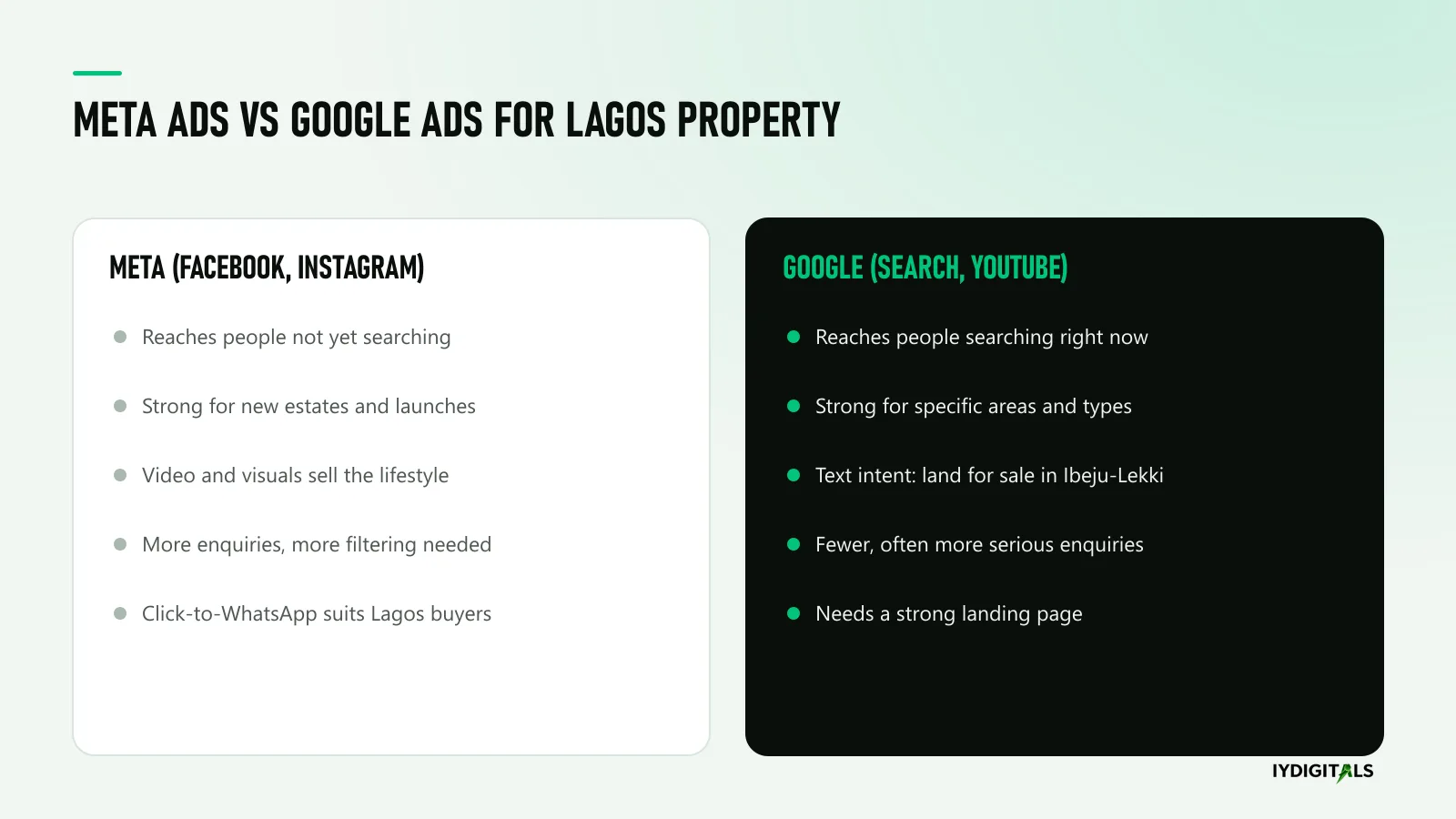
Neither is better in general. Meta creates interest; Google captures interest that already exists. Most property businesses need both, in proportions that depend on what they are selling.
When Meta ads work best
- New estates and launches. Nobody is searching for an estate they have never heard of. Meta puts it in front of people who might want it.
- Lifestyle-led property. Shortlets, premium apartments and estates with a strong visual story. Instagram and Facebook are built for images and video.
- Diaspora audiences. Meta lets you reach Nigerians abroad by location and interest, which is hard to do with search alone.
- Click-to-WhatsApp. Many Lagos buyers would rather message than fill in a form. Ads that open a WhatsApp chat directly often bring more conversations.
- Retargeting. Showing ads to people who have already visited your website or engaged with your content, reminding them to come back.
The trade-off: Meta tends to bring more enquiries, and more of them are casual: people curious about prices, dreaming rather than buying, or far from ready. You need a fast, well-designed follow-up process to filter them.
When Google ads work best
- Specific areas and property types. “Plots in Sangotedo”, “duplex for sale in Ajah”, “shortlet in Victoria Island”. The searcher has already told you what they want.
- Established products. Estates or areas people already know and search for by name.
- Brand protection. Appearing at the top when people search your company or estate name, so competitors don’t take the click.
- YouTube. Longer property tours and explainers, especially for diaspora audiences who research in depth.
The trade-off: Google usually brings fewer enquiries, but more of them are ready to act.
It depends heavily on a good landing page, because the searcher clicks through and decides in seconds whether you match what they searched for.
Before you spend on either
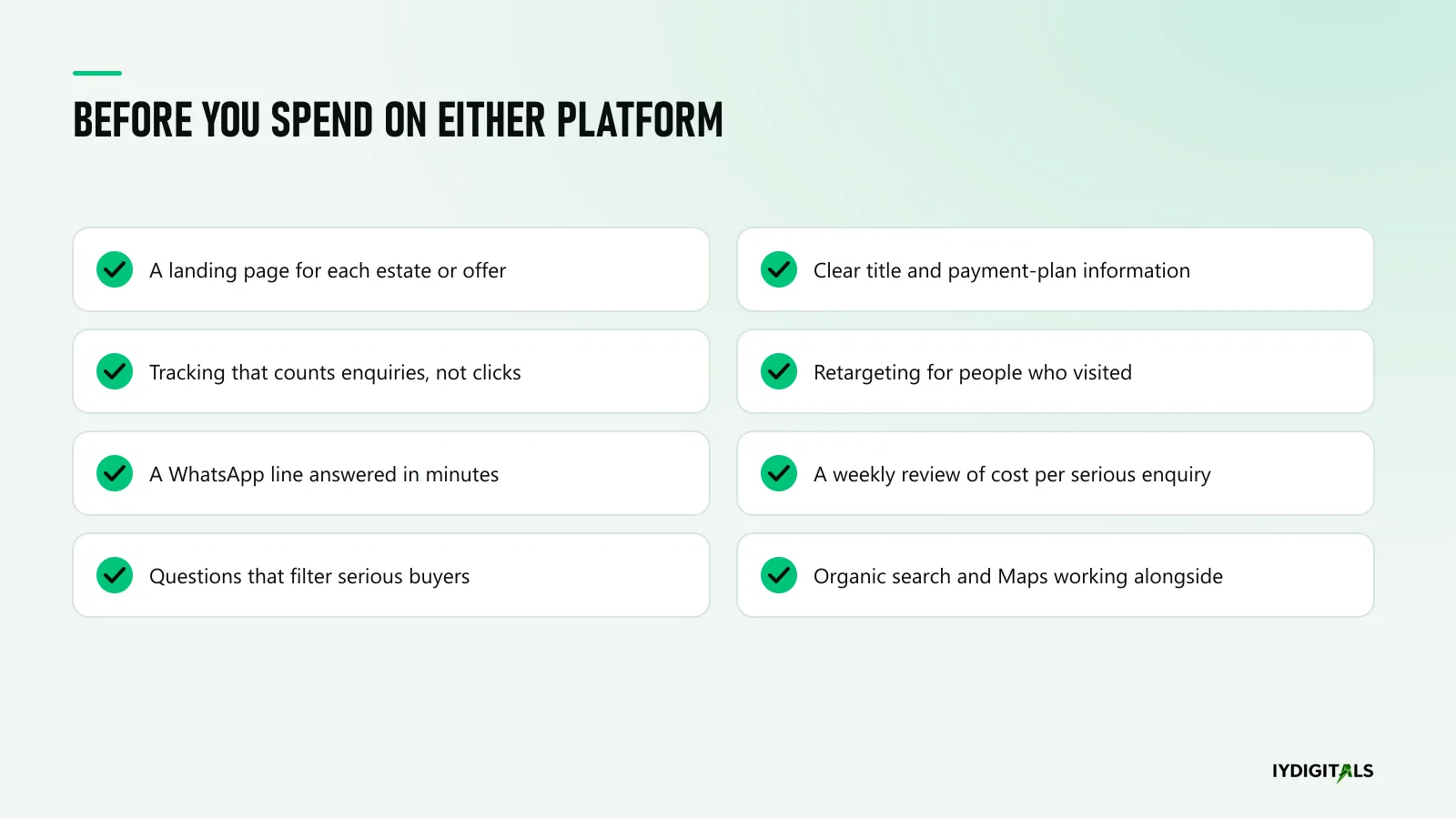
Most failed property ad campaigns don’t fail because of the platform. They fail because of what happens after the click.
- A landing page for each estate or offer. Location, title explained, payment plan, progress photos and one clear next step. Sending ad traffic to your homepage wastes it.
- Tracking that counts enquiries. Know which ad each enquiry came from. Clicks and likes aren’t results.
- A WhatsApp line answered in minutes. Paid enquiries go cold fast. Our guide to WhatsApp lead automation for property shows how to answer every enquiry in seconds.
- Questions that filter serious buyers. Budget, timeline, location preference and whether they are buying to live or invest, asked politely in the first exchange.
- Trust signals. Many people who see your ad will search your company before they reply. If your website, Google profile and reviews look weak, the ad’s work is undone. Read why property buyers don’t trust your website.
Setting up Meta ads properly
- Choose the right objective. If you want enquiries, optimise for leads or messages, not for reach or video views. The platform delivers what you ask for.
- Use real footage. Progress videos, short walk-throughs and real people outperform generic renders for trust. See our guide to AI video ads that bring enquiries.
- Add friction on purpose. A lead form with one or two qualifying questions, such as budget range and timeline, brings fewer but better enquiries.
- Separate audiences. Lagos residents and Nigerians abroad need different messages, times and offers. Run them as separate campaigns.
- Retarget. People who watched most of a video or visited the estate page are far warmer than a cold audience.
Setting up Google ads properly
- Bid on specific searches. Area plus property type (“plots for sale in Ibeju-Lekki”), estate names and your company name. Broad terms such as “property” waste money.
- Add negative keywords. Exclude searches such as “jobs”, “rent” (if you only sell), “free” and “course” that attract the wrong people.
- Match ad to page. The search, the ad and the landing page should all talk about the same thing. A searcher looking for land in Ibeju-Lekki should land on your Ibeju-Lekki estate page.
- Use call and WhatsApp extensions. Let people contact you straight from the ad.
- Protect your brand name. Competitors sometimes bid on well-known developers’ names. A small brand campaign keeps your own searches yours.
Judge them on the right number
The most common mistake is comparing platforms on cost per click or cost per lead.
A Meta campaign might deliver enquiries at a fraction of the cost of Google, but if hardly any become inspections, it is the more expensive channel.
Judge each platform on:
- Cost per serious enquiry: someone with a real budget and timeline.
- Cost per inspection booked: physical or video.
- Cost per deposit: the number that pays the bills.
Track those weekly. Give each platform enough time and budget to produce a meaningful number of enquiries before you decide. A few days of data says very little.
What happens after the enquiry
The platform debate often hides the real problem. Many Lagos property businesses generate reasonable numbers of enquiries from both platforms, then lose most of them in the first hour.
- Reply within minutes. An instant automated WhatsApp reply with the estate brochure, payment plan and a question about the buyer’s timeline, followed by a person within the hour.
- Qualify politely. Budget range, buying to live or invest, preferred area, when they want to buy. Ask naturally, not as an interrogation.
- Offer the next step. A physical inspection date, or a live video inspection for buyers abroad.
- Follow up on a schedule. Most buyers don’t decide on the first conversation. A planned sequence of helpful messages, such as a progress update, a buyer story or an answer to a common question, keeps you in the conversation. Our guide to follow-up automation explains how.
- Record the source. Tag every enquiry with the platform and ad it came from, so you can see which ones produce inspections and deposits.
Fix this, and both platforms suddenly look better.
Common myths
- “Facebook leads are all time-wasters.” Many are early-stage, not useless. With good filtering and follow-up, some become your best buyers months later.
- “Google is too expensive for Nigeria.” For specific, high-intent searches, the cost per serious buyer can be competitive. Broad, poorly targeted campaigns are what make Google expensive.
- “More leads is always better.” Not if your team can’t respond to them. A smaller number of well-handled enquiries usually produces more sales.
- “Ads replace SEO.” Ads rent attention; organic search and AI visibility build an asset. The strongest developers use ads to accelerate, not to replace, being found.
A practical starting mix
- Launching a new estate: lead with Meta to build awareness, use retargeting to bring people back, and run Google ads on the estate’s name and area as searches start to appear.
- Selling in a well-known area: lead with Google for area and property-type searches, with Meta retargeting and diaspora campaigns alongside.
- Shortlets: Instagram for visual reach, Google for “shortlet in [area]” searches, and a strong focus on direct repeat bookings. See our guide on winning more direct shortlet bookings.
A note on budgets
We don’t publish cost-per-click figures here, because they vary widely by area, audience, season and how well a campaign is built, and numbers quoted online are usually from other countries.
The reliable way to know is a controlled test: a fixed budget on each platform, the same estate, the same landing page and the same follow-up process, measured over several weeks on serious enquiries and inspections. Start small, keep what works and scale it.
Don’t forget what you don’t pay for
Ads stop the moment you stop paying.
Organic visibility, meaning your website ranking on Google, your profile on Google Maps and your company being named by AI assistants, keeps bringing buyers without a cost per click, and it makes every ad work harder because buyers who search you find something credible. The developers with the lowest cost per deposit usually combine both.
If you also want to make better ads, read our guide to AI video ads that bring enquiries. At IYDigitals we help Lagos property founders win more serious buyers from search, AI and ads. See how we work with property businesses or our client results.
Common questions
Which is cheaper for property leads in Lagos, Meta or Google?
It varies by audience, area, offer and how well the campaign is set up, so test rather than assume. Meta often produces cheaper enquiries; Google often produces more ready ones.
Compare cost per serious enquiry and per inspection booked, not cost per lead.
Do Click-to-WhatsApp ads work for property?
Often, because many Lagos buyers prefer WhatsApp to forms. The risk is a flood of casual messages, so prepare an automated first reply that answers common questions and asks qualifying questions before a person takes over.
Should I run ads if my website is weak?
Fix the basics first. Many people who see an ad search your company before they enquire. A weak website, missing Google profile or no reviews can waste much of your ad spend.
How long should we test before deciding?
Give each platform enough time and budget to produce a meaningful number of enquiries, usually several weeks, and judge it on serious enquiries and inspections booked, not on the first few days.

Visibility & Conversion Strategist