Why property buyers don’t trust your website, and the 9 fixes
Want more buyers and sales from AI search, without doing the work? Let the IYDigitals team handle it. Talk to an expert now →
On this page
Your website gets visitors. Your ads send people there, agents share the link, and people search your company name after seeing a billboard. Yet very few of them call.
The few who do ask questions the website should already have answered. Somewhere between arriving and calling, most buyers decide not to trust you enough to make contact.
It isn’t personal.
Nigerian property buyers have learnt to be careful, and BusinessDay has quoted industry voices saying credibility is now the hardest thing to build in Nigerian real estate.
Your website is where that credibility is won or lost. Here is why buyers don’t trust most property websites, and nine fixes that change it.
Why buyers distrust property websites
Buyers have seen it all: beautiful renders of estates that were never built, companies that disappeared, listings for properties that didn’t exist.
So they read a property website looking for reasons to doubt. The usual ones are easy to spot:
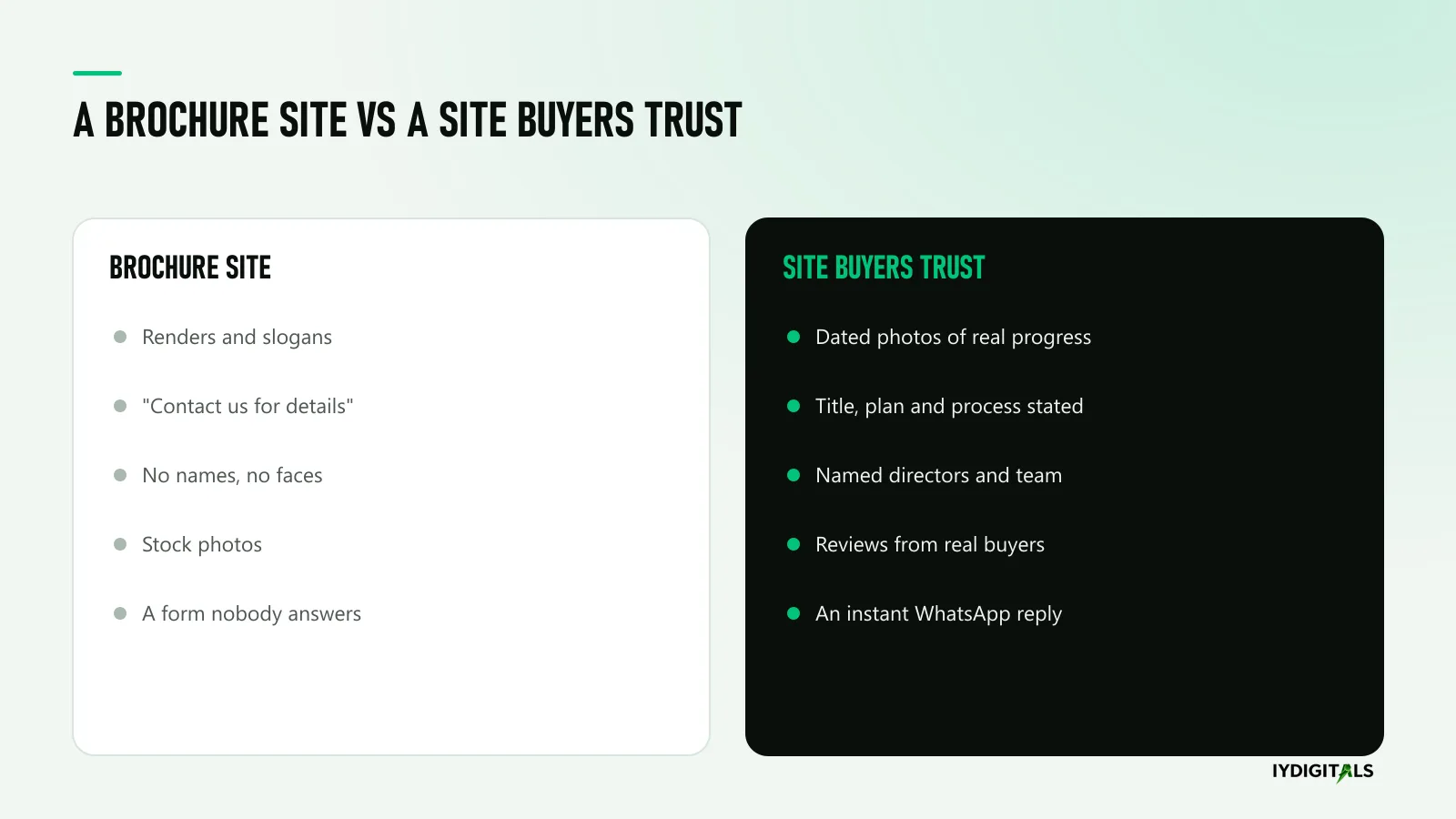
- Renders and slogans, no proof. “Luxury living redefined” tells a buyer nothing.
- No names or faces. Who runs this company? Who will I deal with?
- “Contact us for details”. Title, payment plan and location hidden behind a form.
- Stock photos. Buyers recognise them, and they wonder what you are hiding.
- A contact form nobody answers. Silence after the first message ends most conversations.
The nine fixes
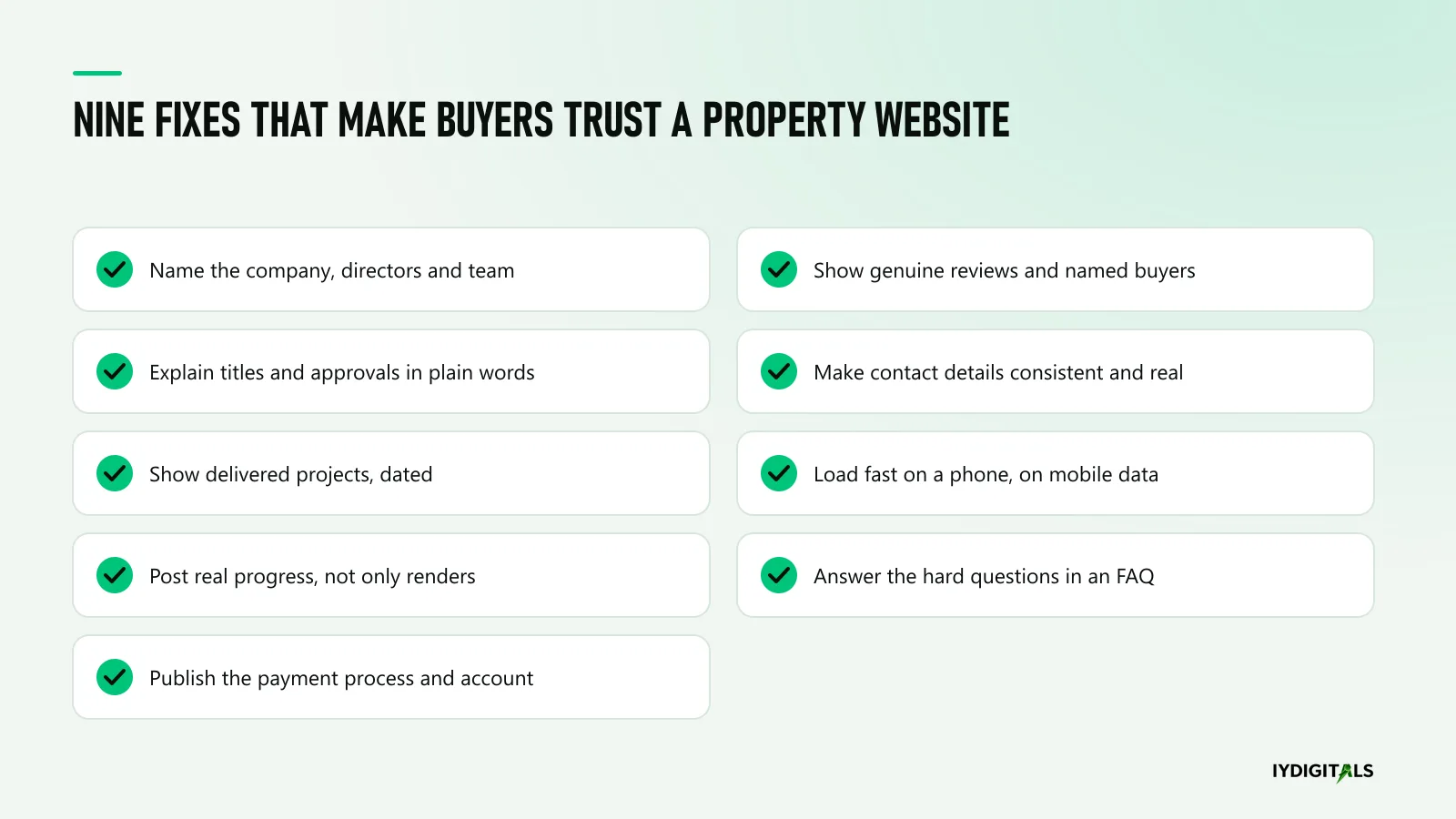
1. Name the company, the directors and the team
Your registered company name and registration number, the directors, and the people buyers will speak to, with real photos and roles. Buyers want to know who is accountable. A company with visible people feels safer than a logo.
2. Explain titles and approvals in plain words
For every estate: what title the land carries, what approvals the project has, what the buyer receives and when. Write it for someone who has never bought land before.
Invite buyers to have it verified by their own lawyer. Only state what you can prove.
3. Show what you have already delivered
A delivered-projects page with real photos, handover dates and, where possible, residents or buyers who agreed to be named. Nothing reassures an off-plan buyer like proof that you have finished before.
4. Post real progress, not only renders
A progress section for every current project, updated monthly with dated photos and short videos from the site. Renders show the plan. Progress shows the plan is happening.
5. Publish your payment process and account
The deposit, the instalment schedule, what happens with late payments, how receipts are issued and the company account name.
State plainly that your staff will never ask buyers to pay a personal account. This protects buyers from impersonators and shows you have nothing to hide.
6. Show genuine reviews and named buyers
Embed or link to your Google reviews, and with permission feature short stories from buyers, especially buyers abroad and buyers who have received their keys. Anonymous five-star quotes with no names convince nobody.
7. Make contact details consistent and real
The same company name, office address, phone number and WhatsApp number on your website, Google, Instagram, portals and brochures. A real office on Google Maps that matches the website. Mismatches are one of the clearest warning signs buyers look for.
8. Load fast on a phone, on mobile data
Most buyers visit on a phone, many on mobile data. Huge drone videos and uncompressed images make pages crawl, and buyers leave before the page appears. Compress images, host videos sensibly and test the site on a mid-range phone.
9. Answer the hard questions in an FAQ
Can I get a refund? What if the project is delayed? How do I inspect from abroad? Is the land under any dispute?
A direct, honest FAQ answers the questions buyers are afraid to ask, and gives AI assistants accurate material when buyers ask them about you.
Read what happens when buyers ask AI “is this developer legit?”.
What to put on every estate page
The estate page is where most of these fixes come together. A buyer who lands on it should find, without scrolling for long:
- The estate’s exact location, a map and how to get there from landmarks buyers know.
- The title, the approvals held and how a buyer’s lawyer can verify them.
- Plot or unit sizes, and a starting price or range with the date it was last updated.
- The payment plan: deposit, instalments and the company account payments go into.
- Infrastructure in place today, and what is planned, with dates.
- Dated progress photos and a short site video.
- How to book an inspection, in person or by live video.
- Two or three reviews or stories from people who have bought in that estate.
An estate page like this does more selling than any brochure, because it answers the questions a buyer would otherwise need three phone calls to settle.
A worked example: the first screen
Most buyers decide whether to stay within the first screen of your homepage on a phone. Here is an illustrative before and after.
Before: a full-screen drone video that takes several seconds to load on mobile data, the words “Redefining Luxury Living” and a “Learn more” button.
After: a fast-loading photo of a delivered estate, a line that reads “Registered developer.
Two estates delivered in Ajah, a third under construction in Sangotedo”, a small row of trust markers (years in business, Google rating, “payments to our company account only”) and two buttons: “See our delivered estates” and “Book an inspection”.
The second version answers who you are, what you have done and what to do next before the buyer has scrolled. It is plainer, and it builds far more trust.
The same test applies to every estate page.
Open it on a phone and ask: within one screen, does a stranger know where the estate is, what title it carries, whether anything has been built yet and how to book an inspection?
If any of those needs a scroll, a click or a phone call, move it up.
Buyers in Lekki, Lugbe or Ibeju-Lekki are comparing several estates at once, and the page that answers fastest usually gets the visit.
Then make the next step easy
Trust gets the buyer ready to act. The website then needs to make acting easy: a visible WhatsApp button, a simple inspection booking (in person or by video), and a reply within minutes.
Buyers often contact several developers at once, and the first clear answer usually wins. See WhatsApp lead automation for property businesses for how to reply instantly, day and night.
The website is only part of it
Buyers don’t judge your website alone. They compare it with what they find on Google Maps, review sites, property portals and AI answers.
A trustworthy website with a missing Google profile, or inconsistent details elsewhere, still raises doubts.
The strongest developers make sure every place a buyer checks tells the same, verifiable story.
This is what we build for property founders, on the Lekki to Ajah corridor, in Abuja and beyond.
Common mistakes when fixing a property website
- Redesigning instead of adding proof. A new look with the same missing information changes nothing for a cautious buyer.
- Burying the trust pages. The About, delivered-projects and payment pages should be one tap from the menu, not hidden in the footer.
- Updating once. A progress page last updated eight months ago raises more doubts than no progress page at all.
- Overclaiming. “Government approved” or “C of O ready” must be precisely true. Buyers’ lawyers check, and AI assistants compare what you say with other sources.
- Forgetting the agents. If your agents send buyers to their own pages with different details, your website’s work is undone.
A 30-day trust plan
If you can’t fix everything at once, this order works for most developers:
- Week 1: write the About page with company details and named people, and publish the payment process with the company account warning.
- Week 2: add the delivered-projects page and the first dated progress update for each current project.
- Week 3: rewrite each estate page to the checklist above and add the FAQ.
- Week 4: compress images, test speed on a phone, make your details identical on Google and every listing, and set up instant WhatsApp replies.
After that, the ongoing work is small: a monthly progress update, and a review request to every new buyer.
A five-minute trust audit
- Open your website on your phone, on mobile data. How long does it take to load?
- Could a stranger find, within a minute, who runs the company, what title your main estate carries and how payments work?
- Is there any dated progress photo from the last two months?
- Do the phone number and address on the website match your Google profile exactly?
- Send a message through your own contact form. When does the reply arrive?
Every “no” is a buyer you are losing. IYDigitals helps property founders build websites and online presence that buyers trust.
See how we work with property businesses, or look at our client results. For agents, read how Lekki estate agents own the map results.
Common questions
Does a website really matter if most of our sales come from Instagram and agents?
Yes. Buyers who find you on Instagram or through an agent usually check your website before paying. A weak website quietly loses buyers you never hear from.
Should we publish prices on our property website?
Many buyers want at least a starting price or price range so they can qualify themselves. If prices change often, show a range and the date it was last updated. It saves your sales team from enquiries that were never going to buy.
Is it safe to publish our account details on the website?
Publishing the company account name and stating that payments only go to that account helps protect buyers from fraudsters impersonating you.
Many developers also publish a warning that staff will never ask for payment into a personal account.
How fast should a property website load?
As fast as possible on a mid-range phone using mobile data. Large videos and uncompressed images are the most common causes of slow property websites.

Visibility & Conversion Strategist