When buyers ask AI “is this developer legit?”: how to make sure the answer is accurate
Want more buyers and sales from AI search, without doing the work? Let the IYDigitals team handle it. Talk to an expert now →
On this page
A buyer in Houston has found an estate in Lekki she likes.
Before she sends a single message, she opens ChatGPT and types: “Is [developer] legit?” A few seconds later she has an answer. It might be confident and reassuring.
It might be vague: “I couldn’t find much information about this company.” It might repeat a complaint from a forum three years ago. Whichever it is, she will act on it.
This question, “is this developer legit?”, is now one of the most important searches in Nigerian property, and most developers have never seen their own answer.
This guide explains where AI answers about developers come from, and what you can do to make sure yours is accurate.
Why buyers ask AI first
Property buyers in Nigeria have good reasons to be careful. Stories of fake developers, disputed land and abandoned estates are common, and buyers abroad can’t easily visit.
Searching on Google means reading through pages of results. Asking an AI assistant gives a summary in seconds.
So more buyers, especially younger buyers and buyers abroad, now start with ChatGPT, Gemini, Copilot or Google’s AI Mode.
The buyer treats the answer as a neutral opinion. In reality, it is a summary of whatever the assistant could find. If the evidence about you is thin, the answer is thin. If the strongest evidence is a complaint, the complaint dominates.
Where the answer comes from
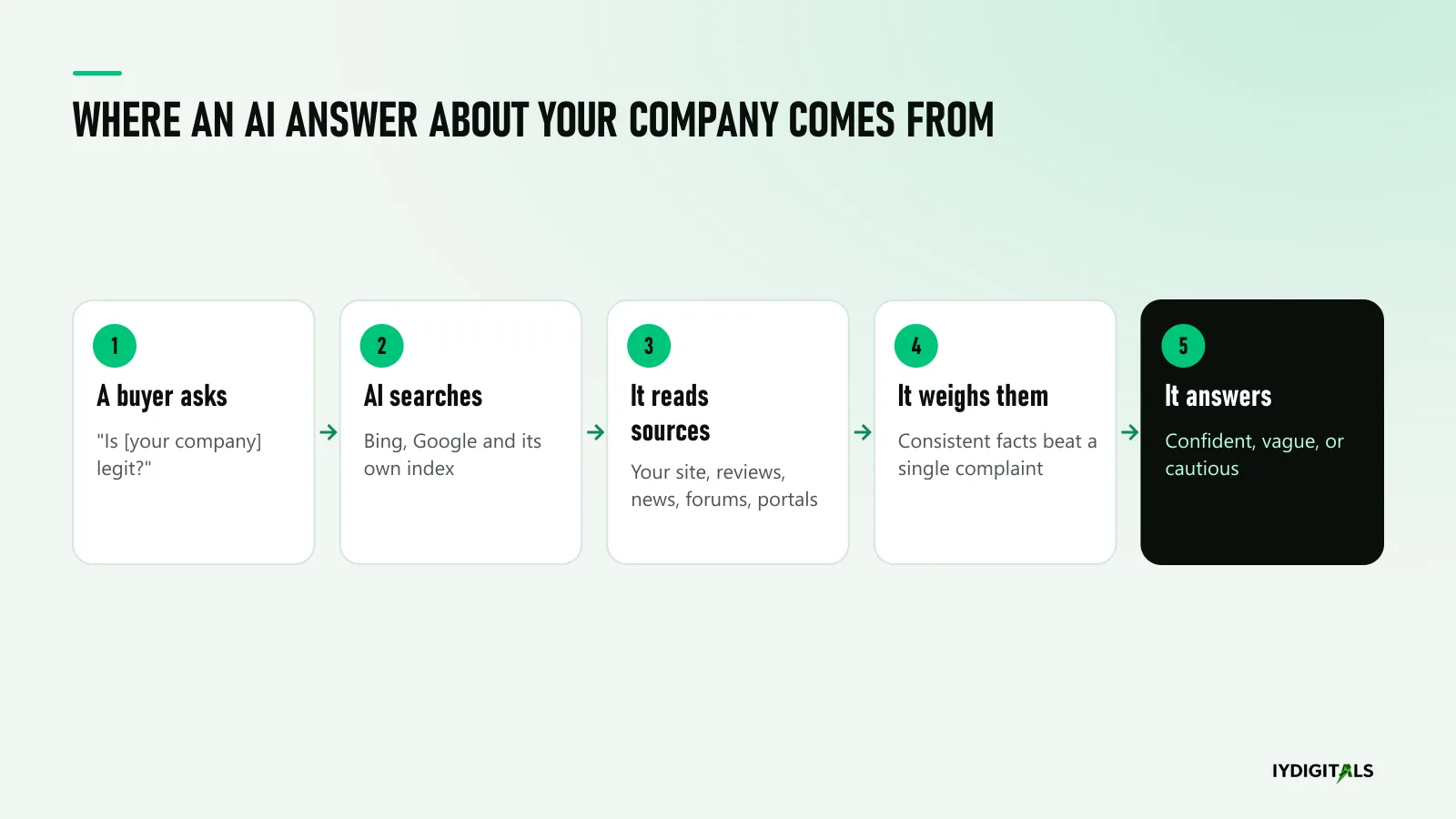
When asked about a specific company, AI assistants search the web through Bing, Google or their own indexes, read what they find and summarise it. Typical sources include:
- Your own website, especially About, project and FAQ pages.
- Your Google Business Profile and reviews.
- Property portals such as Nigeria Property Centre and PropertyPro, and directories.
- News coverage in Nigerian business and property media.
- Forums and social media, including Nairaland threads, X posts and Facebook groups.
- Review sites and complaint platforms.
Assistants tend to trust facts that appear consistently across several independent sources. A single source, positive or negative, carries less weight when it sits among many others. That is the key to improving your answer.
The three kinds of answer, and what each means
The confident answer
“[Developer] is a registered real estate company based in Lagos, known for estates in Lekki and Ajah. It has delivered several projects and has generally positive reviews.
As with any purchase, verify the title with a lawyer.” This is what you want. It means the evidence is clear, consistent and positive.
The vague answer
“I couldn’t find detailed information about this company.
Make sure you verify its registration and title documents before paying.” This is the most common answer for small and mid-sized developers.
It isn’t negative, but to a nervous buyer it reads like a warning.
The cautious answer
“Some buyers have reported delays with [developer]’s projects…” This usually means the strongest evidence the assistant found is negative, even if it is old, isolated or resolved.
How to make your answer accurate
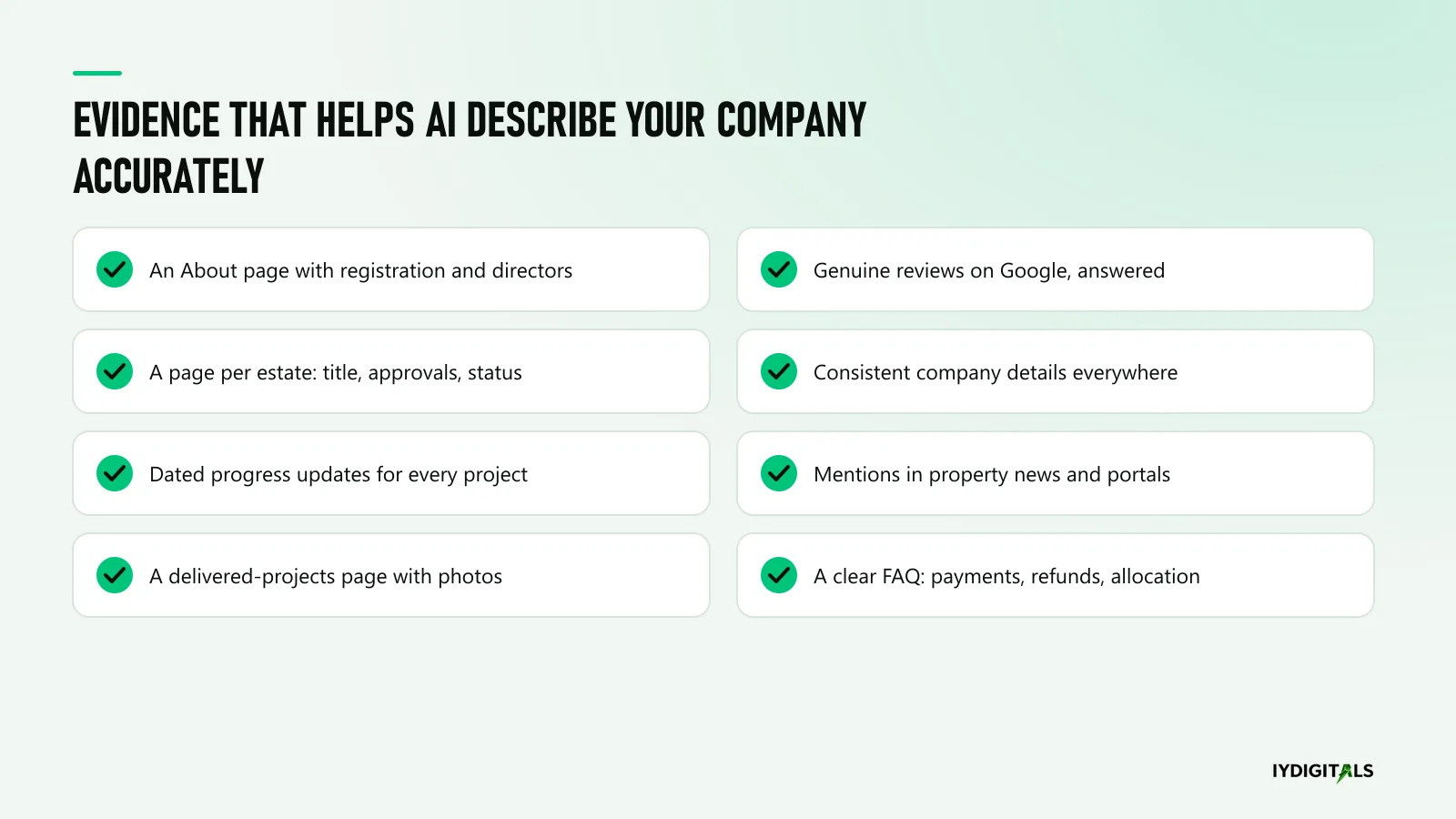
1. Publish the facts buyers and assistants look for
An About page with your registered company name and registration number, directors, year founded and the team.
A page for each estate stating the title, the approvals held and the current status. Facts written plainly on your own site are the easiest thing for an assistant to quote.
2. Show delivered and in-progress work, with dates
A delivered-projects page with photos and handover dates, and a progress page for each current project, updated monthly. “Delivered” is the word every nervous buyer wants to see next to your name.
3. Answer the hard questions in an FAQ
How payments work, which account they go into, how receipts are issued, when allocation happens, what happens if a buyer wants a refund.
An FAQ that answers these honestly gives assistants accurate material for the questions buyers ask.
4. Make your details identical everywhere
The same company name, address, phone number and description on your website, Google, social media, property portals and directories. Inconsistent details make assistants unsure whether they are looking at one company or several.
5. Collect genuine reviews steadily
Ask every satisfied buyer, especially those who have received their keys or allocation, for a Google review. Reply to every review, including critical ones.
A steady flow of recent, genuine reviews gives assistants clear evidence of real customers.
6. Earn mentions on trusted sites
Coverage in property media, interviews, listings on reputable portals and membership of recognised industry bodies give assistants independent sources to cite.
Independent evidence counts for more than anything you say about yourself.
7. Deal with complaints in the open
If there is a complaint online, respond calmly and factually where it appears, explain what was done to resolve it and invite the person to contact you. A resolved complaint with a professional response can actually build trust.
8. Make sure you are on Bing, not just Google
ChatGPT and Copilot rely heavily on Bing’s index. Verify your website in Bing Webmaster Tools and submit your sitemap.
A developer missing from Bing can be partly invisible to these assistants. See why Bing matters for ChatGPT and Copilot.
A worked example: from vague to confident
Here is an illustrative example of how the answer can change. A mid-sized Lagos developer has delivered two estates in Ajah and is selling a third.
When a buyer asks ChatGPT about it, the answer is vague: “I couldn’t find detailed information about this company.”
Looking at what exists online, the reasons are clear. The website has a homepage and a contact form, but no About page, no delivered-projects page and no title information.
The Google profile has four reviews from three years ago. The company name appears three different ways across Instagram, a property portal and the website.
Over the following months, the developer publishes an About page with its registration and directors, a delivered-projects page with dated photos of both completed estates, an estate page for the new project with the title explained, and a monthly progress update.
It makes its name and details identical everywhere, asks residents of the completed estates for reviews and is featured in a local property news story.
None of this is hype. It is evidence.
When a buyer asks the same question later, there is enough consistent information for the assistant to describe the company as a registered developer with delivered estates in Ajah and positive reviews, which is exactly what is true.
What to publish: an About page assistants can quote
The About page is one of the most-read pages for careful buyers and one of the most useful for AI assistants. A strong one includes:
- The registered company name, registration number and year founded.
- The directors and key team, with photos, roles and relevant experience.
- Where the company operates, by district.
- Projects delivered, with names, locations and handover years.
- Current projects and their status.
- Professional memberships you genuinely hold.
- How buyers can verify the company and its titles.
- Official contact details and the company account name, with a warning about impersonators.
Write it in plain, factual sentences. “Founded in 2015, we have delivered two estates in Ajah” is far more useful to a buyer and an assistant than “a leading provider of luxury living solutions”.
What not to do
- Don’t post fake reviews or fake forum praise. It is usually spotted, and when it is, it becomes the story.
- Don’t threaten critics. Legal threats against reviewers often spread further than the original complaint.
- Don’t publish claims you can’t support. “Government-approved” or “C of O ready” must be true and verifiable. Assistants will repeat what you say, and buyers’ lawyers will check it.
The prompts to track
Buyers phrase the question in many ways. Track a fixed set every month so you can see real change. A good starting set for a developer:
- “Is [company] legit?”
- “What do people say about [company]?”
- “Has [company] delivered any estates?”
- “Is [estate name] a good investment?”
- “Which developers in [district] can be trusted?”
- “Best estates in [district] for buyers abroad”
The first four test what assistants say about you. The last two test whether you are named at all when buyers haven’t heard of you yet, which is where new buyers come from.
Run them in a private browser window or logged out, because assistants can tailor answers to a signed-in user’s history.
Check your answer today
- Ask ChatGPT, Gemini and Google’s AI Mode: “Is [your company] legit?” and “What do people say about [your company]?”
- Note whether each answer is confident, vague or cautious, and which sources are cited.
- For each weak or wrong point, find the source and decide what evidence would correct it.
- Repeat monthly and keep a record of how the answers change. Our guide to checking what AI assistants say about your business shows how.
IYDigitals helps property founders build the evidence that makes AI assistants describe them accurately and recommend them confidently.
See how we work with property businesses, read why AI recommends your competitor and not you, or look at our client results.
Common questions
Can I pay to change what ChatGPT says about my company?
No. Some AI assistants now show labelled ads, but the organic answer about your company comes from what the assistant finds on the web.
The only lasting way to change it is to change the evidence: what your site, reviews and other trusted sites say.
ChatGPT says something false about my company. What can I do?
Find the source. Ask the assistant where the information came from, or check the sources it cites.
Correct it at the source if you can, publish the accurate facts clearly on your own website, and make sure your details are consistent elsewhere. Answers usually update as the evidence changes.
One angry review is dominating the AI answer. Should I respond?
Yes, calmly and factually, on the platform where it appears. Then build the balance: more genuine reviews from satisfied buyers, delivered-project evidence and mentions on trusted sites.
One complaint weighs less when it sits among plenty of positive, verifiable evidence.
How long does it take for AI answers to change?
It varies by assistant and by how widely the new evidence spreads. Some changes show within weeks; others take months. Check the same questions monthly and keep a record.

Visibility & Conversion Strategist