How diaspora buyers check a Lagos developer before they pay
Want more buyers and sales from AI search, without doing the work? Let the IYDigitals team handle it. Talk to an expert now →
On this page
A Nigerian accountant in Manchester has been saving for years to buy land in Lagos.
She has three developers on her shortlist, found through Instagram ads and a cousin’s recommendation. She won’t fly home before she decides.
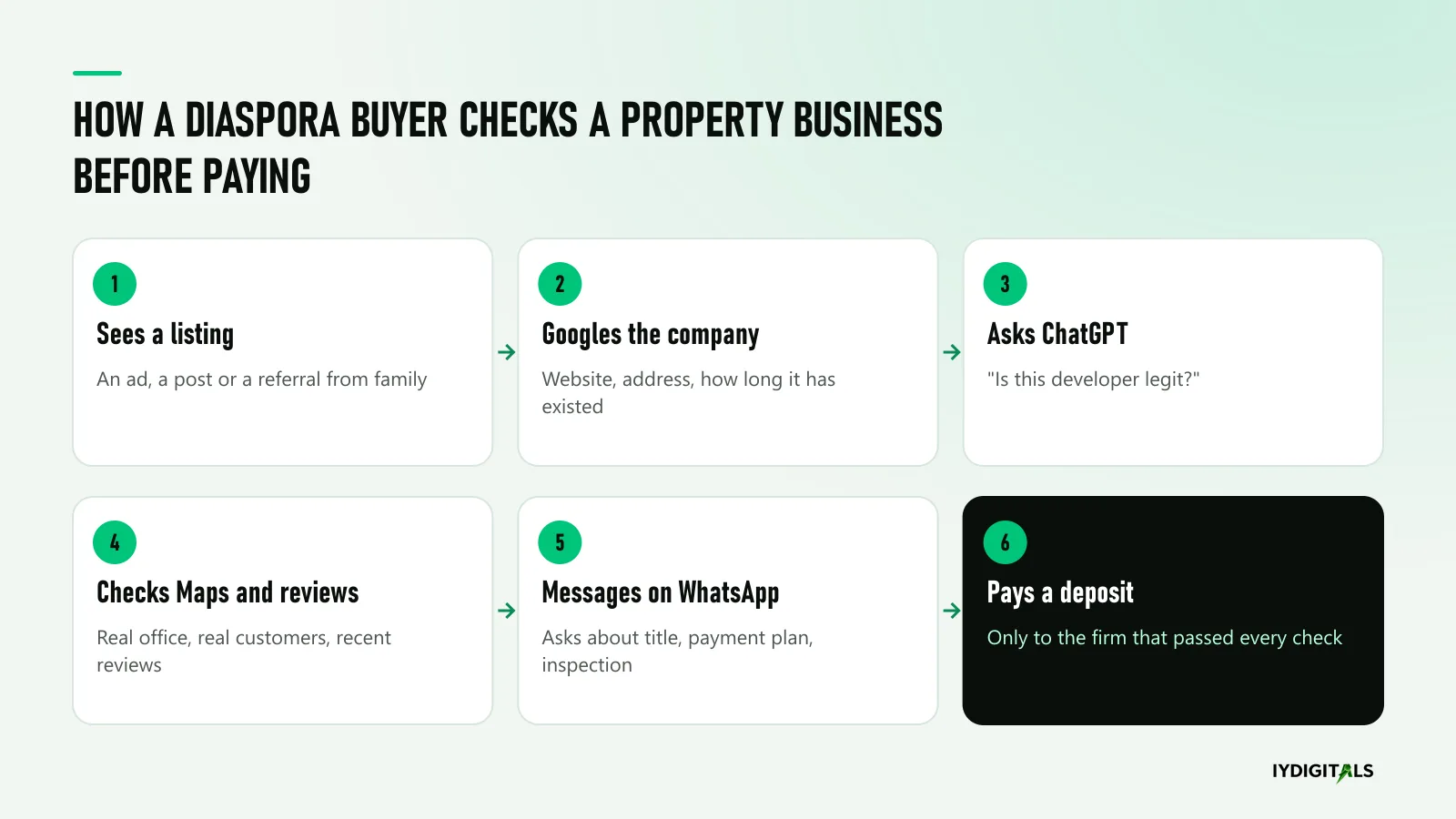
Everything she knows about those developers will come from her phone, and the developer who passes her checks gets her deposit.
This guide covers the checks buyers abroad run before trusting a Lagos developer. If you are buying, use it as a checklist.
If you are a developer, read it as a list of the questions your website and online presence have to answer before any buyer abroad will call you.
Why buyers abroad check so carefully
Buying property in Lagos from abroad means paying large sums to a company you may never meet, for land you may not see until it is built on.
Buyers have heard the stories of delays and disputes, and Nigerian business media such as Nairametrics have reported on delivery delays in Lagos property schemes. So buyers do their homework, and almost all of it happens online.
The eight checks
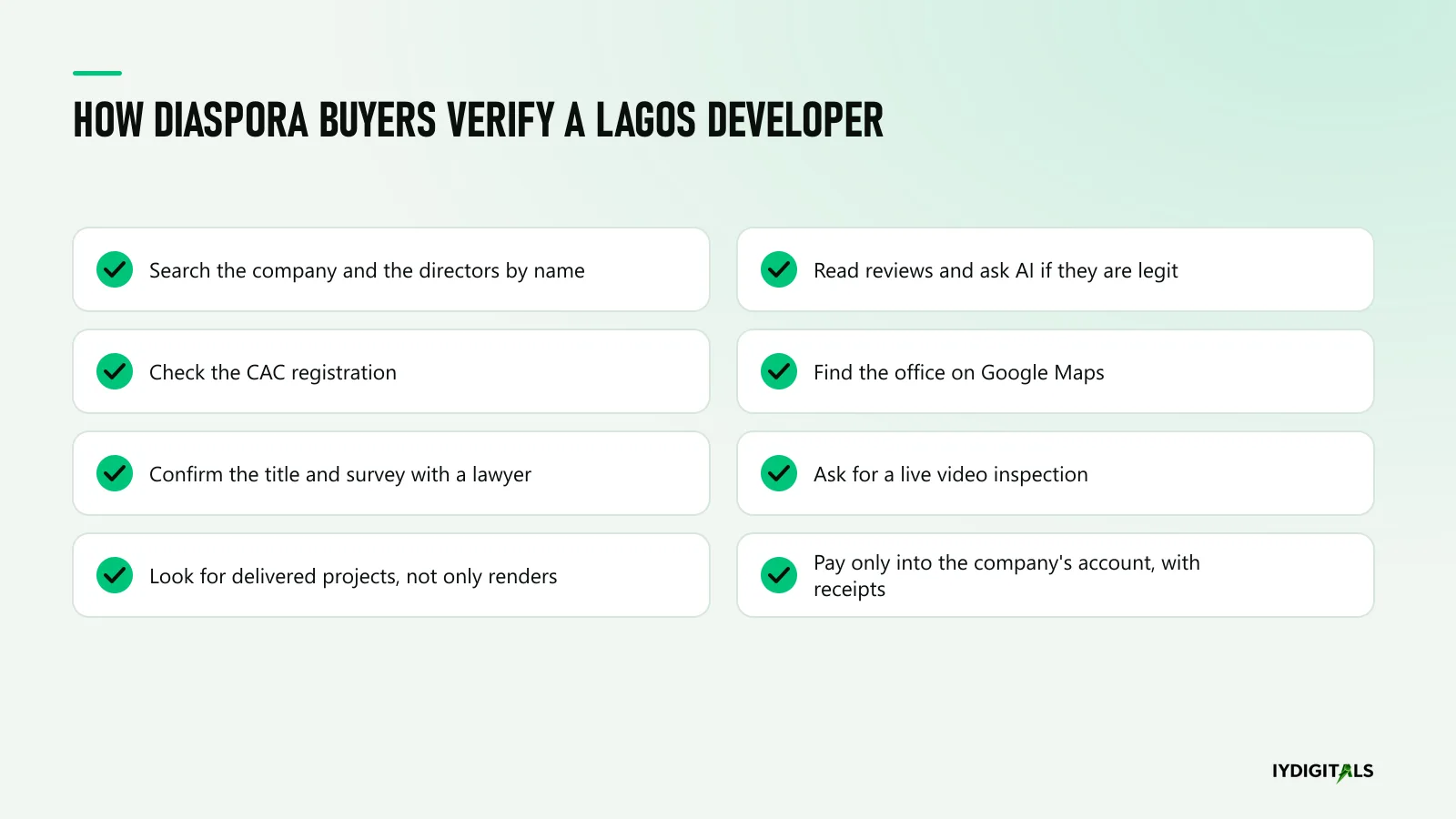
1. Search the company and the people behind it
The first search is the company name, then the names of the directors and the people the buyer has spoken to.
Buyers look for a real website, a history of projects, news coverage and anything negative.
A company with no website, or with a website that says little about who runs it, raises doubts at once.
2. Confirm the company is registered
Careful buyers check that the developer is a registered company with the Corporate Affairs Commission, and that the name on the registration matches the name on the contract and the bank account. Mismatched names are one of the clearest warning signs.
3. Have a lawyer verify the title and survey
Buyers abroad usually instruct a Lagos property lawyer to verify the title documents and survey plan at the relevant registry before paying.
Developers who state the title plainly, explain what the buyer will receive and make the documents available for checking make this step faster and calmer.
4. Look for projects already delivered
Renders show what a developer hopes to build. Delivered estates show what it has built.
Buyers look for photos and videos of finished projects, ideally with dates, and for people who already live in or own property in those estates.
5. Read reviews, and ask AI whether the developer is legitimate
Reviews on Google and social media carry a lot of weight with buyers who can’t visit.
More and more buyers also ask ChatGPT or Google directly: “Is [developer] legit?” or “What do people say about [developer]?” The answer is built from whatever those assistants can find, so a developer with little information online often gets a vague or cautious answer, which is enough to make a buyer hesitate.
6. Find the office and estate on Google Maps
Buyers check that the office address exists and matches what they were given, and look up the estate’s location, access roads and surroundings.
A Google Business Profile with the correct address, real photos and recent reviews quietly answers a lot of questions.
7. Ask for a live video inspection
A recorded video can be staged; a live video walk-through, guided by the buyer’s questions, is harder to fake. Many buyers also send a trusted relative or an independent surveyor to inspect in person before they pay.
8. Pay only into the company’s own account
Payment should go to the company’s corporate account, in the registered company name, with an official receipt for every payment. Requests to pay into a personal account are a common warning sign.
Red flags that make buyers abroad walk away
Buyers abroad don’t always say why they stopped replying. In most cases, one of these raised a doubt they couldn’t resolve from a distance:
- Pressure to pay quickly. “Only two plots left at this price” may be true, but for a cautious buyer abroad it often reads as a reason to slow down.
- A name mismatch. The company on the website, the contract and the bank account should be the same. Any difference makes buyers nervous.
- Requests to pay a personal account. Even if it is the founder’s own account, it looks like a warning sign.
- Vague answers about title. “The documents are being processed” without specifics often ends the conversation.
- No trace of delivered projects. Only renders, no finished estates and no residents to speak to.
- Silence online. No reviews, no news, no clear Google listing, and an AI assistant that can’t say much about the company.
- Slow or inconsistent replies. If it takes days to get an answer before payment, buyers wonder how hard it will be after.
None of these mean a developer is dishonest. Many good developers simply never made the facts easy to find.
But a buyer six thousand kilometres away can’t tell the difference, so they move on to a developer whose online presence answers the question for them.
For developers: how to pass every check
Every one of those checks can be answered in advance.
The developers who win buyers abroad don’t wait to be asked; they put the answers where buyers look, on their website, their Google Business Profile and the sites AI assistants read.
- Put your company details in plain sight. Registered name, registration number, directors and the team buyers will deal with, with real photos and names.
- Explain your titles and documents plainly. What title each estate carries, what the buyer receives and how they can have it checked. Only facts you can stand behind.
- Show what you have delivered. Dated photos and videos of finished estates and current progress, not just renders.
- Publish your payment process. Deposits, instalments, the account payments go into and how receipts are issued.
- Offer video inspections clearly. Make it easy to book a live walk-through from abroad, in the buyer’s time zone.
- Collect genuine reviews steadily. Ask every satisfied buyer, and reply to every review, including critical ones.
- Keep your details identical everywhere. Your company name, address and phone number should match on your website, Google, social media, property portals and directories.
- Answer AI’s questions before buyers ask them. Pages and FAQs that answer “is this developer legit?” questions with facts give assistants something accurate to repeat.
- Reply fast, in their time zone. A buyer in London or Houston who messages at night Lagos time and gets an instant, helpful reply is far more likely to keep talking to you.
A page every developer should publish for buyers abroad
The single most useful page a Lagos developer can add is one written directly for buyers abroad. It might be called “Buying from abroad” or “For diaspora buyers”, and it should cover, in this order:
- Who you are. The registered company name, registration number, directors and how long you have been delivering projects.
- What you have delivered. Each completed estate, with dated photos and, where residents agree, a short testimonial.
- Titles, explained. What title each current estate carries, what the buyer receives at each stage and how their lawyer can verify it.
- How to inspect from abroad. How to book a live video inspection, and how a relative or independent surveyor can visit.
- How payment works. The company account payments go into, how receipts are issued and what happens if a buyer needs to pause or withdraw.
- How to reach you. Named contacts, WhatsApp, and the hours you reply in UK, US and Gulf time.
A page like this answers most of the eight checks in one place. It also gives AI assistants a clear, factual source when a buyer asks about your company.
Our guides on what buyers see when they ask AI whether a developer is legit and the website fixes that build buyer trust go further.
What buyers see when they ask AI about you
Try it yourself.
Ask ChatGPT and Google, “Is [your company] legit?” and “Which developers in [your area] can be trusted?” If the answer is vague, cautious or names other developers, that is what buyers abroad are seeing too.
The fix is rarely a single change.
It is the combination of a clear website, an optimised Google Business Profile, consistent details, genuine reviews and mentions on trusted sites, which together give AI assistants enough evidence to describe you accurately and confidently.
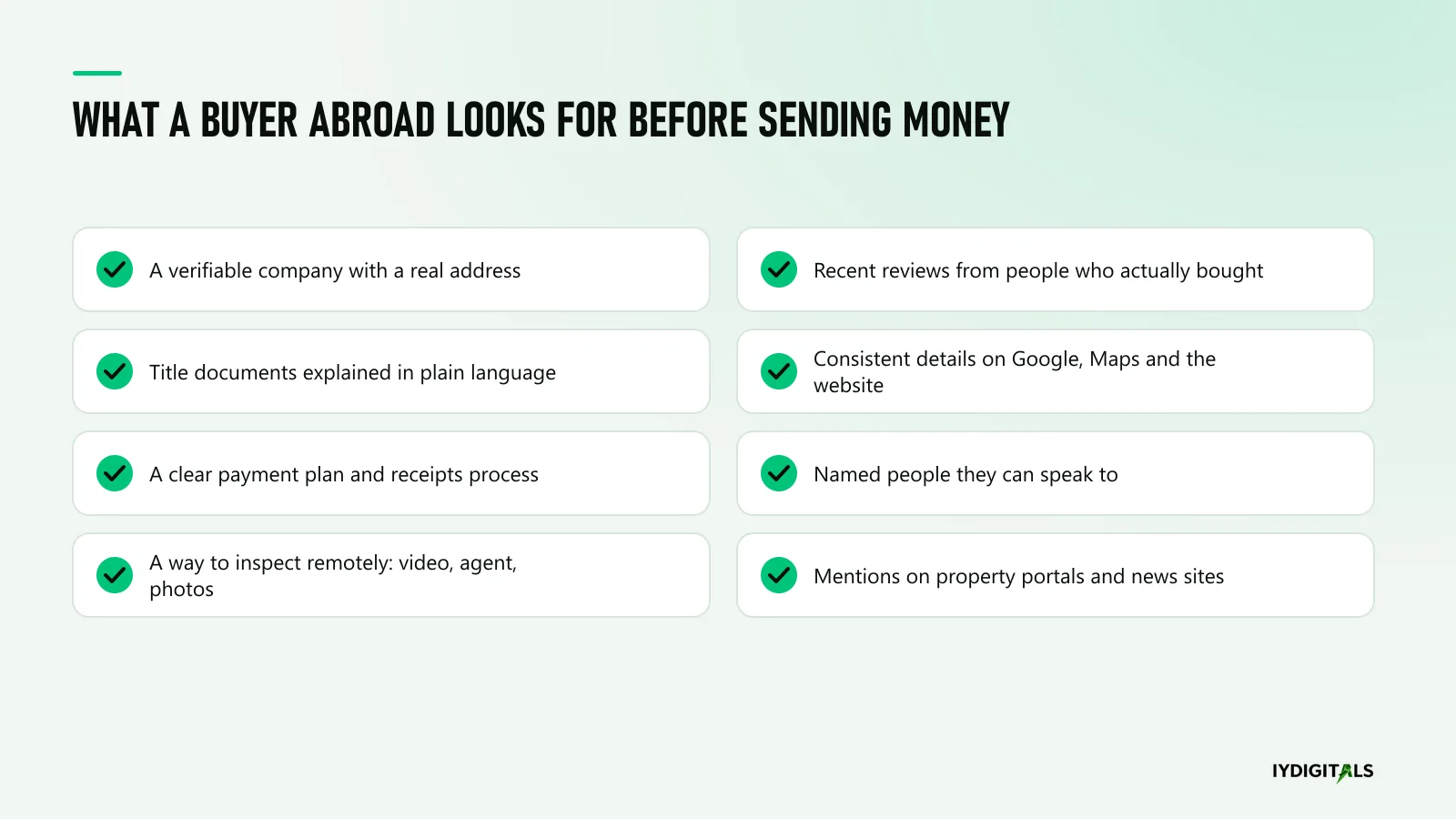
The developers who win buyers abroad
The developers who sell consistently to Nigerians abroad tend to look the same online: clear about who they are, open about titles and payments, proud of what they have delivered and quick to respond.
None of that is a marketing trick; it is making the truth about your company easy to find and easy to verify.
This is the work we do for property founders at IYDigitals.
Read how we help property businesses win more buyers through AI search, see our work on the Lekki to Ajah corridor, or read how to get your business recommended by ChatGPT in Nigeria.
Selling in the FCT? See property marketing in Abuja. For buyers in the Gulf, see selling Lagos property to Dubai.
Common questions
How can I verify a property developer in Lagos from abroad?
Search the company and its directors by name, confirm its registration with the Corporate Affairs Commission, have a Lagos property lawyer verify the title and survey, ask for evidence of delivered projects, read independent reviews, request a live video inspection, and pay only into the company's corporate account with official receipts.
Can I trust what ChatGPT says about a developer?
Treat it as a starting point, not a final answer. AI assistants summarise what they find online, so they can miss recent problems or repeat outdated information.
Use them to find questions to ask, then confirm the facts through official records and your own lawyer.
Why do diaspora buyers rely so much on online research?
Because they usually can't visit the site or the office before committing. Search results, reviews, maps listings and what other websites say become the main way to judge whether a developer is real and reliable.
As a developer, how do I make it easier for buyers abroad to trust me?
Publish what they check for: company details, titles explained plainly, payment plans, dated progress photos, delivered projects, real reviews and named people.
Keep your details identical everywhere, offer video inspections and reply quickly, including outside Lagos working hours.

Visibility & Conversion Strategist