High-converting AI video ads: what works for property and service businesses
Want more buyers and sales from AI search, without doing the work? Let the IYDigitals team handle it. Talk to an expert now →
On this page
- What AI is good for in video ads
- The structure of an ad that brings enquiries
- What builds trust, and what breaks it
- Ideas that work for property
- Ideas that work for service businesses
- Writing hooks that work
- A simple production workflow
- Mistakes that waste ad budget
- Where AI video fits for buyers abroad
- Measure enquiries, not views
AI has made video ads fast and affordable to produce.
A developer in Lekki can now turn a site visit, a few photos and a script into a dozen ad variations in a day, with voiceovers, captions and versions for Instagram, TikTok and YouTube.
A consultancy in Abuja can produce a clear explainer without hiring a studio.
That speed is a real advantage.
It also creates a problem: feeds are now full of AI-made property and service ads that look polished and say very little, and buyers are learning to scroll past them.
This guide explains what makes an AI video ad bring real enquiries for property and service businesses, and the shortcuts that quietly destroy the trust those businesses depend on.
What AI is good for in video ads
- Scripts and hooks. Drafting and testing many opening lines quickly to find the one that stops the scroll.
- Voiceovers. Clear narration in different voices, accents and languages, including versions for buyers abroad.
- Captions. Most people watch with the sound off. Accurate, well-timed captions are essential.
- Editing and resizing. Cutting real footage into short ads and adapting one video for every format.
- Motion graphics. Payment plans, maps, timelines and key facts shown clearly on screen.
- Variations for testing. Ten versions of one ad with different hooks or offers, so you learn quickly what works.
Notice what is missing from that list: inventing the product. The best-performing ads for property and services use AI to present something real more clearly and more often, not to create something that doesn’t exist.
The structure of an ad that brings enquiries
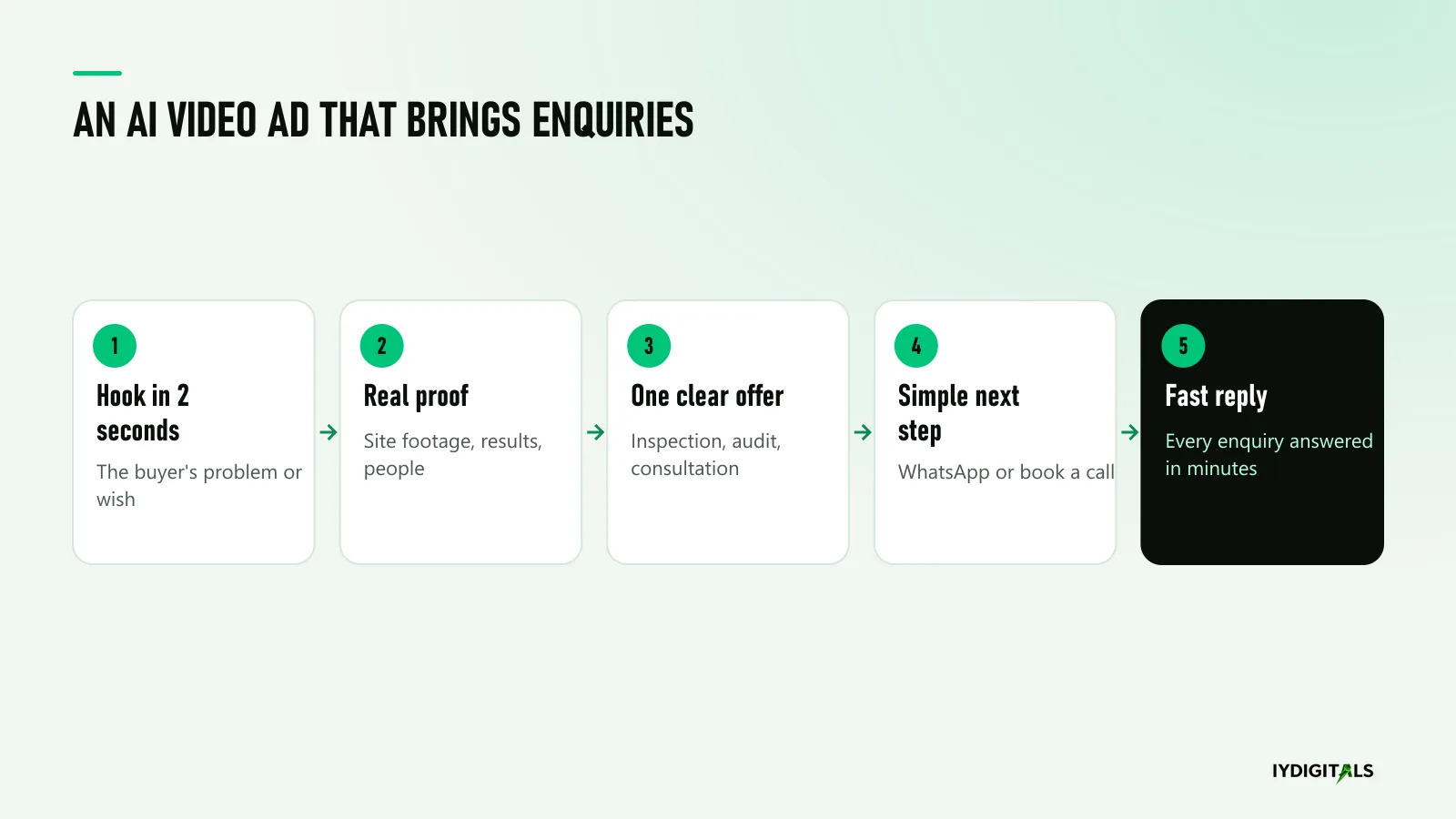
1. A hook in the first two seconds
Start with the buyer’s situation, not your logo. “Buying land in Lagos from the UK? Watch this before you pay a deposit.” “Your clinic is on Google Maps.
So why isn’t the phone ringing?” The hook decides whether anyone sees the rest.
2. Real proof
Show the estate as it is today, with the date. Show your team, your office, a happy client (with permission) or a real result on screen.
For property, a short clip of the access road or the foundations does more for trust than any render.
For services, a screenshot of a real result or a short clip of a real client speaking is hard to beat.
3. One clear offer
One ad, one next step: book an inspection, get a free audit, book a consultation, download the payment plan. Ads that try to say everything usually get no response.
4. A simple next step
In Nigeria, that often means “Message us on WhatsApp” or a short booking form. Make it obvious on screen and in the caption.
5. A fast reply
The ad’s job ends when someone enquires; your job starts. An enquiry answered in two minutes is far more likely to become an inspection or a consultation than one answered tomorrow.
Automated first replies on WhatsApp, followed by a person, protect the money you spent on the ad. Read more in our guide to WhatsApp lead automation for property businesses.
What builds trust, and what breaks it

Property and high-value services are trust purchases.
A buyer who later discovers that the “finished estate” in your ad was a render, or that the “happy client” was an AI-generated face, won’t just walk away.
They may tell everyone they know, and leave reviews that follow you for years.
- Label renders clearly. Renders are useful for showing what will be built. Say on screen that they are artist’s impressions, and pair them with real progress footage.
- Never fake testimonials. Use real clients with their permission. If you use an AI presenter, make it clearly a presenter, not a customer.
- Only claim what you can prove. Titles, approvals, results and timelines must be accurate. If you can’t prove it, don’t say it.
- Check platform rules. Meta, YouTube and TikTok have introduced labels or disclosure requirements for realistic AI-generated or altered content, and have specific rules for property and financial ads. Check the current policies for each platform you use.
Ideas that work for property
- Monthly progress videos. Real drone or phone footage of the site, dated, with a short AI voiceover explaining what changed. Excellent for buyers abroad.
- “What you get” explainers. Title, payment plan and inspection process explained in 45 seconds with motion graphics.
- Area guides. What it is like to live in the area: roads, schools, shops, distance to key places.
- Buyer stories. A real buyer, with permission, explaining why they chose you.
Ideas that work for service businesses
- Problem and fix. A common problem your buyers face, and how you solve it, in under 30 seconds.
- Behind the scenes. Your team doing the work, which builds trust in a way stock footage can’t.
- Proof on screen. Real results such as rankings, bookings or before-and-after (where your profession’s rules allow), with the client’s permission.
- Founder explainers. The founder answering one buyer question per video. AI can handle captions, cuts and versions; the face and the knowledge stay real.
Writing hooks that work
The hook is where most ads win or lose. Strong hooks for property and services usually do one of four things:
- Name the buyer. “If you live in the UK and want land in Lagos…” The right person instantly knows the video is for them.
- Name the fear. “Three questions to ask before you pay any Lagos developer.” Trust is the biggest barrier in property, so addressing it directly earns attention.
- Show the result. “This Ikeja laundry reached first place on Google in six days.” Use real, permitted results only.
- Show something real and specific. “This is the access road to our Sangotedo estate this morning.” Specific beats generic.
Avoid hooks that start with your company name or a generic slogan. Nobody stops scrolling for a logo.
A simple production workflow
You don’t need a studio. A practical weekly routine for a developer or service business looks like this:
- Capture real footage. Ten minutes on site or in the office with a phone: the estate, the road, the team at work, a short comment from a client who agrees. Hold the phone vertically for most platforms.
- Write three hooks. Use AI to draft ten opening lines for the buyer you are targeting, then choose the three that sound most like you.
- Build the ad. Cut the footage to 15 to 30 seconds, add an AI voiceover or your own voice, captions and one on-screen offer.
- Make versions. One ad, three hooks, two formats. AI tools make this quick.
- Prepare the follow-up. Before launching, set up the WhatsApp auto-reply and the landing page the ad points to.
- Launch, then review weekly. Keep the ads that bring serious enquiries, pause the rest and make the next batch from what you learned.
Mistakes that waste ad budget
- Beautiful, empty videos. Drone shots and music with no offer and no next step.
- The same ad for everyone. A buyer in Houston and a buyer in Ikeja need different messages. Make versions for each audience.
- No captions. Most people watch without sound.
- Ads pointing to the homepage. Send people to a page about the exact estate or service in the ad.
- Slow replies. Every hour an enquiry waits, it gets colder. Paid enquiries are the most expensive ones to lose.
- Judging too early. A day or two of results says little. Give each ad enough time and spend to produce a meaningful number of enquiries.
Where AI video fits for buyers abroad
For developers selling to Nigerians in the UK, the US or the Gulf, video does work that photos and brochures can’t.
A buyer who can’t visit wants to see the site, hear from the team and understand the process.
AI makes it practical to produce a version of each ad for each audience, with the right voiceover, captions, time-zone-friendly booking times and currency guide, without reshooting.
Pair these ads with live video inspections and you remove one of the biggest reasons buyers abroad hesitate. Read more in our guide to selling off-plan property to Nigerians in the UK.
Measure enquiries, not views
A video with a million views and no enquiries has failed. Track which ad each enquiry came from, how many became inspections or consultations and how many became sales.
Compare the cost per serious enquiry across ads, then make more of what works. AI makes testing cheap, so test constantly: new hooks, new offers, new proof.
Video ads also work best when buyers who search for you afterwards find a strong website, a well-kept Google profile and good reviews.
Many people watch an ad, then search the company before they message. If you are deciding where to spend on ads, read our comparison of Meta and Google ads for Lagos property.
High-converting AI video ads are one of the services we offer at IYDigitals, alongside AI search visibility. See our services, how we help property businesses, or our client results.
Common questions
What does AI actually do in a video ad?
It can write and test scripts, generate voiceovers in different accents and languages, add captions, resize one video for every platform, create motion graphics and produce many variations quickly for testing.
The most effective property and service ads still use real footage of the business.
Is it acceptable to use AI-generated people in ads?
Be careful. Using an AI presenter to explain a service can work if it is clearly a presenter. Using AI people posing as real buyers or clients is misleading.
Platforms such as Meta and YouTube have introduced labels or disclosure rules for realistic AI-generated content, so check their current policies.
Which platforms work best for property and service video ads in Nigeria?
Instagram and Facebook are the most common for property and many services, TikTok is growing fast, and YouTube suits longer explainers and diaspora audiences. The right mix depends on who your buyers are and where they spend time.
How do we know whether a video ad is working?
Measure serious enquiries, inspections or consultations booked, and sales, not just views or likes. Track which ad each enquiry came from, and compare the cost per serious enquiry across ads.

Visibility & Conversion Strategist