How to see whether AI assistants mention your business
Want more buyers and sales from AI search, without doing the work? Let the IYDigitals team handle it. Talk to an expert now →
On this page
Most business owners find out what ChatGPT says about them by accident.
A prospect mentions that “ChatGPT recommended you”, or a friend sends a screenshot where a competitor is named and they aren’t. Neither tells you much.
One answer, on one day, in one assistant, is a snapshot, not a picture.
The good news is that you can see what AI assistants say about your business properly, for free, in about an hour a month. This guide shows the method we use for our own clients.
Why one search isn’t enough
AI answers are generated fresh every time. Ask the same question twice and you may get different names, in a different order.
The answer depends on the exact wording, where you are, what you asked earlier in the chat and which pages the assistant found at that moment.
So the aim isn’t to find “the” answer. It is to ask a fixed set of questions in the same way every month and watch how the answers change.
The method, step by step
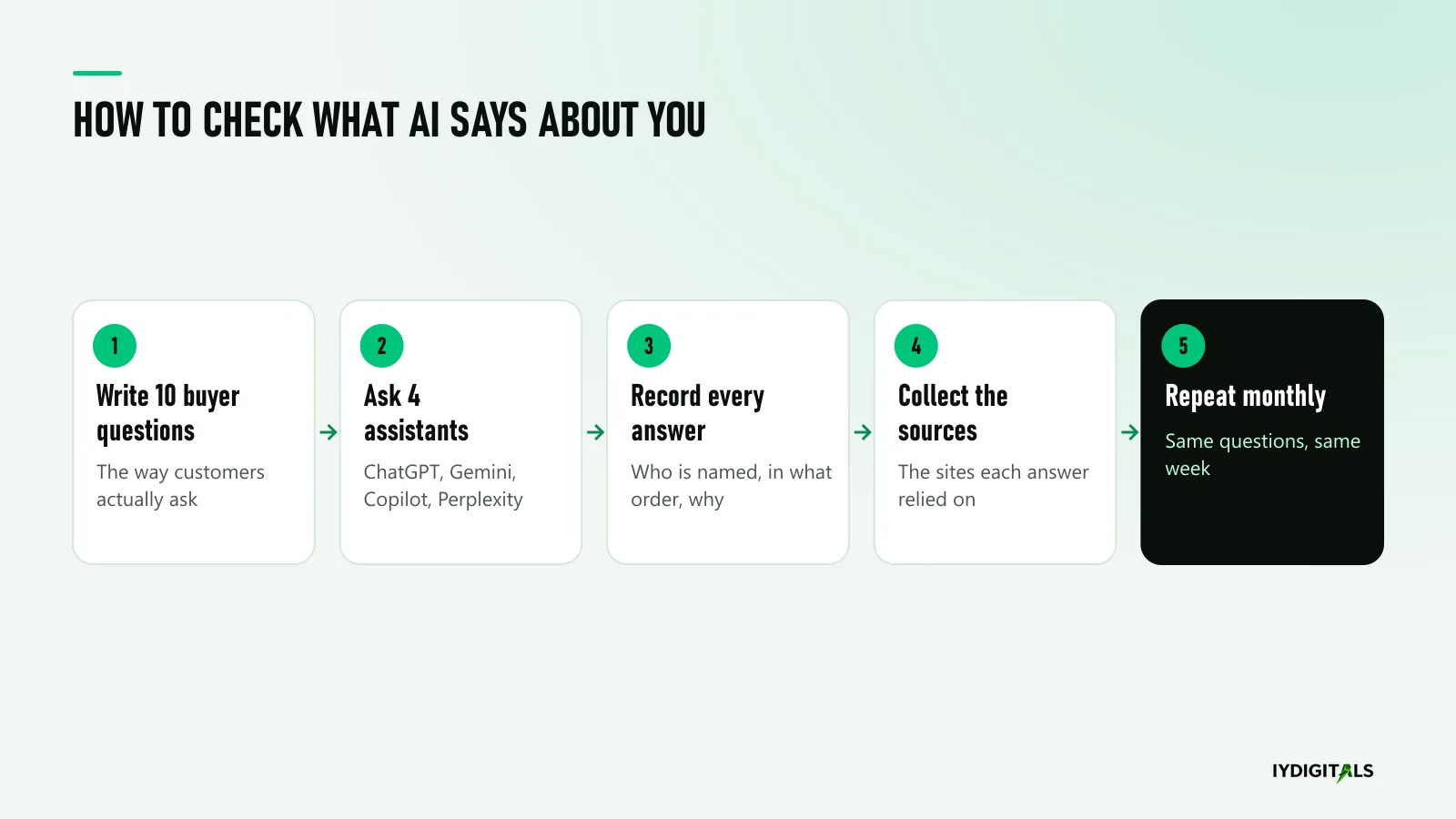
Step 1: Write ten buyer questions
Write the questions the way your buyers would ask them, not the way you would describe yourself. Include your area. A mix works best:
- “Best” questions: “Who is the best land surveyor in Ikeja?” “Best shortlet apartments in Lekki Phase 1?”
- Problem questions: “How do I verify land title in Lagos before buying?” “Which law firm can help with a land dispute in Ajah?”
- Comparison questions: “Is [your company] or [competitor] better for off-plan property in Abuja?”
- Trust questions: “Is [your company] legit?” “What do people say about [your company]?”
Keep the list fixed. Changing the questions every month makes the results impossible to compare.
Step 2: Ask them in four assistants
Use ChatGPT, Google (AI Overviews or AI Mode, or Gemini), Microsoft Copilot and Perplexity. Each uses a different index, so a business can be named in one and missing in another.
Start a fresh chat for each question, ideally logged out or in a private window, so your own history doesn’t shape the answer.
Step 3: Record every answer
A simple spreadsheet is enough. For each question and assistant, note the items below.
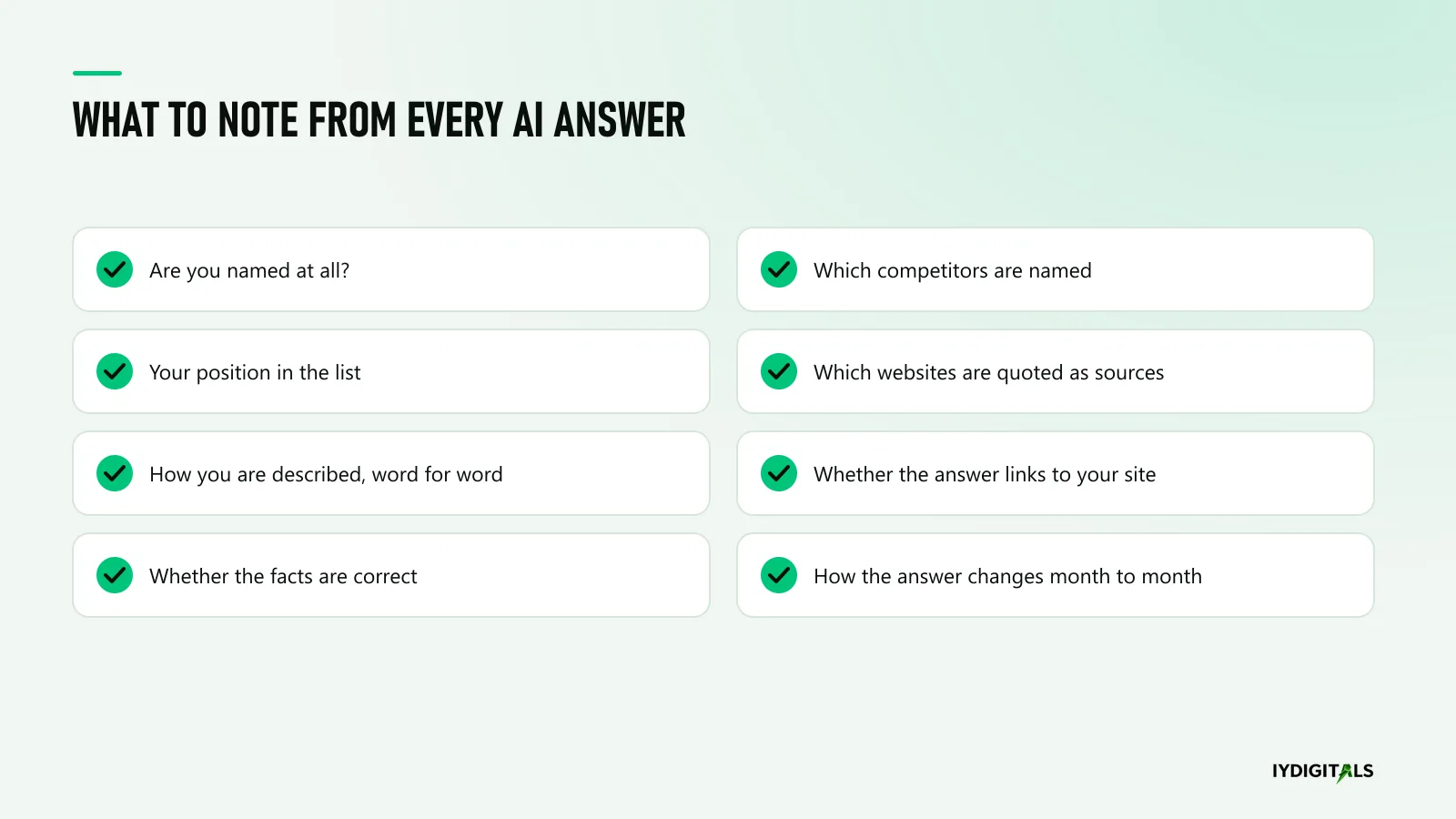
- Were you named? Yes or no.
- Your position in the list, if there is one.
- How you were described, word for word.
- Whether the facts were correct: services, location, phone number, founding date.
- Which competitors were named, and in what order.
- Which websites were quoted or linked as sources.
Step 4: Collect the sources
This is the most useful part. Perplexity and Google’s AI Overviews show the websites they used, and ChatGPT often does when it searches the web.
List every source that mentions a competitor but not you. Those are the directories, lists, articles and platforms you need to be on. They are your link and mention plan.
Step 5: Repeat monthly
Same questions, same assistants, same week each month. After three months you will see clear trends: questions where you are gaining, questions where a competitor is pulling ahead and descriptions that are getting more accurate.
Two example question sets
Here is what a good set of ten looks like for two different businesses. Use them as a pattern for your own.
A property developer selling estates in Lekki and Ibeju-Lekki
- Best real estate developers in Lekki
- Which estates in Ibeju-Lekki are good for diaspora buyers?
- Gated estates in Lekki with good title
- How do I verify a property developer in Lagos from the UK?
- Is [company name] a genuine developer?
- What do people say about [company name]?
- [Company name] vs [competitor] for off-plan homes
- Off-plan homes in Lekki with a payment plan
- Which developers in Lekki have delivered estates on time?
- Safe ways to buy land in Lagos from abroad
A law firm in Abuja
- Best law firms in Abuja for property matters
- Corporate lawyer in Abuja for a start-up
- Law firms in Maitama
- How do I verify a C of O with AGIS?
- Which Abuja law firms handle employment disputes?
- What does [firm name] specialise in?
- Is [firm name] a good law firm?
- Immigration lawyer in Abuja
- Law firms in Abuja that work with international clients
- How to register a company in Abuja
Notice the mix: some questions name the business, most don’t. The questions that don’t name you are the ones that bring new buyers.
A simple tracking sheet
One row per question, per assistant, per month. These columns are enough:
| Column | What to write |
|---|---|
| Date | The day you asked |
| Assistant | ChatGPT, Google, Copilot or Perplexity |
| Question | Exactly as asked, every month |
| Named? | Yes or no |
| Position | 1, 2, 3 or not listed |
| Description | The words used about you, copied exactly |
| Accurate? | Yes, or what was wrong |
| Competitors | Every other business named, in order |
| Sources | The websites quoted or linked |
Forty rows a month sounds like a lot, but it takes under an hour once you have done it twice, and after three months it becomes the most useful marketing document you have.
Two free sources of hard data
Bing Webmaster Tools’ AI Performance report. If your site is verified in Bing Webmaster Tools, this report shows how often your pages are cited in Copilot and Bing’s AI answers, and which pages are cited.
It only covers Microsoft’s assistants, but it is real data rather than spot checks.
When we connected our own site, it showed 16 Copilot citations over three months that we would never otherwise have known about. See why Bing matters for ChatGPT and Copilot.
Your analytics. ChatGPT adds “utm_source=chatgpt.com” to many of the links it shows.
In Google Analytics, look for visits from chatgpt.com, perplexity.ai, copilot.microsoft.com and gemini.google.com.
They are often small numbers, but those visitors tend to arrive ready to act.
What the results tell you
- Not named for anything. The assistant doesn’t have enough evidence about you. Start with clear positioning, consistent details, your Google profile and Bing.
- Named for your brand, not for your service. The assistant knows you exist but doesn’t see you as an answer to buyers’ questions. You need pages that answer those questions and mentions on the sites it quotes.
- Named, but described wrongly. Old information is out there. Find and fix the source.
- Named in one assistant, missing in another. Usually an indexing gap. Missing from Copilot often means a Bing problem; missing from Google’s AI often means a Google indexing or profile problem.
- A competitor named first everywhere. Compare their sources with yours. Our guide on why AI recommends your competitor explains the usual gaps.
Turning what you find into a to-do list
After the first month, go through your sheet and sort what you found into four groups. Each group has its own fix.
Wrong facts
An old phone number, a service you stopped offering, the wrong city.
Search for the wrong detail in quotation marks on Google and Bing to find where it lives: an old page on your site, a forgotten directory listing, a social profile.
Correct it at the source, then update your Google and Bing profiles so the right version is everywhere.
Missing sources
Directories, lists and articles that the answers quote and that mention competitors but not you.
Sort them into ones you can join today, such as free directories and review platforms, and ones you need to earn, such as editorial lists and news coverage.
The first group is a week’s work. The second is a steady monthly effort.
Missing answers
Questions where the assistant quotes a competitor’s guide or a general article because nothing on your site answers them. Each one is a page or article you should publish, with the answer in the first paragraph.
Missing proof
Answers that describe a competitor as “highly rated” or “known for delivering on time” and say nothing similar about you.
That language usually comes from reviews and case studies. Ask more clients for reviews, and publish your results with permission.
Work through the groups in that order. Wrong facts are the quickest to fix and do the most damage if left alone; earned mentions take longest but last longest.
What good looks like
For our clients, success shows up as the business being named for more of its buyer questions, described accurately, and enquiries that mention the source.
Ire-Ayo Crown Foods is now named first in Google’s AI Overview for snack manufacturers in Ibadan.
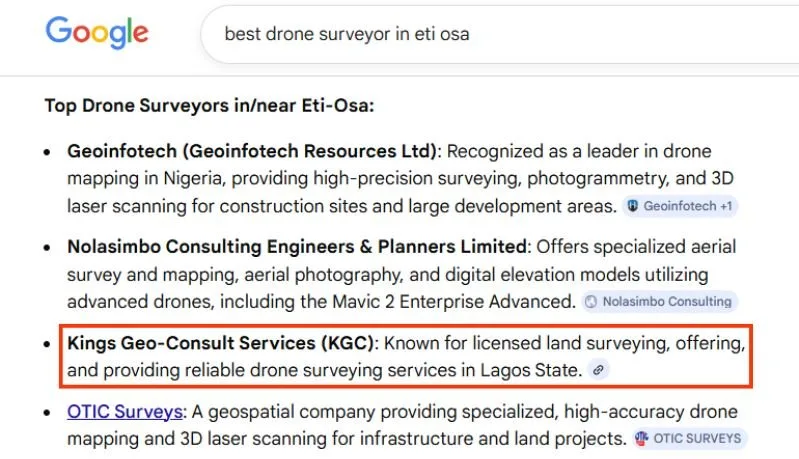
Kings Geo-Consult appears in Google’s AI answers for drone surveyors near Eti-Osa.
Use our 20-point AI search checklist to close the gaps you find. If you would rather we run the checks and do the work, it is the first step of our AI search visibility service.
See our client results or book a free strategy call and we will show you what the assistants say about you today.
Common questions
Why does ChatGPT give a different answer every time I ask?
AI answers are generated fresh each time, and they change with wording, location, chat history and the pages found at that moment. That is why you track a fixed set of questions over time rather than judging one answer.
Should I search for my business name or for my service?
Both, separately. Searching your name shows whether the assistant knows you and describes you accurately.
Searching your service and area shows whether it recommends you to a buyer who doesn't yet know you exist, which is what brings new business.
ChatGPT says something wrong about my business. How do I fix it?
Find where the wrong information comes from. Check the sources the answer quotes, old pages on your site, outdated directory listings and your social profiles.
Correct them, keep your details identical everywhere, and the answers usually follow over the following weeks.
Are there tools that do this automatically?
Yes, several paid tools track AI answers at scale. For most small and mid-sized businesses, a monthly manual check of ten questions is enough to make good decisions.

Visibility & Conversion Strategist